JIGOKU
Ask most genre enthusiasts what the first gore film was and you�ll likely get the answer: H G Lewis� BLOODFEAST (1963). However, the Japanese got there first with this film, in 1960. (It could be argued that Jos� Mojica Marins� AT MIDNIGHT I�LL TAKE YOUR SOUL (1963) also beat Lewis to the title). Nobuo Nakagawa is one of the most respected of the �old school� of Japanese directors, and specialised in atmospheric ghost/horror films. He had been steadily producing some of the best Japanese cinema of the 1950�s when he made what is still regarded by many as his
greatest work, THE GHOST STORY OF YOTSUYA (1959, aka 'Tokaido Yotsuya Kaidan').
This is still regarded as the definitive version of this oft-filmed story, which
was written as a play by Nanboku Tsuruya in 1894 (it has been filmed eleven
times to date, with Nakagawa's version the most widely known. In 1994 Kinji
Fukasaku (director of BATTLE ROYALE (2000) and many other famous films) directed
a big budget version called GHOST STORY OF YOTSUYA: CHUSHINGURA VERSION (aka
'Crest of Betrayal')). Nakagawa followed up YOTSUYA's success the following year
with JIGOKU (meaning �Hell�), which took 7 months to film and was partly financed
with Nakagawa's own money. It was produced by Shintoho Studios, which
went bust shortly after the film's release. This led to the film being little
seen until Toei got hold of it several years later and re-distributed it.
It's a way-ahead-of-its-time film, and has been widely sought after by Japanese
film fans for many years. However, this DVD marks the film's first ever
availability with English subtitles - it has never even been available on the
bootleg market with subtitles before.
It tells the story of Shiro Shimizu, a young man
living in Tokyo. He is engaged to Yukiko Yajima, whose father is a lecturer. He
met another young man called Tamura (when or where we don't ever find out).
Tamura is an enigmatic, cold figure who Shiro doesn't care for at all. However,
he doesn't seem to be able to escape him. One night he is at his fianc�e's
house when Tamura appears in the doorway carrying a rose. Tamura says that he
will give Shiro a lift home. They leave, and Shiro asks Tamura to take a back
road as he wants to call somewhere on the way. Tamura gives Shiro some money to
pay his rent with. A drunk man steps out in front of them and they hit him,
before driving off. However, an old woman is watching from the shadows and takes
their registration number. Shiro tries to persuade Tamura to go to the police,
but he refuses. Meanwhile we find out that the young man (whose name was Kyoichi)
has died and that he was a member of a local yakuza gang. His fianc�e, Yoko,
and his mother are distraught. The old woman who saw the accident was Kyoichi's
mother and she tells Yoko that she saw the car, but that going to the police
won't help them. Instead, they will plot to kill their loved one's killers.
Shiro confesses to Yoko about the accident, just as she is about to tell him
something. They decide to go to the police and Shiro insists on getting a taxi.
When they're sat in the car, the driver suddenly appears to be Tamura. The car
crashes and Yukiko is killed. Later, Shiro is drinking in a sleazy pub. A
dancing girl talks to him. She turns out to be Yoko, and they leave to spend the
night in a hotel room. When Yoko wakes up the next morning she sees Shiro's
wallet on the floor and realises who he is. She arranges to meet him again that
night, but Shiro instead heads off to an old people's home in the countryside to
see his parents. His mother is sick and his father keeps a mistress in the next
room. In another room live an old artist and his daughter, Sachiko. Sachiko
looks just like Yukiko and bewitches Shiro. Shiro walks along the train tracks
by the home, and is almost hit by one. Whilst talking to Sachiko, Tamura
suddenly appears, sat on the train tracks wearing sunglasses. Soon after,
Shiro's mum dies. Professor Yajima and his wife Fumi arrive (they were invited
by Tamura). Tamura seems to know people's secrets and describes to them how each
of them is responsible for a death. Meanwhile, festivities are underway for the
10th Anniversary of the home. The staff of the home catch fish in the river
nearby. Yoko follows Shiro to the home (how isn't made clear) and arranges to
meet him on a high bridge over a valley. When they meet, she tells Shiro who she
is, before pulling out a gun. As she tries to kill him, she trips and falls to
her death, observed by Kyoichi's mother. Shiro picks up the pistol and suddenly
Tamura appears again. He wrestles with Shiro and is shot, before falling over
the side of the bridge. It's now the night of the anniversary and things are
well underway - there are two groups of revellers, one being the old people of
the home and the other the staff and hangers-on. Shiro's father's mistress finds
Shiro in a barn and tries to seduce him (she wants to go to back to Tokyo with
him). They are found by Shiro's father who is enraged. In the ensuing fight, the
mistress is killed. The Yajima's leave the home, and Kyoichi's mother arrives,
with a flask of poisoned Sake. The group of old people have all eaten the fish,
which were caught dead. They all start to die. Meanwhile, the other group drink
the sake. Just as Shiro is about to drink his glass, Tamura appears, with a
whitened face. Sachiko comes running in to tell them that the Yajima's have
killed themselves by jumping in front of a train. Tamura shoots Sachiko, and
Shiro tries to strangle him, whilst Kyoichi's mother tries to strangle Shiro.
They all keep crushing until they are all dead.
The above, somewhat convoluted narrative takes up
just over an hour of the film's running time. We now switch to Hell, and the
banks of the River Sanzu (the Japanese equivalent of the River Styx in Greek
mythology). Shiro speaks to Tamura, and then meets Yukiko. He is judged by the
King of the 8 Great Hells, and sees the torment of the damned - people are
burnt, cooked in giant cauldron, drowned in a lake of blood. Eyes are plucked
out, hands cut off, teeth smashed in, people are flayed and cut in half. All
this is intermingled with Shiro's encounters with the different characters he
has known. He discovers that Sachiko was actually his sister and that Yukiko was
pregnant when she was killed. Their baby, Harumi, is also damned, and Shiro must
try to save it. The film ends with the baby on a giant wheel, which slowly
turns. Shiro manages to get onto it and begins to crawl towards his child...
JIGOKU is a remarkable change of pace for
Nakagawa. His previous horror films are sedate, traditional and atmospheric,
whereas JIGOKU is modern, confusing and controversial. There are some remarkable
pieces of photography and some very strange set-pieces. The music is a mix of
traditional Japanese with a modern (for 1960), swinging jazz score. The opening
credits show fetishised images of part-naked women, unusual for 1960, with a
distorted, discordant soundtrack. The film is very much an experimental piece,
yet it retains a great deal of theatrical style and Noh influence. There
are traditional songs and dancing, and much of the acting resembles Noh theatre.
However, the reason the film will long be remembered are the scenes in Hell.
These are remarkable, and the scope, colour photography (this was Nakagawa's
first all-colour film) comes into its own here. The effects are very good, and
are way above the crude level of Lewis' BLOODFEAST shocks. The film is obviously
concerned with religion and fate, but it can be difficult to follow for a
Western viewer. For example, what has Shiro done that has damned him so? Why
does death follow him? Who is Tamura and why has he picked Shiro to torment? If
Tamura is the devil (or a demon) then how come does he end up suffering the
torments of Hell too? Perhaps the answers to these points are more obvious to a
Japanese viewer... Regardless, JIGOKU is a film that demands to be seen by a far
wider audience, if only to show people just how advanced Japanese cinema was in
relation to the West post-WWII.
In 1981 (1979 according to some sources) Tatsumi
Kumashiro re-made JIGOKU, with much more explicit scenes of Hell. This re-make
is similarly impossible to obtain with subtitles, though a bootleg Japanese tape
is available. Hopefully, a subtitled Japanese DVD release might follow at some
point in the future. It should also be noted that Shiro Toyoda's classic
JIGOKUHEN (1969, aka 'Hell Screen') is often confused with JIGOKU. IKI-JIGOKU
(2000, 'A Living Hell') is a very loose remake by Fujii Shugo, whilst the
prolific Teruo Ishii (best known for his 1970 film BLIND-WOMAN'S CURSE) is also
rumoured to have re-made the film in 1999.
This DVD release is part of a series of releases
by Japan's BEAM ENTERTAINMENT, called Nobuo Nakagawa - Kisou Katsugeki
Kessaku-sen (= 'Nobuo Nakagawa - Master of Japanese Horror'). These releases
consist of brand new, digitally remastered transfers of his films, English
subtitled and in anamorphically enhanced widescreen wherever this is correct. So
far, the other releases have been TOKAIDO YOTSUYA KAIDAN (1959, aka 'The Ghost
Story of Yotsuya')), BOUREI KAIBYOU YASHIKI (1958, aka 'Black Cat Mansion'),
KAIDAN KASANEGAFUCHI (1957, aka 'Ghost Story of Kasane Swamp'), ONNA KYUKETSUKI
(1959, aka 'The Lady Vampire') and ONNA SHIKEI-SHU NO DATSUGOKU (1960, a drama).
Forthcoming releases include KAII UTSUNOMIYA TSURITENJOU (1956) and DOKUFU ODEN
TAKAHASHI (1956), both of which are period mysteries or Jidaigeki
(classic period dramas) rather than ghost/horror films. Sadly, they are all very
expensive at about �35 each.
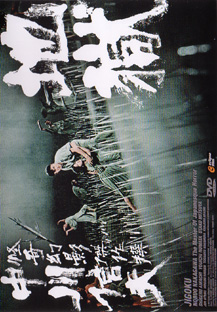 DVD Specification
Original year of release - 1960
Approximate running time - 101min.
Aspect ratio - Widescreen 2.35:1
System - NTSC (Colour)
Rating - Unrated.
Sound - Dolby Digital Mono (1.0)
DVD release - Beam Entertainment (BIBJ-1301)
Region Coding - Region 2 (Japan)
DVD Extras
Filmographies (in Japanese)
| MAIN CAST |
|
| Shigeru Amachi |
Shiro |
| Youichi Numata |
Tamura |
| Utako Mitsuya |
Sachiko |
| Hiroshi Hayashi |
|
| Torahiko Nakamura |
|
| Fumiko Miyata |
|
| Jun Otomo |
|
| Kanjuro Arashi |
|
| MAIN CREW |
|
| Director |
Nobuo Nakagawa |
| Producer |
Mitsugu Ookura |
| Screenplay |
Ichiro Miyagawa & Nobuo
Nakagawa |
| Music |
Chumei Watanabe |
| Cinematography |
Mamoru Morita |
| Production Design |
Haruyasu Kurosawa |
| Editing |
Toshio Goto |
| Sound |
Kihachiro Nakai |
| Lighting |
Hiroshi Ishimori |
| Planning |
Sosuke Kasane |
DVD Ratings (out of 5)
Picture - 4
The film is presented in its original 2.35:1 aspect ratio, 16x9 enhanced for
widescreen TV's. This means you can watch it as it probably hasn't been seen for
over 30 years, in its full scope glory. The excellent English subtitles are
optional and very readable, whilst the picture itself is excellent. The colours
look a bit washed out and there is a fair bit of grain, and damage around reel
changes. However, what can one really expect from a film that's over 40 years
old and has hardly seen the light of day since? The picture quality is very
impressive, and puts most Western releases of films of a similar age to shame.
There's no way JIGOKU will ever look better than this.
Sound - 4
The original mono track is presented here as two-track DD Mono. It is very
clear, and there's no audible hiss or interference. You can now enjoy the
screams of the damned in the comfort of your living room! The songs and screams
all sound very good, and the track is in pretty amazing condition overall.
Perhaps a 5.1 remix for such an important film wouldn't have been too much to
ask, but the Japanese aren't too into such things at the moment. I don't think
anyone will be complaining anyway...
Extras - 1
Nothing to speak of - what look like quite detailed filmographies, but they're
in Japanese so they won't be of much use to Western viewers. No trailer which is
a shame, as some of the other DVD's in the collection do feature trailers. I'm
sure one must have existed for JIGOKU, though it is perhaps lost today.
Overall Rating - 5
One of the most searched for Japanese films of all time finally arrives with
subtitles on DVD. For anyone interested in Japanese horror cinema, and
particularly classic Japanese cinema, this is an essential purchase. Nakagawa's
two key films (this and YOTSUYA) are extremely influential pieces, which still
retain their value today. The DVD presentation is immaculate and one can only
hope that this transfer eventually finds its way to US DVD where it would gain
the film (and Nakagawa) a whole new audience. With the release of films like
this on DVD, one can almost hope to see other neglected classics such as 100
MONSTERS (1968, Kimiyoshi Yasuda), MOJU - THE BLIND BEAST (1969, Yasuzo Masumura)
and the re-make of JIGOKU on DVD one day. Let's just hope that if they do ever
make it they're up to the standard of this release... The other releases in the
Nakagawa Collection that I have seen are all equally fine, and the DVD of GHOST
STORY OF YOTSUYA (previously available on subtitled bootleg, but not widescreen)
is highly recommended.
AKA
Hell (literal translation)
Sinners of Hell (International title)
Sinners to Hell (International title)
Alternative versions
A bootleg of the Japanese language print (not in full scope) has been available
for some time, but no subtitled version of the film has ever been issued before
this DVD release.