AWAKENING OF THE BEAST
The third and final �Coffin
Joe� DVD released by Fantoma is �The Awakening of the Beast�. This film
started life as �O Ritual dos S�dicos� (=�The Ritual of the
Sadists/Maniacs�), and was made in 1969. Marins� previous film was �The
Strange World of Z� do Caixao�, an anthology of three stories, the third of
which featured Z� do Caixao (or Coffin Joe to US audiences). This story
involved Z� trying to prove to a sophisticate and his wife that love is now
dead, and involved some pretty extreme imagery. AWAKENING shares quite a few
similarities with that story, but is also very much a �message film�...
The film starts with Z�
delivering a wild-eyed monologue into the camera (as in the opening of the first
Z� film, AT MIDNIGHT I�LL TAKE YOUR SOUL), then the credits start. These are
written across photo�s of Marins� Z� comic stories and are intercut with
shots of a young girl preparing to inject herself with heroin, which she
eventually does (into her ankle, in lingering closeup). The film proper then
begins. The girl is sat in a room with four other men. Pornographic photo�s
adorn the walls and the setting is sleazy. The girl suddenly stands up and
removes her dress, followed by her bra and panties, much to the men�s obvious
approval. The men have a package on the floor, which is wrapped in newspaper.
They frantically tear it open to reveal a chamberpot, which the girl then
laughingly climbs onto� Next we
see a group of men sat around a table, in a TV studio. They are discussing drugs
and addicts and are looking at case studies in which the behaviour of drug
addicts can be studied. Several increasingly bizarre vignettes follow, depicting
weird behaviour, rape, sex, drug abuse and orgies, combined with very strange
behaviour. Returning to the men, we find that one of them is a doctor, whose
case studies we have been observing. One of the other men is Jos� Mojica Marins
(playing himself), who sits in the dark, puffing on a cigarette mysteriously.
The doctor explains that his ultimate experiment involved taking four addicts
and trying to get them to undergo and extreme trip under monitored conditions.
He derived his theory when he saw Marins on a televised debate, and decided to
use the character of Z� do Caixao in his experiment. The addicts are gradually
hypnotised and exposed to lots of Z� imagery, including watching THIS NIGHT
I�LL POSSESS YOUR CORPSE at the cinema. Eventually, they are all injected and
go under. The film up to this point has been filmed in subdued black-and-white,
but we are now plunged into a stunningly coloured sequence (as in THIS NIGHT�s
famed hell sequence) as the addicts hallucinate all sorts of bizarre things, all
presided over by the maniacal character of Z� who makes lots of his
characteristic speeches. When we return to the men the doctor explains his
hypothesis, which is that drugs merely enhance or release aspects of our
personalities that are already there, i.e. they cannot be used as an excuse for
deviant behaviour. The twist is that the subjects were not in fact drugged, but
only made to think that they had been through suggestion. As the men leave the
studio, the doctor asks Marins how he gets the ideas for his films. Marins shows
him a piece of paper with the title of the film written on it (throughout the
scenes of the men at the table, Marins is shown writing notes), before looking
into the camera and saying �Cut�.
Marins originally intended this
to be the third Coffin Joe film. Z� was to take LSD and imagine himself flushed
down a toilet. He emerges in Hell and finds himself inside the human body.
However, Marins was unable to find backing and proceeded with this film instead,
retaining some elements of the plot for that third (unfilmed) Coffin Joe movie.
Marins was invited to appear on a TV show called Who's Afraid of the Truth? He
was asked questions by a panel of experts to determine if he was a fake. Scenes
from this show are shown in the film when the doctor is shown watching Marins on
TV.
This film is very much a period
piece, very 60�s, very hippy, very psychedelic. It�s also surprisingly
explicit for the time (compare it with Italian produce of the same year) and
this would lead to many problems. Marins conceived the film after seeing a
pregnant drug addict being beaten by police. He had no money and no backers, but
he had by this point become very involved with the Brazilian Cinema do Lixo (literally,
trash cinema) movement and knew
many directors including Carlos Reichenbach and Mauricio Capovilla (both of whom
appear as guests on the chat show in the film, along with other real-life
associates, Jairo Ferreira (a critic), W�lter C Portella and Jo�o Callegaro). These people clubbed
together and helped Marins finance the film, also helping him by providing film
stock. Marins couldn�t afford to hire a studio or set, so he filmed most of
the picture in his office, repeatedly redecorating it. Many of the people in the
film were friends, associates and even people dragged in off the street,
including some police officers who were recruited after coming to investigate
complaints about Marins� use of drugs in the shooting of the film.
Marins� style is very much
more refined than in his earlier efforts, and he uses all sorts of cinematic
tricks to make the film look more interesting, including a lot of Russ Meyer-esque
super-fast editing and multiple camera angles. In fact, in the final part of the
film, he rarely holds a shot for more than a couple of seconds. This style
complements the subject matter perfectly, and helps create a really trippy
ambience. The colour hallucination scenes are even more impressive than those in
THIS NIGHT and feature some similar imagery, including Z� walking across a
bridge constructed of (live) human bodies. It would take several paragraphs to
detail all the weird imagery Marins packs into the hallucinations (some scenes
are out-takes from his earlier work or scenes that had been cut), but one of the
most notable involves a row of men with their rears exposed and faces painted on
them. This works surprisingly well, and is a really odd scene that you�ll
remember afterwards! (Apparently Marins wanted to have Martians in this scene,
but because of fx limitations he couldn�t get them right so he painted men�s
arses instead!!) Two other scenes in the first 2/3 of the film also merit
singling out � one involves a vision of Jesus, who proceeds to stick his staff
into a woman�s privates, and another involves a woman who keeps seeing a
lecherous producer as farmyard animals.
The film obviously contains a
strongly anti-drugs message (Marins feels that dealers and producers should be
punished, not the addicts) but it is also an interesting view of late 60�s
Brazil, here depicted as just as decadent and free spirited as the US in the
same period. Marins very much focuses on the darker side of this movement and
the exploitation of addicts (particularly women) by those in power. The
doctor�s rather dubious methods seem a little unlikely to find acceptance, to
say the least (one of his experiments ends with the subject dead) but they do
provide an effective way of getting across Marins� message in an original way.
The way in which Z� is incorporated into the film is also ingenious, and the
whole last third of the film strongly reminds me of the final story in the
STRANGE WORLD anthology as I mentioned above and this film almost seems like a
more fleshed-out retread of that work.
The film isn�t just about
drugs, though � it�s also about identity, a subject which would go on to
interest Marins more and more. Marins� appearance in the film as himself
(along with several other people playing themselves) and also as Z� is only the
start of the ID crisis which he would later go on to explore in other projects.
At one point the doctor is discussing Z� and Marins feels moved to point out
that �Z� is dead�, and that he stayed in the graveyard where he ended up at
the close of THIS NIGHT. The televised appearance which the doctor watches
continues this theme, with Marins being accused of a crime and acquitted, first
as Marins, then as Z�. Finally, the movie�s film-within-a-film structure
further emphasises this merging of reality and fantasy. Some of these elements
might not work too well, but they are certainly interesting and do hint at
Marins� later obsessions.
The film was banned in Brazil
(an unusual event) and has never been released there to this day, with the
exception of isolated showings. Marins was even arrested for a time, accused of
producing politically inflammatory material. Marins considers the film to be one
of his greatest achievements and many fans apparently agree. Whilst I enjoyed
the film, and can see its merits, I have to say that I prefer the two
�proper� COFFIN JOE films, AT MIDNIGHT and THIS NIGHT. These have dated much
better and showcase a unique talent and a real vision, whilst AWAKENING seems
very old-fashioned in places despite its explicitness. The main point against
AWAKENING is that I�m not sure I would watch it again (except perhaps the
hallucination sequence), whereas the first two films stand up to repeated
viewing. A point in favour of AWAKENING is Marins� obviously much improved
technical abilities � when one considers the budget and shooting limitations
he had to endure, the end product is truly stunning and shows Marins to be a
director of considerable skill. In any event, the film is well worth seeing, and
its anti-drug message is handled with considerable skill (compare this with US
films on the subject like the infamous REEFER MADNESS (1936))
Marins� other notable horror
films are; O EXORCISMO NEGRO (1974, aka �The Bloody Exorcism of Coffin
Joe�); INFERNO CARNAL (1976, aka �Hellish Flesh�); O ESTUPRO (1978, aka
PERVERSAO,
�Perversion�); and DELIRIOS DE UN AMORAL (1979, aka �Hallucinations of a
Deranged Mind�, Z�'s last appearanace in a film) - all these feature the
character of Z� (with the exception of PERVERSAO), but only in
dreams/hallucinations; THIS NIGHT was the second and last film to feature him as
a 'real' character. Most of his other films are sex films (of both the hard and
soft variety), with the notable exception of the two little-seen �Finis Hominis� films
(FINIS HOMINIS - O FIM DO HOMEM (1971, aka �End of Man�) and QUANDO OS
DEUSES ADORMECEM (1976, aka 'When the Gods Fall Asleep')),
which concern another Marins alter-ego, this time a messiah figure who is the
polar opposite of Z�. He also made an autobiographical piece, DEMONS &
WONDERS (1976).
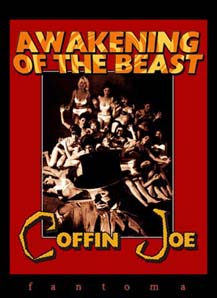 DVD Specification
Original year of release - 1969
Approximate running time - 92min.
Aspect ratio - Widescreen 1.66:1
System - NTSC (b&w with colour segment)
Rating - Unrated.
Sound - Dolby Digital Mono (1.0)
DVD release - Fantoma
Region Coding - Region 0 (code free)
DVD Extras
Original Theatrical Trailer, plus trailers for 'At Midnight I'll Take Your Soul'
and 'Awakening of the Beast'.
Interview with Marins
Reproduction 'Coffin Joe' Comicbook
| MAIN CAST |
|
| Jos� Mojica Marins |
Jos� Mojica Marins/Z� do
Caixao |
| Sergio Hingst |
|
| Ozualdo Candeias |
|
| Andr�ia Bryan |
|
| Lurdes Ribas |
|
| Mario lima |
|
| Annik Malvil |
|
| �tala Nandi |
|
| MAIN CREW |
|
| Director |
Jos� Mojica Marins |
| Screenplay |
Jos� Mojica Marins |
| Director of Photography |
Giorgio Attili |
| Production Designer |
M�rio Lima |
| Script |
Rubens F Lucchetti |
| Producer |
Luis Elias |
DVD Ratings (out of 5)
Picture - 4
This is probably the best of the three DVD�s in terms of picture quality,
though THIS NIGHT wasn�t far behind. One obvious reason for this is that the
film was never actually shown in Brazil, and the negatives are therefore in much
better condition than those used for the previous two transfers. The
black-and-white looks quite flat, much like the other two COFFIN JOE discs.
Compare these to Japanese films of the same period (for example ONIBABA (1964)
or KURONEKO (1968)) to see how stunning monochrome photography could look. This
is probably down to cheaper film stock being utilised. The colour sequence more
than makes up for this though, and would not be as effective if the rest of the
film was also colour. This sequence makes use of all sorts of filters, dyes and
ethereal lighting, putting one in mind of Argento�s SUSPIRIA (1976) and
INFERNO (1980), and the colour literally jumps out at the viewer. There is still
quite a lot of grain present in the b&w scenes, and quite a lot of shimmery
images, but to a lesser extent than in the other DVD�s. The colour sequence is
in by far the best condition of anything on the three discs, and is a very
impressive restoration achievement. The 1.66:1 framing (not 16x9 enhaned) is also more exact than
was the case in the first two films, and the subtitles are equally excellent and
visible.
Sound - 3
Two-track
DD Mono, as on the other two discs. As with the other films, Marins uses a lot
of peripheral sound in this film, and lots of reverb and screams. These are all
rendered faithfully, but I did think the audio on this disc was perhaps a bit
less clear than on the first two, and there is quite a bit of hiss in places.
Still, nothing major and nothing that one wouldn�t expect in a case like this.
The film also features a groovy protest song, which is played at the beginning
and end, and actually gets quite catchy by the time the film has finished. This
sounds suitably aged and 60's to suit the mood of the film perfectly.
Extras - 4
As
with the other DVD�s, we get a trailer, plus trailers for AT MIDNIGHT and THIS
NIGHT, and a reproduction Z� comic book. There�s also another interview with
Marins, clocking in at about 8+� minutes. This is very interesting, as with the
other interviews and Marins has some revealing comments to make about the film.
Also, the main menu uses a backdrop of the �painted arses� scene - which is
nice!
Overall Rating - 4
An excellent presentation of a rare, unusual film. If
you�ve never seen a COFFIN JOE film then I wouldn�t watch this first. Start
at the beginning (AT MIDNIGHT), and prepare yourself for this. If you like
60�s films about tripping then you�ll definitely love this, and if you like
provocative, original film-making then it�ll do just the trick. Fantoma are to
be congratulated heartily for these three excellent releases, and I await
further COFFIN JOE releases with eagerness (surely THE STRANGE WORLD would make
a worthwhile addition to the set). An interesting side note is that the inlays
for the 3 DVD�s list Mike Patton in the �thanks� section. Anyone who was a
fan of the bands Faith No More or Mr
Bungle will be interested to see his name in there; I wonder what he did to
help out? As a final point of interest, Jos� Mojica marins has a site on the
internet - www.zedocaixao.com
AKA
O Ritual dos S�dicos (Original Brazilian title)
O Despertar da Besta (Brazilian re-title)
Ritual of the Maniacs (Translation of original Brazilian title)
Ritual
of the Sadists (Translation of original Brazilian title)
Alternative versions
The only other widely seen version of this film was
Something Weird's VHS release which was essentially the same as this release in
terms of content. It was also subtitled.