AUDITION
Before I begin, I would like to give a word of
warning; if you haven't seen this film yet and have avoided reading too much
about it, then don't read any further. This film is at its most effective
without any previous knowledge of it, as I found last autumn on viewing it for
the first time without knowing anything about it. I would go further and advise
you not even to read the blurb on the back of the DVD case. Just watch the film
first. However, if you do want to read on, I've tried to avoid giving away any
of the film's defining elements... Note also that I have reproduced much
of the text from my review of the HK DVD release for this section of the review.
AUDITION is Takashi Miike's only entry into the horror genre to date. Miike is
the current darling of Japanese cinema and was to be found at most of the major
film festivals in the last year in place of 'Beat' Takeshi Kitano, who usually assumes
this position. His career is fascinating. Up until FUDOH: THE NEW GENERATIONS in
1996, Miike was an unknown, even in Japan. This film is often mistakenly
referred to as Miike's debut - it wasn't. He had made quite a few low budget
yakuza flicks in the first half of the decade and had worked extensively within
the Japanese film industry in roles other than director. By the time he
made FUDOH he was 36 - quite a late start for a Japanese director. As if to make
up for this delayed success, he has been steadily increasing his output over the
last few years, to the stage where he made an incredible seven films in the last
two years (what's even more amazing is the fact that they're all so good!).
AUDITION is one of those seven films. Most of Miike's work falls into the
'violent yakuza' genre, popularised by Kitano. However, the similarities end
there. Where Kitano makes beautifully crafted films meditating on the nature of
life and death filmed in a refined, stately manner, Miike couldn't care less
about anything! His films are invested with a pop culture mentality more suited
to a twenty year old director, they move at a frenetic pace and he employs every
cinematic technique in the book to create wild, ultra-violent punk yakuza films
that leave the viewer literally stunned. Don't think that that's all Miike does
though - his BIRD PEOPLE OF CHINA (1997), LEY LINES (2000), BLUES HARP (1999)
and GUYS FROM PARADISE (2000) offer a wider picture of Miike's talents, making
award-winning mystical adventure films, black comedies and dramas. However,
Miike's talents are undoubtedly best suited to the violent yakuza films that
have made his name, and are most fully illustrated in his incredible DEAD OR
ALIVE (1999).
AUDITION has widely been acclaimed as a masterpiece and was one of the most
hotly debated films of last year, appearing at several festivals and reportedly
leading to audience walk-outs 'en masse', much to the delight of Miike. Miike
has denied that any cultural or social commentary exists in his films and says
that he tries simply to do his best with the material that is given to him. He
famously takes the scripts he's given and pushes them to the extreme, best
illustrated in the crazed ending to DOA in which he took very literally the idea
of a climactic apocalyptic battle between the two leads. AUDITION's source
material was a best selling novel by Ryu Murakami (a well-known author in Japan,
and also director/writer of the 1991 film TOKYO DECADENCE). However, Miike's film (and
Daisuke Tengan's screenplay) takes elements of the novel to whole new levels and
produces a hypnotic, hallucinogenic viewing experience guaranteed to keep the
audience on edge.
The story concerns a simple, genial middle-aged man named Shigeharu (played by
Ryo Ishibashi who is best known for his role in ANOTHER LONELY HITMAN (1995) but
has also appeared in Kitano's KIDS RETURN (1996) and BROTHER (2000), amongst
other things) whose wife dies at the start of the picture, leaving him and his
young son alone. Cut to several years later. Shigeharu has remained single and is
lonely, though he does at least have his (now teenage) son Shigehiko (played by
newcomer Tetsu Sawaki). He discusses life with his best friend, producer
Yoshikawa (Jun Kunimura), who convinces Shigeharu to attend a bogus audition
that he will arrange in order for Shigeharu to meet and assess lots of young
women. The last interviewee is Asami (stunning newcomer Eihi Shiina, a former
model), a beautiful, perfectly spoken young lady. Shigeharu is fascinated by her
and they meet for lunch. Afterwards, Yoshikawa advises Shigeharu not to phone
Asami but he finds it impossible not to....
I don't want to say more about the story, but suffice to say that things take a
turn for the decidedly nasty... The impact of the film is helped by the weird
editing (very reminiscent of the style used to such brilliant effect in Kiyoshi
Kurosawa's CURE (1997)) and multi-layered levels of 'reality', which are blurred
to the point where one doubts even Miike is quite sure what's going on. What
exactly Miike's purpose with this film is supposed to be remains obscure - is it
a cautionary tale, a feminist statement, or just a horror film? Regardless, it
is a film that is certain to stay with you long after viewing, and demand repeat
appraisals. Both Ishibashi and Shiina's performances are excellent, Ishibashi's
charismatic, laid back style provoking real empathy (and sympathy) with the
audience and Shiina icy cool as the girl of nightmares. The special effects work
in the film is also very good (and were done by Yuichi Matsui, who also provided
the amazing effects for RING I and II (both 1998, Hideo Nakata), CURE, NAKED BLOOD (1995, Hisayasu Sato), and Gaira's GUTS OF A
VIRGIN (1988) and GUTS OF A BEAUTY (1986)), but Miike doesn't rely on his effects alone, and
one scene in the last reel of the film involving a simple trick in which
something is tossed with a 'thud' against a glass screen that the viewer hadn't
realised was there really makes the viewer jump! I read a comment somewhere on the
internet last year in which a horror film fan cited this film and Pupi Avati's
L'ARCANO INCANTATORE (1996) as the two finest horror films of the 1990's - I for
one would be hard-pressed to disagree with that sentiment.
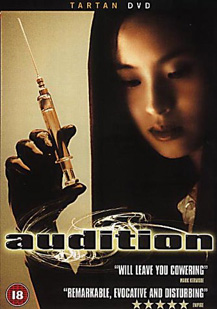 DVD Specification
Original year of release - 1999
Approximate running time - 110m51s @ 24fps
Aspect ratio - Widescreen ~1.85:1 (16x9 enhanced)
System - PAL (colour)
Rating - 18
Sound - Dolby Digital Stereo (2.0)
DVD release - Tartan DVD (the DVD packaging gives their URL as www.tartanvideo.com
- there's nothing there though!)
Region Coding - Region 0 (code free)
DVD Extras
Star and Director Filmographies
Takashi Miike Interview
Original Theatrical Trailers
'Extreme Asia' Trailer Reel
Film Notes by Chris Campion
Screensaver
Gallery
| Ryo Ishibashi |
Shigeharu Aoyama |
| Eihi Shiina |
Asami Yamasaki |
| Jun Kunimura |
Yoshikawa |
| Miyuki Matsuda |
Ryoko Aoyama |
| Ren Osugi |
Shibata |
| Renji Ishibashi |
Old Man |
| Tetsu Sawaki |
Shigehiko Aoyama |
| Director |
Takashi Miike |
| Executive Producer |
Toyoyuki Yokohama |
| Line Producer |
Junichi Shindo |
| Producers |
Soji Fukushima & Akimi
Suyama |
| Based on the Novel by |
Ryu Murakami |
| Screenplay |
Daisuke Tengan |
| Cinematography |
Hideo Yamamoto |
| Editing |
Yasushi Shimamura |
| Music |
Koji Endo |
| Special Effects |
Yuichi Matsui |
| Production Design |
Tatsuo Ozeki |
| Sound Department |
Kenji Shibazaki |
| Costume Design |
Tomoe Kumagai |
DVD Ratings (out of 5)
Picture - 4
Right, here's where things get difficult. I compared specific scenes in the film
on Tartan's DVD to the Universe HK DVD to try to determine which release was
better. I have to say that I can't say 100% that one is better than the
other. Let's start with the obvious differences: Tartan's release is
anamorphically enhanced, which is a big plus point in my book. The framing on
both DVD's looks the same to me. However, the subtitles on Tartan's release are
(surprise, surprise!) burnt in. The HK DVD allowed one to view the film without
any subtitles, or with English or Chinese subtitles. This is a pity, but
Tartan's subtitles are much more literate and also clearer and easier to read.
As for image quality, the Tartan disc has better depth to the image - colours
(and blacks especially) look deeper and better defined. The Universe disc
featured a very good transfer for a HK DVD, but I think things look slightly
less crystal clear on it, and blacks are less black. Tartan's DVD is grainer if
anything and is certainly darker overall than Universe's, but I think that if I
had to choose one over the other, I'd go for the Tartan release.
Sound - 3
The soundtrack is stereo, as on Universe's disc. I listened to both carefully,
but couldn't really detect much difference. Everything's nice and clear, and
there's no hissing or interference. Not anything special, but perfectly
adequate.
Extras - 3
The first, and best, extra feature on the DVD is a rare interview with Takashi
Miike himself. This lasts just over 13 minutes and is subtitled. Miike talks
about the film and the various themes contained therein, and also about the
film's reception in Japan (apparently, it was not successful at cinemas in
Japan). For a Miike fan like myself, the DVD is almost worth buying for this
alone, though it could have been longer. Also included are two trailers for the film, one European and one
Japanese. Both are quite short, and are presented anamorphically enhanced. The
European trailer is the less impressive of the two and is also the poorer
quality. The Japanese trailer features English subtitles. Next there is a
gallery which consists of just four posters. There are filmographies for Miike
(very incomplete, listing just 13 of his 45-or-so credits to date and even
omitting some fairly well known works), Ryo Ishibashi, author Ryu Murakami,
Eihi Shiina and Tetsu Sawaki (both of whom have only this film to their credit
to date making their filmographies somewhat worthless). There is also a screensaver
and an 'Extreme Asia' trailer
reel. This consists of trailers for Hideo Nakata's RING I and II, John Woo's
HARD BOILED (1992) and Myung-se Lee's NOWHERE TO HIDE (1999). Finally there are
film notes by Chris Campion (who he?) - these are quite interesting and contain
a piece of info that I haven't seen anywhere else; apparently, 'Daisuke Tengan'
(the screenwriter) is a pseudonym for Shohei Imamura's son! (Imamura is a famous
Japanese director best known for films such as VENGEANCE IS MINE (1979), BLACK
RAIN (1989) and THE EEL (1997) to name but three.) One other point to
note: there is no inlay card with this DVD release, so the chapter listing can
only be viewed through the DVD menus.
Overall Rating - 4
AUDITION has been passed uncut for UK release; perhaps this is slightly
surprising, but the film is primarily a psychological horror story and the BBFC
do have a long and infamous past reputation for letting subtitled 'art' films
through the net unscathed. I for one am not about to complain! One of the
best things about this release is an inconspicuous line on the back of the packaging:
"Look out for more films in Tartan Video's Miike Takashi Collection: RAINY
DOG (1997), CITY OF LOST SOULS (2000), SHINJUKU TRIAD SOCIETY (1995), DEAD OR
ALIVE I (1999) and II (2000)". This is great news, particularly in
the case of SHINJUKU TRIAD SOCIETY, Miike's breakthrough yakuza film and the
first of his 'Triad Society' trilogy (the other two films in the trilogy being
RAINY DOG and LEY LINES). SHINJUKU... has never been available subtitled before,
even on the bootleg scene, so it will be a most welcome release. I have to
wonder about DEAD OR ALIVE's chances of getting through the BBFC uncut but time
will tell... The only sad thing about this is that many people (myself included)
believed that Tartan were planning to release LEY LINES and BLUES HARP, two of
the other 'main' Miike films that remain impossible to see with subtitles... oh
well, hopefully someone somewhere will pick these two up eventually.
Tartan's DVD release of AUDITION is perfectly acceptable and better quality
overall than, say, their RING DVD. It isn't a vast improvement on Universe's HK
release, but the good quality (if burnt-in) subtitles, 16x9 enhancement and
Miike interview conspire to make this the definitive release of a Miike film on
DVD to date. At the time of writing, this is the only Miike film available
on DVD in the West, and one of only two Miike films officially available with
subtitles (the other title being CITY OF LOST SOULS (aka HAZARD CITY), available
on either a shoddy flipper DVD from HK or a lovely, but very expensive,
subtitled Japanese DVD). An unofficial subtitled DVD release of VISITOR
Q (2001) is the only other title to have surfaced so far (unless one counts
Tokyo Shock's out-of-print VHS release of FUDOH in the US), so Tartan's
commitment to releasing more of Miike's work in the West is very much to be praised. Miike
is unquestionably the most interesting (and prolific) director currently at work
in the world today, and even if his work is at times uneven, he is always
interesting and always manages to produce something characteristically unhinged.
AKA
'Odishon' (Original Japanese Title)
Alternative versions
There is only one other subtitled version of the film available; that is the
region 3 NTSC Hong Kong DVD released by Universe (the review I wrote of this DVD
is here: AUDITION
HK DVD). The film is also available on
region 2 Japanese DVD from 'Art Port', but this isn't subtitled. A US DVD
release is surely imminent following the film's limited theatrical release there
over the
summer.
Taglines
"She always gets a part" (US)
Awards
Won - International Fantasy Film Award - Special Mention (Takashi Miike)
Won - Rotterdam International Film Festival FIPRESCI Award (Takashi Miike) - "for its narrative freedom,
technical mastery of genre and the inventivitry (sic) of an important new and
prolific director".
Won - Rotterdam International Film Festival KNF Award (Takashi Miike)