The ALL NIGHT LONG trilogy
Note: I�ve decided to cover all three films in one long review as they are all very similar in theme (and execution). To cover them separately would mean a great deal of repetition, and I feel it is easier to discuss the trilogy�s themes, rather than consider each film individually.
The ALL NIGHT LONG trilogy of films is without doubt one of the most controversial series of all time.
Indeed it is probably only equalled in notoriety by the GUINEA PIG series, another Japanese production.
Unlike the GUINEA PIG films, the ALL NIGHT LONG (henceforth ANL) films have a clear message and don�t exist purely to shock the viewer (though they undoubtedly do that too).
Another important difference between the two series is that the ANL films are the work of a single writer/director, Katsuya Matsumura.
Matsumura�s trilogy concerns a very Japanese idea � that a society will always tend to turn on its weakest members, destroying them in order for the strong to prosper.
Of course, this is a very fascist way of thinking and effectively destroys the notion of a civilised society � surely civilisation means protecting society�s weakest members and providing for them, thus setting us apart from animals.
Various Japanese films have used this theory as a basis for unpleasantness, most notably film school graduate Kaziyoshi Kumakiri�s very extreme but award-winning picture KICHIKU DAI ENKU (1996, aka �Kichiku�).
Kumakiri expounds upon the theory, proposing that when a group (in this case a sect of radical students) are isolated from the rest of society they will not only turn on their weaker members, but will kill them as nastily as possible, resulting in a nihilistic bloodbath which leaves no-one alive by the end of the film.
Nihilism is the keyword when discussing the ANL trilogy � these are without doubt the most nihilistic films you�ll ever see.
They�re also amongst the most unpleasant things ever committed to celluloid and are almost certain to offend even the most hardened viewer.
For this reason, they�ve become much sought after amongst the video underground, but have been very difficult to obtain subtitled... until now.
Japan Shock Video continue to fearlessly release titles that no other studio would touch with a 10 foot bargepole, and this trilogy is their latest foray into the extremely murky waters of the Japanese underground cinema.
The ANL films are the type of film that one can safely assert will never see the light of day in the UK.
What follows is a brief summary of each film. I haven�t gone into too much detail as it would become very tiresome for the reader, but I�m sure that the gist will become very clear�
ALL NIGHT LONG
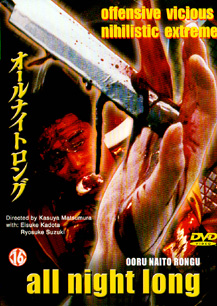 ALL NIGHT LONG (1992) was a �proper� film; that is, it was filmed for theatrical distribution. The sequels were shot on video, whereas this film was shot
on film, in widescreen. Perhaps as a result of this, it�s also the tamest film in the trilogy.
Having said that, it�s still fairly strong stuff and isn�t going to leave most viewers unmoved.
The film concerns the sad daily life of a geeky college student. One day, he is on his way to college when he has to stop at a crossing.
A car is also stopped, as is a motorbike. A pretty young girl walks up and the four wait for the crossing to be clear.
A fifth person walks up to the girl and asks her for directions, waving a sheet of paper in her face.
She tries to move away from him and he suddenly becomes enraged, pulling out a great big knife.
The girl puts up her hand to defend herself, and he stabs the knife through it, before repeatedly stabbing her.
Afterwards he seems stunned and starts to hammer on the car windows. The guy on the motorbike runs him down and they detain him until the police arrive.
After this event, the three men form a bond and arrange a party to which they will bring their partners.
One problem though � they don�t have partners. The next (and largest) part of the film focuses on the relationships between the young men and their personalities as they try to find girlfriends to take to the party. One of them falls in love with a girl, but their happiness
doesn't last long - a gang capture them, beat the boy and rape the girl. The final part of the film then concentrates on the three young men�s attempts to revenge themselves on the gang, ending the film in a very bloody massacre.
ALL NIGHT LONG (1992) was a �proper� film; that is, it was filmed for theatrical distribution. The sequels were shot on video, whereas this film was shot
on film, in widescreen. Perhaps as a result of this, it�s also the tamest film in the trilogy.
Having said that, it�s still fairly strong stuff and isn�t going to leave most viewers unmoved.
The film concerns the sad daily life of a geeky college student. One day, he is on his way to college when he has to stop at a crossing.
A car is also stopped, as is a motorbike. A pretty young girl walks up and the four wait for the crossing to be clear.
A fifth person walks up to the girl and asks her for directions, waving a sheet of paper in her face.
She tries to move away from him and he suddenly becomes enraged, pulling out a great big knife.
The girl puts up her hand to defend herself, and he stabs the knife through it, before repeatedly stabbing her.
Afterwards he seems stunned and starts to hammer on the car windows. The guy on the motorbike runs him down and they detain him until the police arrive.
After this event, the three men form a bond and arrange a party to which they will bring their partners.
One problem though � they don�t have partners. The next (and largest) part of the film focuses on the relationships between the young men and their personalities as they try to find girlfriends to take to the party. One of them falls in love with a girl, but their happiness
doesn't last long - a gang capture them, beat the boy and rape the girl. The final part of the film then concentrates on the three young men�s attempts to revenge themselves on the gang, ending the film in a very bloody massacre.
The stabbing of the girl at the beginning of the film is extremely violent, with blood spurting everywhere and extremely convincing fx work.
Other than that scene, the rest of the film is reasonably restrained, though there is a nasty scene in which the gang cut the girl�s ankle with a pair of scissors and some fairly graphic murders at the end.
This seems a little strange, as the film has a very strong reputation and one might have been forgiven for expecting a seriously nasty film.
However, it is the mood of the film which has led to its infamy as much as its subject matter � it has a dangerous, powerful, anarchistic feel to it that makes the viewer feel they�re watching something forbidden.
The rape scene is quite tame for a Japanese genre film, though it does have some unpleasantly sadistic overtones to it.
ALL NIGHT LONG II
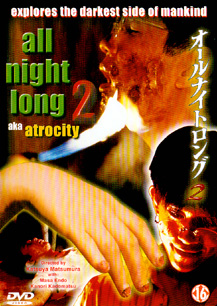 ALL NIGHT LONG II (1995) is also known as ATROCITY, perhaps a more fitting title. If ANL was effective but restrained then ANL2 aims to redress the balance.
This film�s history is a little muddled; some sources claim it was prepared with theatrical distribution in mind whilst others state it was intended for the straight to video market.
Certainly, it appears to have been shot on video (like the GUINEA PIG films) and the subject matter is so offensive and unlikely to appeal to even a Japanese audience that it seems unlikely the film would ever have seen a projector.
As it turned out these points were moot anyway, as the film reputedly ran into trouble with Japan�s ratings board Eirin and was denied a certificate, meaning that a video release was the only option available.
(Interesting sidenote: the bootleg copy of the film previously available included a titlecard informing us that it was not allowed to be shown in cinemas.
This is missing from JSV�s release). Like in ANL, the main protagonist of the film is a bespectacled
geek called Shinichi, but this time the other main character is an evil, sadistic, misogynistic, effete, homosexual maniac!
The maniac and his gang have been harassing Shinichi, and the maniac appears to take a fancy to
him, after having killed his former boyfriend by pouring superglue into his ear whilst he was asleep.
Shinichi makes some internet friends who he hopes will help him to escape the gang�s attentions, but things don�t work out quite that way.
As in Part I, the film ends in a bloodbath with Shinichi summing up all that has gone before quite nicely: �this is all meaningless�.
ALL NIGHT LONG II (1995) is also known as ATROCITY, perhaps a more fitting title. If ANL was effective but restrained then ANL2 aims to redress the balance.
This film�s history is a little muddled; some sources claim it was prepared with theatrical distribution in mind whilst others state it was intended for the straight to video market.
Certainly, it appears to have been shot on video (like the GUINEA PIG films) and the subject matter is so offensive and unlikely to appeal to even a Japanese audience that it seems unlikely the film would ever have seen a projector.
As it turned out these points were moot anyway, as the film reputedly ran into trouble with Japan�s ratings board Eirin and was denied a certificate, meaning that a video release was the only option available.
(Interesting sidenote: the bootleg copy of the film previously available included a titlecard informing us that it was not allowed to be shown in cinemas.
This is missing from JSV�s release). Like in ANL, the main protagonist of the film is a bespectacled
geek called Shinichi, but this time the other main character is an evil, sadistic, misogynistic, effete, homosexual maniac!
The maniac and his gang have been harassing Shinichi, and the maniac appears to take a fancy to
him, after having killed his former boyfriend by pouring superglue into his ear whilst he was asleep.
Shinichi makes some internet friends who he hopes will help him to escape the gang�s attentions, but things don�t work out quite that way.
As in Part I, the film ends in a bloodbath with Shinichi summing up all that has gone before quite nicely: �this is all meaningless�.
As I mentioned above, Matsumura seems to have deliberately set out with this film to offend practically anyone watching it. The victims in the film are not solely female � in fact, more men are killed and tortured than women, but the violence towards the female characters tends to be more gleeful, sadistic and deliberately provocative.
Once again however, the most upsetting parts of the film are psychological.
A case in point occurs fairly early in the film; the maniac has been keeping a drug-addicted woman in his house.
He has tortured her (pulling out her fingernails) and abused her, reducing her to an animal state.
He leaves Shinichi with her, and watches them on a video linkup. The woman is completely out of it, but gives the geek a blowjob.
Afterwards, she begs him to help her escape. However, at the crucial point when we can feel
Shinichi almost raising the courage to help her she vomits his semen back up into his face.
Enraged, he starts to beat her before realising that he is acting on the same level as his tormentor.
This scene probably sounds unpleasant to the reader, but when watching the film it comes across much more powerfully.
The utter degradation of the girl makes the viewer feel extremely uncomfortable and actually slightly sick.
Of course, worse is to come, both for the girl and for the rest of the unpleasant characters that populate this film.
The effects in the film are once again extremely effective � I�ve seen a lot of Japanese genre films, yet I�m still often surprised by the technical ability that they tend to show when it comes to gore scenes.
A good example of this is Hisayasu Sato�s NAKED BLOOD (also released on DVD by JSV), which has such convincing effects that it�s hard to believe they�re not real (I defy anyone to watch the �fork/eye� scene without turning away!)
Anyway, this is besides the point, but the realism of the effects certainly help the film, as do the excellent performances put in by the main actors (this is equally true of the other two films in the trilogy).
The maniac is particularly well played, given that this part could so easily have become laughable; a gay, fascist loony who whispers �I�m sorry� to his victims is difficult to portray to convincing effect, yet the actor manages well.
Many times I�ve wondered how Japanese producers manage to find actresses to appear in films like this.
Often they are adult film stars, or amateurs, yet it�s amazing that they agree to many of the things required of them in films like this (and GUINEA PIG).
It�s hard to imagine Western actresses agreeing to the sort of degradation that they would be required to undergo to appear in a production like ANL, but Asian productions seem to have no such problems.
The actresses in the film certainly make the (male surely) viewer emphasise with them to very uncomfortable effect, and most people will stop at some point and ask themselves what they�re doing watching a film like this.
Entertainment? Hardly. Yet, Matsumura manages to convey a real sense of commitment and serious commentary in all three films.
What is this point? Hard to say. That violence leads inevitably to further violence?
That life is meaningless? Not exactly uplifting messages, huh?
One other point that I should mention here: the version of this film that was previously available through VSoM was a shorter one. Additionally, VSoM's print appeared to be
widescreen, but in actuality was simply matted over the top and bottom of the
picture (they did the same with their release of Elio Petri's A QUIET DAY IN THE
COUNTRY) whereas JSV's DVD presents the film in its correct aspect ratio (4:3). JSV's DVD omits the previously mentioned title card, whilst the VSoM tape has several shortened scenes (not all of them violent/sexual in nature). The subtitles on JSV's release are extremely similar to VSoM's, but they occasionally fail to appear for some reason. Thanks to Harald Gruenberger for pointing these differences out.
ALL NIGHT LONG III
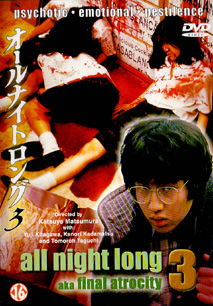 The final part of Matsumura's trilogy of bleak
misery is also known as 'Final Atrocity', linking it more directly to the second
film in the trilogy; this is fitting since the mood of the film is once again
fairly extreme to say the least. Perhaps the most interesting thing about
this entry in the trilogy is the presence of Tomoroh Taguchi in the cast.
Taguchi is best known for his roles is Shinya Tsukamoto's TETSUO (1989, 1992)
films and was a fellow film school student with Tsukamoto and Kei Fujiwara (who
played the girlfriend in TETSUO and directed/starred in ORGAN (1996)).
However, he is also one of the most prolific Japanese character actors of the
1990's, having appeared in many critically acclaimed and successful films by
most of Japan's major directors - several of Takashi Miike's works, Masato
Harada's KAMIKAZE TAXI (1995), Sabu's DANGAN RUNNER (1996) and POSTMAN BLUES
(1997), Nagisa Oshima's GOHATTO (1999), Shunji Iwai's LOVE LETTER (1995) and
SWALLOWTAIL BUTTERFLY (1996), Shohei Imamur'a THE EEL (1997), Naoto Takenaka's
TOKYO BIYORI (1997), the horror film TOMIE (2000, Ataru Oikawa) and the RING TV
film (1995, Chisui Takigawa) to name but the most important. It is
therefore very surprising to see him in a film like this, and serves to
underline the very serious attitude that Matsumura has towards these films -
they might be exploitation (no-one could really deny this could they?!) but
they're exploitation with a very serious (and nasty) theme to them and Matsumura
surely felt he was making a real statement with his trilogy.
The final part of Matsumura's trilogy of bleak
misery is also known as 'Final Atrocity', linking it more directly to the second
film in the trilogy; this is fitting since the mood of the film is once again
fairly extreme to say the least. Perhaps the most interesting thing about
this entry in the trilogy is the presence of Tomoroh Taguchi in the cast.
Taguchi is best known for his roles is Shinya Tsukamoto's TETSUO (1989, 1992)
films and was a fellow film school student with Tsukamoto and Kei Fujiwara (who
played the girlfriend in TETSUO and directed/starred in ORGAN (1996)).
However, he is also one of the most prolific Japanese character actors of the
1990's, having appeared in many critically acclaimed and successful films by
most of Japan's major directors - several of Takashi Miike's works, Masato
Harada's KAMIKAZE TAXI (1995), Sabu's DANGAN RUNNER (1996) and POSTMAN BLUES
(1997), Nagisa Oshima's GOHATTO (1999), Shunji Iwai's LOVE LETTER (1995) and
SWALLOWTAIL BUTTERFLY (1996), Shohei Imamur'a THE EEL (1997), Naoto Takenaka's
TOKYO BIYORI (1997), the horror film TOMIE (2000, Ataru Oikawa) and the RING TV
film (1995, Chisui Takigawa) to name but the most important. It is
therefore very surprising to see him in a film like this, and serves to
underline the very serious attitude that Matsumura has towards these films -
they might be exploitation (no-one could really deny this could they?!) but
they're exploitation with a very serious (and nasty) theme to them and Matsumura
surely felt he was making a real statement with his trilogy.
This time the story concerns an individual, as
opposed to a gang (though the individual is certainly influenced by those around
him). Once again, he is a bespectacled misfit student (what's Matsumura
got against spectacle-wearing people anyway?) and once again he has problems
when it comes to the opposite sex. This main character is called
Kikuo. He is introverted, walks with a stoop and keeps carnivorous
plants. He also works in a sleazy hotel where men bring women for a good
time. He puts fly paper out by garbage to catch flies for the plants, and
one day he takes a bag that was waiting to be collected by the garbage
men. This bag contains a woman's personal items that she has thrown
away. Becoming increasingly interested, he starts obsessively collecting
her refuse, and documenting what he finds (cue very tasteful scenes involving
panty liners!) He meets Kawasaki (Tomoroh Taguchi's character), who is
also a garbage fan (and 'dust hunter'!) and who believes that human's are
"imperfect corpses". One day his friend takes him to see the
'local slut'. Previously, we had seen this poor girl been forced to wee by
taunting schoolgirls, and she has a horribly scarred leg. The friend gets
a blowjob off her then tortures her a bit, telling Kikuo that she likes
it. Later, Kikuo's 'friends' chase and catch a girl who robbed one of
them. They beat her, rape her, urinate on her and then leave her for
dead. Kikuo takes her back to his hideout and tortures her for quite a
long time before killing her. Kawaski helps him dispose of the corpse, and
is then despatched by Kikuo too. Becoming increasingly deranged, Kikuo
tracks down the girl he's obsessed with (Nomura), who has been kidnapped along
with her boyfriend for reasons that aren't clear. Once again, a climactic
bloodbath ensues.
Watching this third film, I was quite often
reminded of Hideshi Hino's GUINEA PIG: MERMAID IN A MANHOLE episode - there are
several similarities and the shot on video (SOV) look of the film probably
helped too. All three of the ANL films focus on the latent sadism that
Matsumura apparently believes is inherent in all of us. In each film, the
main character is a weakling, a social misfit and someone with major mental
problems when it comes to the fairer sex. However, they don't start out
evil - this sadism is brought out in their character by external factors, but
they eventually learn to revel in it. None of the main characters are
punished in the films, and each film ends with them rejoining society, at least
in part. This is a typically Japanese theme, but is handled with consummate
skill by Matsumura. I'm not 100% convinced of Matsumura's intentions with
these extremely disturbing films, and as always the thought that some people
will actually get pleasure from watching this sort of thing is very
worrying. You see, there's a big difference between Western and Japanese
films of this sort - Western films will usually feature fake-looking or plain
ugly women who can't act one bit and focus on the cruder aspects of the
fetishistic relationship whereas Japanese films will usually feature attractive,
competent actresses who make the whole twisted thing seem much more realistic
and difficult to take.
Some people consider the final part of the
trilogy to be the best. I don't; it drags too much in the middle and
doesn't get its message ('humans are just rubbish') across too well. Most
people consider the second part to be the best. Once again, I beg to
differ; although this is by far the most extreme of the three films and the
hardest to watch, it goes too far out of its way to offend the viewer and also
is too unpleasant for anyone to consider it 'entertainment'. I find the
first film works best on all levels, and is also by far the nicest to look at; I
just can't get used to SOV films. The lighting always looks wrong, and
there's an artificiality to it that isn't present with film. The effects
are the most impressive in this film too, and its message really seems to
transfer to the viewer effectively. Still, all three films are not without
merit, though I would certainly hesitate to actually recommend them. If
you want to see how far your tolerance can be pushed, watch the second
film. If you want something that might actually entertain you (at least a
little...) then the first film's your best bet. If you're just plain sick
watch all three!
NB: A fourth film in the series appeared on bootleg video in 2002. Entitled 'All Night Long R', it is unclear whether or not the film is a true sequel, but it was apparently directed by Matsumura, which would seem to confirm it. No subtitled copy has yet surfaced.
DVD Specification
Original year of release - 1992/1994/1996
Approximate running time - 90min/ 76 min/ 82min
Aspect ratio - Widescreen 1.85:1 (ALL NIGHT LONG) / 4:3 (ALL NIGHT LONG
II & III)
System - PAL (colour)
Rating - 16 (!)
Sound - Dolby Digital Mono (1.0)
DVD release - Japan Shock Video
Region Coding - Region 0 (code free)
DVD Extras
Picture gallery (on each disc)
| MAIN CAST |
- ALL NIGHT LONG |
| Eisuke Kadota |
|
| Yoji Tetomi |
|
| Iyosuke Suzuki |
|
| MAIN CAST |
- ALL NIGHT LONG II |
| Masa Endo |
Shinichi |
| Kanori Kadomatsu |
|
| Masahito Takahashi |
|
| MAIN CAST |
- ALL NIGHT LONG III |
| Yuji Kitagawa |
Kikuo |
| Tomoroh Taguchi |
Kawasaki |
| Kanori Kadomatsu |
|
| MAIN CREW |
- all three films |
| Director/Writer |
Katsuya Matsumura |
DVD Ratings (out of 5)
Picture - 4
As one would probably expect, the first film looks by far the nicest. I'd
go so far as to say that this is JSV's most impressive transfer to date, and the
image looks lovely. Crystal clear with well defined colours and no obvious
print damage. Both parts II and III look very good too, but are not as
impressive as the first film. The subtitles are optional, not burnt in,
and are fairly literate, though they do tend not to appear for some lines of
dialogue (why? Who knows?) The first film is presented in its correct
aspect ratio, though isn't anamorphically enhanced. Both parts II &
III are presented 4:3 as one would expect for SOV films. Overall, very
good transfers for films which one wouldn't exactly expect to see on DVD at all,
let alone in such nice condition.
Sound - 3
All three films are presented in stereo, and sound very clear. One thing I
didn't mention above is the excellent soundtracks that all three films
have. The first film really benefits from its theme music, which is used
at strategic points throughout the film - it's the sort of thing that sticks in
your head for days afterwards. The music is very clear on all three discs,
and there's no hissing or anything of the sort.
Extras - 1
All you get is a picture gallery on each disc. The menus are nicely
designed, with the theme music from each film playing in the background.
Also (unusually for JSV) there are inserts in each DVD with liner notes about
the three films (all three DVD's feature the same liner notes). These
notes are by Tom Weisser, author of the 'Japanese Cinema Encyclopedia' series of
books and the Asian Cult Cinema magazine. He also subtitles films for VSoM,
along with his wife, Yuko Mihara. However, when I read them I thought they
seemed familiar and sure enough, they consist entirely of Weisser's entry for
the trilogy in his 'Horror, Fantasy & SF Films' book. Whether JSV
lincensed these notes from Weisser seems highly dubious, but still it's nice to
see them making some attempt to provide the uninitiated purchaser with some
worthwhile information about the film they've bought. In the past, JSV
have been very lax in providing this sort of information so it's nice to see
them making a bit more effort.
Overall Rating - 4
Excellent DVD presentations of an important and infamous series of very
unpleasant, but strangely compelling psychological studies of loners and weirdos.
As I said above, I would be lying if I said that I recommended this series -
they're not fun to watch, they're mean-spirited, nihilistic, ugly and
cruel. However, they do seem to have a genuine message behind them, not
that it's exactly a revelationary or pleasant experience for the viewer.
This is surely the best they'll ever look, and they're an absolute definite
no-no so far as release in this country goes. A note of caution regarding
the second film should be raised regarding the 'uncut' status of Part II, though
it's unlikely to affect your viewing experience much, if at all. If you're
open-minded and not easily offended (and preferably of sound mental health!)
then this is a good place to start in the field of 'extreme cinema'. If
you don't like watching the sort of things I describe above, then who can blame
you? Try NAKED BLOOD for an extreme film that's actually enjoyable to
watch.
AKA
ALL NIGHT LONG's original Japanese title was 'Ooru Naito Rongu'.
ALL NIGHT LONG II is aka 'Atrocity' or 'All Night Long II: Atrocity', and its
original Japanese title was 'Ooru Naito Rongu: Sanji'
ALL NIGHT LONG III is aka 'Final Atrocity' or 'All Night Long III: Final
Atrocity', 'All Night Long III: The End', 'All Night Long III: The Final
Chapter', 'All Night Long III: Atrocities' and its original Japanese title was 'Ooru
Naito Rongu: Sanji'.
Alternative versions
The trilogy were previously available as subtitled bootlegs from Video Search of
Miami in the US. The VSoM tape of ATROCITY was longer than JSV's release.