 |
|
|
|
|
|
|
|
|
|
|
|
|
|
|
|
|
|
|
|
|
|
|
|
|
|
|
|
|
|
|
|
|
 |
|
Understanding the Last Emperor |
|
 |
|
|
|
|
|
 |
|
|
|
 |
|
|
|
|
|
|
|
|
|
|
Henry PuYi, Last Emperor of China |
|
|
|
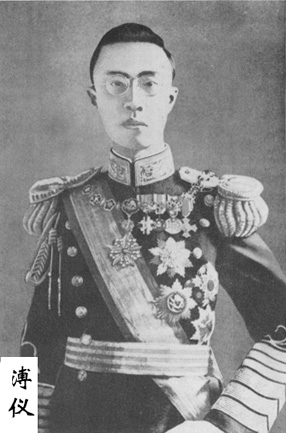
��������� The last Emperor of China is not a well known figure, and it is an unfortunate truth that most of the notoriety he does hold is on account of the famous Academy Award-winning film about his life. Though he lived not a very long time ago, the last Chinese Emperor remains a very enigmatic figure. The accounts of his life written by others invariably come from biased sources, people who have some agenda to push and in his case it involves the necessity of vilifying the Emperor. Yet, even reading his own accounts, it is hard to come to a very clear understanding of the man. In his youth in the Forbidden City of Peking, surrounded by traditionalist mandarins and submissive eunuchs he was a staunch Chinese imperialist. When he was head of state of Manchuria under Japanese protection he was a staunch ally of Japan and finally when he was taken by the Communists he voiced his disgust at his past life and praised the People?s Republic. Which opinion was the sincere one? Where any of them sincerely felt? What sort of man was he or was his life spent so dominated by others that any individualism in him was stamped out? Regarding the last Chinese Emperor anyone will find that there are many more questions than answers. |
|
|
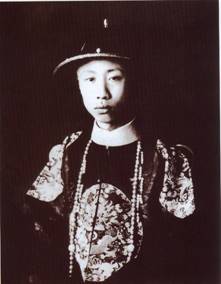
��������� The last Emperor was born Aisin-Gioro Pu-Yi on February 7, 1906 to Prince Chun II; the half brother of Emperor GuangXu, and Princess Youlan; daughter of General Ronglu. He had very little time for a normal childhood however as he was summoned to the Forbidden City by the Empress Dowager Cixi when he was not yet three years old. Empress Dowager Cixi was ruling in the place of the nominal monarch, Emperor GuangXu, whom she had suppressed in a military coup after he tried to modernize the country. Now on her deathbed, Cixi wanted to make sure that the Emperor could not retake power after her death and ensure that the system she had in place would continue. An infant monarch would allow those she trusted to hold real power and bring up the child in line with their way of thinking and so she chose PuYi to be the adopted heir of his uncle and succeed as the next emperor. She possibly had GuangXu poisoned as he died on November 14, 1908 with Cixi herself dying the following day. The following month PuYi was officially enthroned as Great Emperor of the Great Qing Dynasty, Grand Khan of Tartary, Lord of 10,000 Years and the Son of Heaven with the reigning name of Hsuan-tung. Already the victim of circumstances beyond his control this occasion marked the beginning of the end of the ancient Chinese Empire. |
|
|
��������� Because of his age, the little emperor was watched over by his adopted mother, Empress Dowager Longyu and his father who served as regent on his behalf. Opinion varies considerably on Prince Chun, encouraged by the fact that he was quite adept at being acceptable to the powers-that-be at all times. Some view him as a potential reformer, others as a hopeless reactionary. Regardless though, he had relatively little time at the helm of the Chinese Empire before the outbreak of the republican revolution in 1911. The revolt happened almost by accident and was led by the American educated Sun Yat-sen who received the aid of the notorious General Yuan Shihkai. This general had already betrayed the previous emperor, betrayed PuYi and would ultimately betray Sun Yat-sen when after being given the presidency in return for convincing the Qing Dynasty to abdicate he declared himself emperor and tried to found a new dynasty. The Qing were quickly overwhelmed, intimidated and through the persuasion of Yuan Shihkai convinced that they had to come to terms with the revolution in order to survive. |
|
|
��������� Prince Chun gave up being regent on December 6, 1911 and passed the position to Empress Dowager Longyu who was left to deal with the disaster. It was she, on behalf of the Hsuan-tung Emperor, signed the "Act of Abdication of the Emperor of the Great Qing" on February 12, 1912. The agreement which brought about this abdication, an unprecedented event in world history, was extremely interesting. For one thing, it stated that the Emperor was bowing to the Mandate of Heaven as expressed through the will of the people; which had certainly never been done before in the history the succession of Chinese dynasties. Likewise, in return for the peaceful surrender of the monarchy, the newly born Republic of China agrees to the Articles of Favorable Treatment which guaranteed the title of the Manchu Emperor, the protection of the imperial tombs and monuments, imperial ownership of the imperial palaces within the Forbidden City and the Summer Palace, the treatment of the emperor with the respect of a foreign head of state and the payment of four million dollars a year to the imperial court. It was a remarkable agreement in the history of fallen monarchies especially in that, even though China had embraced republicanism, a certain mystique still surrounded the child emperor and even the republic would not deny that the emperor was an emperor and thus worthy of a certain respect. Unfortunately, the republic did not ultimately live up to this agreement, especially in terms of the payments which were stopped fairly quickly, but neither did the imperial court which never accepted the republic as permanent and continued to hope for a restoration. |
|
|
|
 |
|
|
|
 |
|
|
|
|
|
��������� During this period PuYi led a rather uneventful life. There were occasional ceremonies for him to participate in, dignitaries to be received and of course his education at the hands of the mandarins, particularly his tutor Chen PaoShen who was to be one of his closest advisors throughout much of his life. It is interesting to note how many of the republican officials treated the Emperor. China, especially during this period, was a place where everyone tried to keep all bases covered as to whom might one day be in a position to benefit them. When republican officials would come to the Forbidden City on some errand they would often enter in western clothes, deliver their speech on behalf of the republic in a dignified manner and then leave again, don traditional robes, come back in and bow down to address the Emperor as a private individual. There was a constant dance between the imperial court, the republican government and the military warlords who held most of the actual cards, each one paying lip service to the other for momentary support and looking for a chance to gain political power with the little emperor caught in the middle. |
|
|
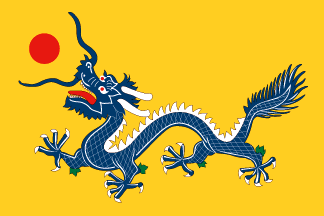
��������� This situation seemed to reach a pivotal moment for the Qing in 1917 when a monarchist warlord, General Chang Hsun, marched on Peking. His troops were known as the Pigtail Army because they retained the Manchu queue hairstyle as a symbol of their continued loyalty to the Qing. The General offered to restore the young monarch and with the assurance that the republican government was supportive, and that the President would step down, the court agreed and announced the official return of Emperor Hsuan-tung to nominal power on July 1. For a brief time dragon flags appeared on the streets and imperial-era robes were being worn again. There was even a rush on costume shops to obtain horse hair queues to give the appearance of having been ever loyal. Yet, not everyone was convinced, and vendors were selling imperial pronouncements with the advertisements that they would soon be antiques. True enough, the President of the republic did not go along with the restoration and soon Peking was besieged by republican forces under General Duan Qirui. There was even a brief air raid when a republican plane dropped a bomb in the Forbidden City which did little damage but caused considerable fright simply because of the novelty of it. By July 12, 1917 the Pigtail Army had been dispersed and Chang Hsun was forced to flee to the Dutch legation. Another abdication announcement was hastily issued on behalf of the young Emperor and once again China reverted to republicanism and warlord rule. |
|
|
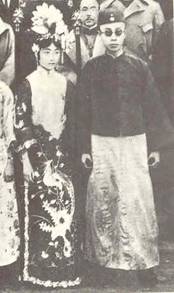
��������� Inside the Forbidden City life went on under the usual routine for PuYi. In the hope of gaining foreign aid and to give the Emperor a more western education a British official named Reginald F. Johnston was employed as tutor to the Emperor. He befriended his pupil and would remain a defender of the last Emperor for the rest of his life, even after certain political problems arose during the 1930's between Britain and some other friends of the last Emperor. It was with Johnston that PuYi chose a name for himself from a list of British monarchs, picking Henry in reference to Henry VIII and so became known by many in the English-speaking world as Emperor Henry of China. In 1922 it was decided that, as he was 16 years old, it was high time for the Emperor to marry. He was given a number of candidates to choose from, but his first choice, the Princess Wen Xiu, was deemed too ugly by the courtiers and so Princess Wan Jung was chosen for the job of wife and Empress with Wen Xiu coming along as concubine. |
|
|
|
 |
|
|
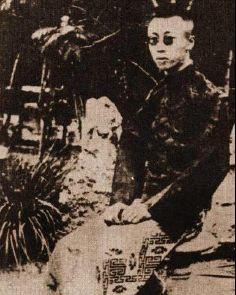
��������� Married life made the Emperor feel more like his own man and shortly thereafter he decided that if he could not rule China he would at least rule the Forbidden City in line with his own ideas. He had, especially through the influence of Johnston, become something of a radical liberal by the standards of the staunch Chinese traditionalists. He wanted reform and modernization and shocked the court when he cut off his queue and appointed a new chamberlain, Cheng Hsiao-hsu, and attempted a crackdown on the black market sale of antiques from the palace. When he met resistance on this front from those entrenched at court, particularly the eunuchs who had been his only constant companions since childhood, he expelled the eunuchs from the Forbidden City. This was quite an undertaking considering the ancient and powerful position of the eunuchs and the fact that there were still roughly 1,200 of them living in the Forbidden City. What would have come of this new effort to create his own society inside the palace walls we will never know. In 1924 another warlord seized Peking. This time it was a Communist, who ironically also claimed to be a Christian, named General Feng Yuxiang, who ordered PuYi and the entire court to evacuate the Forbidden City immediately. |
|
|
��������� PuYi considered several destinations to relocate to but eventually settled in the foreign section of Tientsin, specifically in the Japanese legation. Here he had more freedom than he had ever enjoyed in the traditional confines of the Forbidden City and preferred the modern conveniences and cosmopolitan atmosphere he had never known before. He was generally treated with great respect by the representatives of foreign nations, still given the respect due an emperor and was able to dress in western clothes and adopt western practices. This is something most Chinese people were doing anyway but it upset some of his more traditional courtiers who thought it beneath the dignity of the Lord of 10,000 Years to look and act like a European playboy. He also never gave up hope of restoring the Qing Empire and was in constant contact with Chinese loyalists, his Manchurian relatives and the always fickle warlords who demanded a lot of money but delivered only promises. He was also conspicuously well treated by the Japanese who convinced him that they had his best interests at heart, and as fellow believers in the superiority of monarchy and the imperial system, were entirely supportive of his restoration. |
|
|
��������� There were problems and worries for the Emperor too in Tientsin. The rest of China was engulfed in the civil war between the republican government and communist revolutionaries. In 1931 Princess Wen Xiu, tired of being the second class wife, sought and obtained a divorce from the Emperor, something unprecedented in Chinese imperial history but rather keeping with the more modern lifestyle he had adopted in Tientsin. Most significantly however was when republican troops raided and sacked the tombs of the Qing emperors. For any Chinese raised with the traditional Confucian moral code of filial piety this was a terrible outrage. PuYi was especially incensed to learn that the grave of the Empress Dowager had been desecrated and pearls from her headdress given to the wife of Generalissimo Chiang Kai-shek to decorate the toes of her shoes. PuYi vowed to those around him to avenge this wrong and to restore the Qing and the dignity of his ancestors, declaring that if he did not do so then he was no Aisin-Gioro. |
|
|
��������� What seemed like his chance to do so came in 1932 when the Japanese, who had occupied Manchuria with little resistance from official Chinese republican forces, approached the Emperor about returning to power in his ancestral homeland. It took a little negotiation to get PuYi to go along with the idea, especially when it was made clear that this would be a new state and not a restoration of the Qing Empire. Further, PuYi was rather insulted when the Japanese insisted that he be installed first as Chief Executive rather than as a monarch. His longtime advisor Chen Pao-shen was totally opposed to the idea and favored what seemed the safer course of trying to restore the Articles of Favorable Treatment. Others, however, like Cheng Hsiao-hsu and Lo Chen-yu impressed upon him that this was an opportunity that might never come again and the Japanese promised that he would resume his imperial status at an appropriate time in the future. PuYi finally agreed to the enterprise on a trial basis and if he did not become emperor after a certain amount of time he would resign and resume his life as an exile. |
|
|
|
��������� PuYi was taken to Manchuria and on March 1, 1932 was formally installed as the Chief Executive of the State of Manchukuo. As the Japanese were continuing their expansion in China this attracted the attention of the League of Nations which sent a delegation to Manchuria to determine whether or not Manchukuo was a legitimate nation which reflected the will of the Manchu people or simply a puppet state of Japan. As was often the case, the commission seemed mostly concerned with the opportunities this offered for other foreign nations rather than focusing on the stated intent of their mission. Nonetheless, the commission, led by the British Earl of Lytton, eventually reported that Manchuria was and would remain Chinese though some degree of autonomy was suggested. This prompted Japan to resign from the League of Nations, deeply offended they claimed, and no further action was taken on the part of the international community. Once the Japanese were better entrenched and the Manchu government better established they did finally agree to restore the imperial dignity to the head of state. |
|
|
|
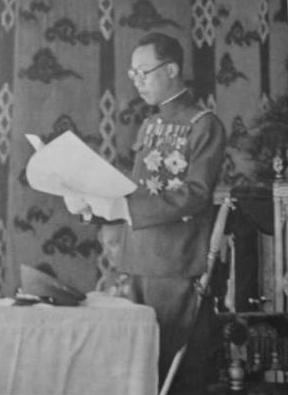
��������� In 1934 PuYi was formally enthroned as Emperor of Manchukuo, taking the reign name of Kang Teh or Tranquility and Virtue of the Great Manchu Empire. This new status did not, though, ease his relationship with the Japanese which was difficult even at the very start of his new reign. PuYi could not bear the idea of being enthroned in anything but the traditional robes of a Chinese emperor. The Japanese, on the other hand, insisted that he wear Manchukuo military uniform. In the end it was agreed that PuYi would be enthroned in uniform but wear traditional regalia when he announced his accession to Heaven at a recently constructed earthen altar. PuYi was, nonetheless, filled with hope for the future, especially after a formal visit to Japan where he was warmly received by Emperor Hirohito. He announced that Japan and Manchukuo were partners and friends and that he intended to produce an heir to secure the succession. |
|
|
|
 |
|
|
 |
|
|
|
|
|
|
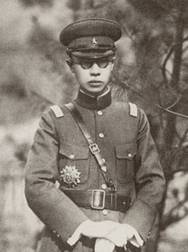
��������� The Japanese, however, were not too enthusiastic about his talk of Japan and Manchukuo being partners, insisting on being treated as the actual power in the country which they were. Most western nations dismissed Manchukuo as no more than a Japanese puppet state, particularly after the start of World War II in the Pacific. Some countries did open diplomatic relations with Manchukuo such as of course Japan, the Kingdom of Italy and Nazi Germany as well as General Franco in Spain, Marshal Petain of the Vichy regime in France, Pope Pius XI, the pro-Japanese Republic of China under Wang Qinghui, El Salvador, the Dominican Republic and surprisingly the Soviet Union as well as a few others. Emperor Henry was never successful in producing an heir however and he was obliged to designate his brother, Prince Pu Chieh, as his successor who was married to the Japanese Princess Hiro Saga but even they bore only daughters. In 1939 the Emperor took another wife which also caused some friction with the Japanese who wanted him to take a Japanese wife. Instead, another compromise was worked out by which PuYi married a Han Chinese girl named Tan Yuling. She was educated by the Japanese-controlled school system, which made her acceptable to them, and was only a teenager so the Emperor hoped she would be politically innocent. |
|
|
|
��������� Any hope the Emperor had that this would be his opportunity to prove himself as a worthy monarch proved futile. Over time it became more and more clear that the Japanese had the first and last word on virtually every aspect of life in the new Manchukuo. Japanese became the official language taught in Manchukuo schools, Japanese advisors exercised control for the nominal Manchu ministers at every level of government and those who opposed the Japanese in any way were quickly dispensed with, no matter how powerful they might have been among the local population. The Emperor was obliged to proclaim Shinto as the official state religion of Manchukuo and government appointments were controlled by the Japanese who also had no problem in making officials they disapproved of vanish. Even the consort Tan Yuling was not immune as few considered it mere coincidence that she died at the hands of Japanese doctors in 1944 when she was known to oppose the level of Japanese influence in Manchuria. The Emperor himself became very worried about his safety and constantly consulted Buddhist oracles and delved into divination to try to protect himself. Empress Wan Jung dealt with the situation by becoming addicted to opium, a fact which particularly distressed the Emperor as his mother had died of an opium overdose when he was young. |
|
|
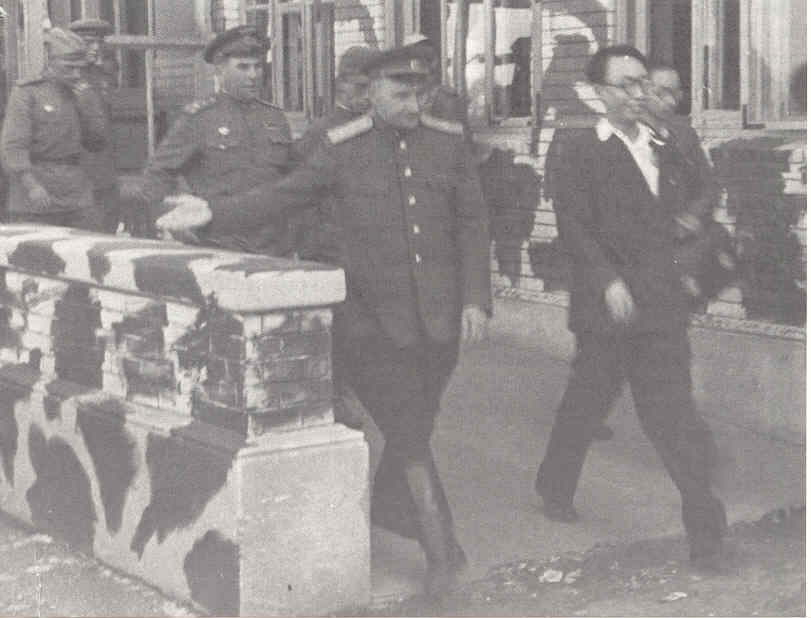
��������� In actuality, the life of the Emperor had in a way regressed to what it had been like for him as a boy in the Forbidden City, only with a change in handlers. He signed what documents the Japanese put before him, he followed their advice on who he was to meet and what he was to say and was not allowed to leave the palace unless the trip had been cleared by the Japanese and he was accompanied by an official escort. Japanese scrutiny and his own paranoia only increased as the defeat of Japan loomed closer. This is unfortunate because the Emperor was legitimately popular among the native Manchu people, if for no other reason than that he was one of their own. Even the majority who grumbled about Japanese rule still felt sympathy for their Emperor in whom they say a brief vision of their former glory and status. When the end finally came PuYi hoped to fly to Japan where he could surrender to the Americans, but unfortunately for him, he was overtaken by the Russian invasion, captured and placed under house arrest in the Soviet Union for five years. Having long held the Communists to be the worst of all revolutionary, republican groups, he was certain that his fate was doomed. |
|
|
|
 |
|
|
|
��������� His fear turned out to be misplaced. The Russians, for their own part, cared very little about him. The Soviet Union had, after all, originally recognized Manchukuo as a legitimate country and had only declared war on Japan at the last minute, after the atomic bomb had been dropped and Japan was all but defeated, in order to grab territory and extend their influence in the Far East. The actual state of mind of the former Chinese Emperor, at this period, is hard to estimate. He made gushing overtures to Joseph Stalin about how his mind had been liberated by reading Karl Marx, yet at the same time he named a cousin to be his successor in the imperial line. Was he genuinely being changed or was he simply throwing himself at the mercy of the powers that be as he had done before with the republic and the Japanese? He had, after all, testified at the war crimes trials in Tokyo in 1946 and claimed that he had been kidnapped by the Japanese, used against his will as their instrument and pleaded his total opposition to these people to whom he had once expressed his deepest thanks, loyalty and admiration to. Which stance represents his true beliefs? Only PuYi himself could say for sure and his story changed constantly. |
|
|
��������� Whatever his feelings about Marxist doctrine he certainly did not want to go back to China and fall into Red Chinese hands, certain that he would face death at their hands. The Soviets soon grew uncomfortable keeping him and realized they could not use him to their benefit. So, as a gesture of friendship to the government of Chairman Mao Tse-tung who had recently seized power; even standing triumphantly over the gates of the Forbidden City announcing that the world had stood up, and turned over the despised former monarch to them in 1950. PuYi and his entourage were returned to Manchuria and incarcerated in the Fushun prison for war criminals. He underwent a constant battery of communist indoctrination and reeducation through labor. Famously, he had to learn to dress himself, tie his own shoes, make his own bed, wash his own clothes; all of which he had no idea how to do since he had never had to do anything for himself. He was a tragic figure, especially at that time, being a man who had never known real personal freedom except perhaps for his few years in Tientsin, and yet even the comfort of his previous prisons denied him of any independence and self worth because of his pampering. |
|
|
 |
|
|
|
 |
|
|
|
|
��������� In time, PuYi overcame his fear of being killed. The Communists had decided that he would be more useful to them alive than as a traditionalist martyr. Across China, as in most every Communist country, there was an effort to create a "new man" who would see no class distinctions, who would idolize the party, revere the Chairman and march lock-step with the dictates handed down by the absolutist government, even in terms of dictating thoughts and opinions. They saw in PuYi the chance for a great propaganda coup, that they could "reform", as they called it, the Emperor himself, the man once called the Son of Heaven and the Lord of 10,000 Years, as an ordinary working communist. Unfortunately, they were successful in this, though it took ten years to do it. It is hard to say how much individualism he ever had and the Communists have always been masters at denying the value of any individual and by the time of his release PuYi was praising his Communist captors, scorning his imperial background, voicing shame for his great crimes and thanking the Communist government for their charity, benevolence and wisdom. |
|
|
��������� Chairman Mao officially pardoned PuYi who returned to Beijing and became a simple worker at the Botanical Gardens. Having abandoned his wives in Manchukuo, Empress Wan Jung died in Communist prison in 1946 and his surviving concubine divorced him, the government played matchmaker to see him married to a nurse, also a member of the Communist Party of course, who he stayed with for the rest of his life. PuYi served on the Chinese People?s Political Consultative Conference from 1964 and wrote his memoir, "From Emperor to Citizen" in which he recounts the story of his life, remarking on how very wicked he and his compatriots were in his time as Emperor and lavishing praise on the Communists for saving his life and helping him to see the truth and be apart of their remaking of China into a much better country than it had ever been before ?as he had been duly taught. The life of the last Emperor of China finally came to an end in 1967 when he died in a hospital in Beijing from cancer. At this time, China was at the height of the horrific Cultural Revolution and rumors began that he had been assassinated by Red Guards. The truth, as with much of his life, may never be known. The Cultural Revolution was a reaction against all things traditional, and as the former Emperor PuYi inherently represented the old China, yet as a reborn Communist he also represented the new China and it would seem a little late to kill him. Interestingly, that night the sky turned brown and eerie from a Mongol sand storm that was quite unheard of at that time of year. The strange light and sounds caused many elder Chinese especially to guess that the "last dragon" had flown into the clouds. |
|
|
��������� Initially, after his death, PuYi was cremated and buried in a Communist Party cemetery alongside government elites and older graves of imperial concubines and eunuchs. Later, in 1995, his widow moved his body to a private cemetery near the old Qing dynasty tombs, paid for by a Hong Kong businessman who admitted that he hoped the presence of the last Emperor would help boost his sales for plots. He also stated that he planned to build a larger memorial for the Emperor and his later wives as a sort of tourist attraction. The Aisin-Gioro, never very taken by PuYi's last wife, were reportedly extremely upset about this action. Even in death, it seems, PuYi is still being used as an instrument for the cause of others. |
|
|
|
 |
|