 |
|
|
|
|
|
|
|
|
|
|
|
 |
|
Japanese Support for Monarchy: The Greater East Asia Co-Prosperity Sphere |
|
 |
|
|
 |
|
|
|
|
 |
|
|
|
|
|
|
|
����������� Especially following the Meiji Restoration, the leaders of the Japanese Empire seemed to agree that if the imperial monarchy were to be a viable source of unity and focus of patriotism they would have to make it an ideal government philosophy to be upheld in any and all cases possible. Today, this is viewed with a great deal of criticism and hatred, understandable given the events of World War II, but really no different in principle to the devotion shown in the west to democracy and democracies around the world or the international groups which campaign for socialism or communism. In fact, what makes the monarchism of Imperial Japan stand out is that so few other monarchies ever took a similar position; especially in the 20th Century. |
|
|
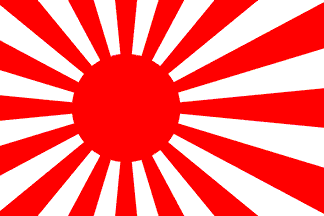
����������� When Japanese troops went to war, of course they did so first and foremost for Japan and for Japanese interests. However, where possible, they also showed clear preference for monarchies over republics. To mangle the words of an American President, Imperial Japan wanted to make the world safe for monarchy. One amendment to this principle though was that the preference extended only to Asian monarchies as Imperial Japan was certainly no friend of the British or Dutch monarchies. Japan wanted to promote a pan-Asian nationalism, led by Japan of course, with the Japanese Emperor as the ceremonial pater familias of the Far East. Even going back to the conquest of Korea, Japan did not destroy the native royal family, but rather made them a part of the Japanese aristocracy. Likewise, throughout her conquests in East Asia; which the Japanese portrayed as liberation from European colonialism, the Japanese preferred to work with monarchic movements and royalist figures wherever possible. |
|
|
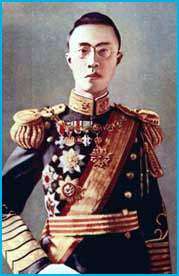
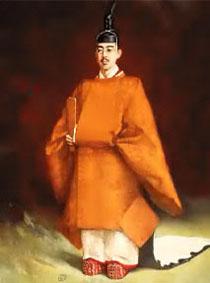
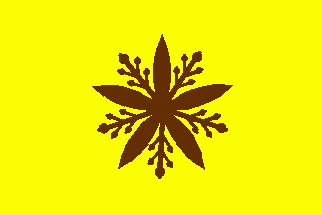
����������� Nearest to Japan and Korea was, of course, Manchuria which remains probably the most famous Japanese allied power. Having earlier befriended the last Emperor of China, Henry Puyi (as he is known in the west) they supported his installation and eventual coronation as Emperor Kang Te of the Great Manchu Empire or Manchukuo. As the last Chinese dynasty had been the hereditary rulers of Manchuria before their victory over the Ming dynasty there was a case of legitimacy to be considered and the Manchu Emperor seemed the natural choice to be monarch of the new Manchuria. The twin pillars of the new state were effectively monarchism and friendship with Japan. Most homes kept a portrait of the Manchu Emperor and children had to bow before his picture at the start of each school day as well as being expected to memorize and recite his imperial edicts. Government propaganda put out images of Emperor Hirohito of Japan and Emperor Kang Te of Manchukuo as friendly partners in the new Greater East Asia Co-Prosperity Sphere Japan wished to create. |
|
|
����������� The Manchurians had also been closer to the Mongolians than the Han Chinese and although Japan never concentrated a great deal of resources on Mongolia (long fought over by China and Russia) they nonetheless would have liked nothing better than to see a separate Mongolia friendly to Japan. Mongolia had previously been a Buddhist, monarchical theocracy such as existed in Tibet under a leader titled as Kahn or Emperor and a Living Buddha. However, in 1924 republicans aided by Soviet Russia overthrew the first and last of these Living Buddhas, Jebtsundamba Khutuktu who had been Emperor or Bogd Khan of Mongolia. The Khan had earlier cooperated with the infamous Tsarist Russian and zealous monarchist General Baron Roman Ungern who restored him after he was briefly deposed by the Chinese. |
|
|
����������� Restoring the theocracy was never really an option for the Japanese as the Communists had declared the reincarnations to be ended following the death of the last Khan. However, Japan did manage to carve out a friendly state under the leadership of the Mongol Prince Te Demchugdongrub known as Mengjiang. He was close to the Manchu Emperor and is unique among many who collaborated with the Japanese in that he is still considered a patriot by many Mongolians today. With Japanese support he advocated a return to the spirit of Genghis Kahn and the restoration of the once mighty Mongol Empire. This was also in the interest of Japan as such a state would naturally consist of lands taken at the expense of China and Russia, both traditional enemies of the Japanese. After so many years of domination by these two powers and so many previous liberations being nothing more than efforts to enforce Chinese or Russian revolutions on Mongolia it is no wonder Prince Te had his supporters. |
|
|
����������� One region in which monarchism played little or no part in Japanese foreign policy was in China itself. This was to be expected given their support of the former Emperor in Manchuria and indeed the Manchu Emperor himself was always rather upset that his restoration was in Manchuria only rather than a revival of the Chinese Empire which he had been born to. The primary collaborator with the Japanese in China was Wang Jingwei, himself certainly no monarchist. He had been jailed under the empire for plotting to assassinate an imperial prince and worked closely with Sun Yat Sen who succeeded in toppling the ancient Middle Kingdom. Practically since the death of Sun he had grappled for power with Chiang Kai Shek who, obviously, prevailed in gaining the support of the winning side in World War II for his own nationalist government. The Philippines are another example since there had never been a united monarchist presence on the islands in their modern history. The last monarch to reign over the Philippines had been the King of Spain until they were taken by the United States. |
|
|
����������� In Malaysia the Japanese were able to establish cordial relations with a number of local royal rulers including the Anglophile Sultan of Johore and the Sultan of Selangor. Part of Malaysia was also ceded by the Japanese to the Kingdom of Thailand, who were their primary allies on the Indochinese peninsula and who shared their pro-monarchy sentiments, including royal veneration. Thailand, at this time, was under the nominal reign of King Rama VIII and led by Field Marshal Plaek Pibulsonggram; a Thai nationalist. Although not fondly remembered today the period of World War II was one that would make most Thai people, of the ultra nationalist variety anyway, quite proud. Taking advantage of the confusion following the defeat of France by Nazi Germany and the establishment of the Vichy regime, Thailand invaded French Indochina with the aim of retaking territories previously lost to the French. Japan stepped in to help resolve the conflict and Thailand allowed Japanese forces freedom of movement through their country and eventually signed a treaty with Japan. In return, Thailand was rewarded with the return of territories previously taken by Malaysia, France and Burma. Thailand even declared war on the United States and Great Britain and there was talk of uniting all ethnically Thai areas into a larger Thai empire. The collaboration of the government with Japan might have hurt the Thai monarchy (as it certainly did in other countries) but this did not happen in Thailand as the young King Rama VIII was fortunate enough to have been at school in Switzerland during these years and did not return until World War II and the nationalist government were over. |
|
|
����������� Across the border in French Indochina Japan had been involved discreetly for some time, at least in what had been Vietnam. The Japanese had long groomed the exiled Marquis Cuong De as a potential Japanese friendly ruler for Vietnam. While the Nguyen dynasty had become fairly unpopular for cooperating with the French, the Marquis had not and had contacts among armed groups in southern Vietnam especially that opposed France and looked to Japan for their example and in the hope of liberation from French control. However, it never became necessary to put Cuong De on the throne. The French, who actually ruled Vietnam, Laos and Cambodia, were under the control of the Vichy regime and allowed the Japanese freedom of movement through the country for their attacks on British and Dutch forces further south. As a result, Vietnam was occupied by Japan but the French colonial administration was kept in place as before, under the nominal reign of Emperor Bao Dai. It was not until 1945 that the Japanese removed the French and Bao Dai declared the independence of the Empire of Vietnam. The government was led by Tran Trong Kim, who was a friend of Japan, and Vietnam joined the Co Prosperity Sphere. However, this situation did not last more than a few months before the outbreak of the Communist August Revolution led by Ho Chi Minh. After seizing control of the capitol the Emperor quickly abdicated in favor of Ho Chi Minh though Japanese troops remained in the imperial citadel ready to defend him. |
|
|
����������� Other regions of French Indochina acted along similar lines. In Laos it was Prince Phetsarath Rattanavongsa who held the post of prime minister and vice-king from 1942 until 1945 under the reign of King Sisavang Vong. The Japanese occupation did not interfere much with the French or with King Sisavang Vong who was so supportive of the French and the Kingdom of Laos that he was briefly deposed by nationalist forces after the end of World War II for refusing to back their declaration of independence. To the south, in Cambodia, the situation was much the same. King Norodom Sihanouk was enthroned in 1941 and accepted the Japanese. Like Vietnam, in 1945 he was given the opportunity and declared independence from France with Son Ngoc Thanh as Prime Minister. His government, however, did not survive the allied victory and the return of the French though King Norodom Sihanouk, perhaps the most gifted political survivor of his time, managed to become the only monarch in the former French Indochina to regain and keep his throne. |
|
|
|
����������� Moving to the west, the Japanese were quick to move into Burma to threaten the crown jewel of the British Empire which was India; ripe, the Japanese hoped, for throwing off British rule. Monarchism, however, was off the table in Burma, which the British had lumped together with their Empire of India. The last King of Burma, Thibaw, had been overthrown by the British and exiled to India where he died during World War I with no surviving sons to succeed him or carry on the banner of Burmese royalism. This did not mean though that Japan supported or would support republicanism. In fact they seemed to loathe the very word. In the years before the Manchu Emperor had been enthroned in Manchukuo the country had been called the State of Manchukuo rather than a republic. Similarly, in Burma, it was the State of Burma rather than the Burmese republic which was declared independent in 1943 following the Japanese seizure of the country from the British. In the absence of a royal figure, the former premier and long time independence advocate Ba Maw was released from prison and made head of state. |
|
|
����������� Actions such as these might have won the Japanese a great many friends were it not for their harsher deeds. Japan, before the war, had in fact been widely admired among many of the nationalists of East Asia. Japan had maintained her independence in the face of European colonialism, modernized while still preserving the core of her culture and after the Russo-Japanese War and World War I had proven that the Europeans were not invincible and that an Asian country could prevail and become a major power in the world. However, Japanese selfishness killed any hope of a new future to match their slogan of Asia for the Asians. There were the biological warfare experiments carried out by the Japanese in Manchuria, the starvation that resulted in a famine in Vietnam as the Japanese stripped the area of food for their own armies. In Burma Ba Maw bore the brunt of the criticism for the Burmese forced laborers who worked to help the Japanese build roads, bridges, defenses and other arduous tasks. |
|
|
|
����������� Little room was found for royals on the edges of the new Japanese Empire, due in part to their being too numerous rather than too few as in the cases of India and Indonesia. Sukarno, the leader of Indonesia after the war, enthusiastically supported the Japanese in taking control of the archipelago from the Dutch. A declaration of independence did not come until the end of the war, as in other places, and leaves one wondering how committed Japan truly was to real independence. In India, of course, independence never came as Japan never had the strength to conquer the subcontinent. Subhas Chandra Bose led an Indian government in exile in collaboration with Japan to fight the British but which had little impact on India itself. Further west, in Afghanistan, Japan had some contact with Sardar Mohammad Hashim Khan who was the uncle of the Afghan King Mohammad Zahir Shah. Other than an exchange of moral support for investments from Germany, Italy and Japan nothing of military significance was done so far out in remote central Asia. |
|
|
����������� Looking at the big picture of Japanese actions, of the nations controlled or occupied by Japan before and during World War II there was a clear preference for monarchial governments. Although not possible in all cases, as shown the Japanese preferred to work with royal figures in China (Manchuria), Mongolia, Vietnam, Laos, Cambodia, Malaysia, and Thailand. Moreover, they wanted to instill a political culture of respect and reverence for the legitimate royal leaders of the people in question. In Indochina there was a concerted effort on the part of the native governments to foster traditional attitudes toward the monarchy. In fact, as the Vichy government ruled throughout most of the Japanese occupation, there was even an effort by Vietnamese conservatives to idolize Marshal Petain and draw parallels between the writings of Confucius and the French royalist Charles Maurras. However, Japanese efforts to portray themselves as Asian nationalists and liberators were not often compatible with their own interest in dominating Asia. This was especially obvious in the closest Japanese ally, Manchuria, where Japanese was taught in Manchu schools and Japanese blood was attempted to be forced into the imperial dynasty through the marriages of the Emperor and his brother. Through it all of course there was also the fact that local officials, be they monarchist or republican, were ultimately under Japanese military control. |
|
|
����������� Despite this heavy handed approach, it is remarkable and often unnoticed just how many foreign nationals collaborated with and even fought alongside the Japanese. Setting aside other issues, there is no doubt that had Japan been successful in maintaining her empire and Co Prosperity Sphere; the world would have had an Asia dominated by monarchies rather than republics. Considering the other issues one cannot but accept the guilt of Japan, however, of these client states; without Japanese interference how were they so bad? Compare the possibilities of these states, free of Japanese control, to what happened to them after the war. In the case of Indonesia Sukarno became the free leader anyway. In Thailand, there was no great deal of outside interference and in China there likely would have been no happy ending either as a divided nationalist camp would probably have fallen even faster to Communist forces. However, can anyone say that Burma has had a happy ending? The days of British rule seem like a picnic compared to what the Burmese have been forced to live with since. Even more stark a contrast is seen in the monarchies. How has Korea, particularly in the Communist north, benefited from the loss of the Yi Dynasty? An independent Manchuria under the last Emperor could have provided an invaluable bulwark against Communist aggression in China, Mongolia and Korea. Have conditions in Laos or Vietnam improved since the end of their monarchies? Certainly no one could say that of Cambodia where the end of the kingdom meant the eventual victory of the Khmer Rouge and the annihilation of a quarter of the entire population. Just as the United States saw the wisdom in maintaining the Japanese monarchy, perhaps we should take a closer look at doing the same for those associated with the Japanese and consider that the traditional monarchies could have built a much better Asia than exists today. |
|