 |
 |
 |
 |
 |
| "The Last Emperor" |
| This movie is absolutely terrific, IF one takes into account that it was made by an Italian Communist. Therefore, it is rather inevitable that the fall of Aisin-Gioro Pu-Yi from Emperor of China and Lord of 10,000 Years to a working 'comrade' in the Chinese Communist Party is seen as an improvement. However, it is very accurate in many ways and was made with the collaboration of the Emperor's brother, HIH Prince Aisin-Gioro Pu-Chieh and others directly involved with the events depicted. "The Last Emperor" consists largely of a series of flashbacks. It opens with 'Mr. Pu-Yi' getting off a train in China and being taken to a prison for war |
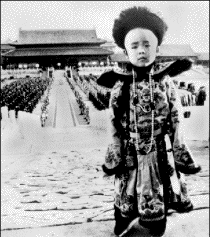
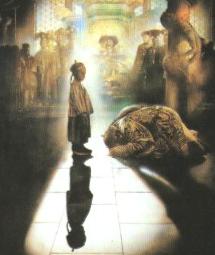
| criminals. In a flashback he recalls being taken to the Forbidden City as a 3-year-old infant where he is crowned as "The Son of Heaven". |
| It soon becomes clear that he is simply a prisoner in a golden cage. We are not shown when exactly the monarchy was replaced by the republic, which is rather fitting considering Pu-Yi himself was unaware that anything had changed. Pu-Yi is portrayed first as a spoiled child, later as a reformer frustrated in his desire for personal freedom from the palace walls, later as an idle playboy, a naive nation-builder, despondent puppet and finally as a quiet worker determined to stay out of the way. |
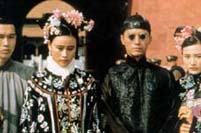
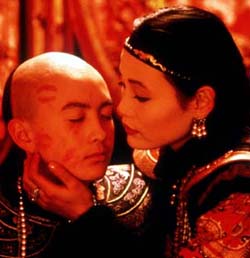
| The movie is unique in that the "hero" of the film is one who reacts rather than acts, who is constantly manipulated, used and played upon. The Emperor is used by a corrupt court, by the Japanese and by the Communists themselves. The main performances are excellently done, with John Lone as the adult Emperor, Joan Chen as his primary wife Empress Wan Jung and Peter O'Toole as the British tutor Reginald F. Johnston. There will be other familiar faces, and the minor role I thought was played best was that of the Empress-Dowager Cixi, whose death scene is certainly not accurate, but seemed in just a couple of minutes to really capture how I would imagine the real "Old Buddha" to be. The costumes are fantastic and the sheer number of extras absolutely blows the mind. Aside from actual events, you do get a good feeling of what life was like in the Forbidden City before the removal of the Emperor. |
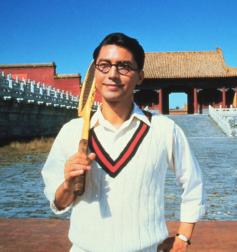
| It may be tempting to view "The Last Emperor" as a collection of scenes rather than a full movie with an introduction, climax and conclusion. The visuals certainly stand out and the sets, above all the massive, majestic Forbidden City itself is fully a character itself. Most of my own very favorite scenes take place inside the "Great Within". These include the death of the Dowager Empress, the colorful enthronement of the new Emperor and the short but moving expulsion from the Forbidden City when the Emperor walks out of his walled palace for the first time since he entered as an infant. This scene, by means of the hateful army officer carrying out the eviction, makes a very good point about how Pu-Yi was an emperor who was judged without having ever been tried. There is simply no logical reason that this perfectly harmless young man playing tennis should stir such anger and resentment among so many outside the palace walls. It was all a result of propaganda heaping the blame for every failure on the old imperial system, and on the Manchu minority, both of which Pu-Yi inherently represented. It also broke the abdiaction treaty of 1911. |
| Later, when Pu-Yi is approached by the Japanese for the purpose of becoming emperor for their recently acquired State of Manchukuo, he points out, quite honestly and correctly, that the Chinese Republic broke every promise they ever made to him. However, this was also a result of the fact that the Republic of China had no stability or security of any kind after the fall of the empire, it being little more than a succession of warlords who battled each other for power. The film makes it clear that Pu-Yi chose of his own free will to go to Manchuria and collaborate with the Japanese whereas he had always maintained that he was kidnapped and taken to Manchukuo by force. However, the movie does show that his motives were far from being treasonous. Rather, he looked upon the Manchukuo enterprise as his opportunity to at last show China and the world what kind of ruler he could |
| be. As he explains to his wife, China had already betrayed him, they had abandoned Manchuria, his ancestral homeland, of which he was the rightful leader, and even if the Japanese were using him, he would try to turn the tables and use the Japanese. Of course, this is not how it all worked out. The Japanese set him and his wife against each other, promised him the moon and made every possible flattery. After he is crowned Emperor Kang Teh of Manchukuo he goes to Tokyo where he is treated as a respected equal by Emperor Hirohito. However, when he returns he finds that his authority has been stripped from him and the Japanese military are totally running the show. Personally, I don't think the movie spent enough time and attention on the years Pu-Yi was Emperor of Manchukuo. However, it does show his remorse over |
| all that happened, and the self-recrimination he felt for not being able to do more to stop it. Although I think it would have been an excellent touch to show him testifying against the Japanese at the war crimes trials, the ending itself was touching and in all good enough. The sight of mobs of tourists tramping through the 'Hall of Supreme Harmony' was, for someone like me, the saddest possible ending of all. |