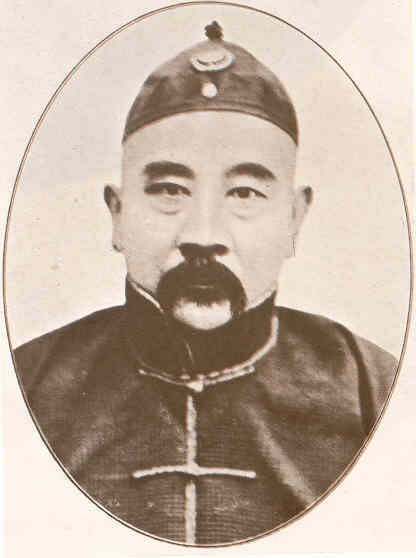
One of the most unique figures of the "Warlord Era" in post-revolutionary China was Chang Hsun (Zhang Xun). He was a veteran military commander in the Imperial Army of the Manchu dynasty's Great Qing Empire. He is best known today for his effort to restore the last Emperor of China, Hsuan-tung, to the Dragon Throne. He had been in contact with the Manchu officials in the Forbidden City for some time and was well known for his loyalty to the old Qing Empire. He demonstrated this by the fact that he and his men continued to wear the traditional Manchu queue, which had been mandatory during the Qing reign, but which almost everyone had by now cut off as a sign of defiance and "modernization". Prior to his coup d'etat Chang Hsun had been the Viceroy of Kiangsi, Kiangsu, Anhwei, High Inspecting Commissioner for the Yangtse River and was Governor of Kiangsu.
On June 16, 1917 Chang Hsun paid a courtesy visit to the young Manchu Emperor at the Mind Nurture Palace in the Forbidden City. It was the first time he had ever held a private audience, and the first time he had ever done so with a Han Chinese. On July 1, he returned, having secured the capital with his army, to request that the Emperor once again ascend the Dragon Throne. He told the young Emperor, "A republic does not suit our country....Only Your Majesty's restoration will save the people". He was assured that the Chinese President, Li Yuan-hung, was willing to resign in favor of the Emperor.
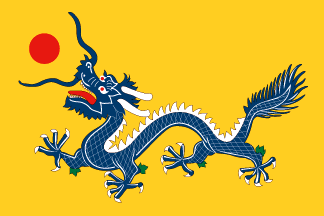
At the urging of his elder courtiers, Hsuan-tung agreed and he was duly restored as "Great Emperor of the Great Qing Dynasty", though a seven-man board of regents was set up to rule in his place, including General Chang and his tutor Chen Pao shen. The highly respected monarchist reformer Kang You-wei was also involved in the effort. Dragon flags appeared on the streets, Qing robes were worn again and there was a rush of people on costume houses to buy imitation horse-hair queues. However, the republican response was swift and stunning. President Li had no intention of allowing the monarchy to be restored. He recalled Duan Qirui (Tuan Chi-jui) from Tientsin to become Premier again and summoned all loyal troops to converge on the capital to drive out what the foreigners called, "the pigtailed army".
The Emperor was soon abandoned by many of his followers and the Forbidden City was attacked by the first bombing raid in Chinese history, though the damage was more on the nerves of the inhabitants than the compound itself. General Chang was able to retreat with the remnants of his troops to the grounds of the Temple of Heaven. From there he began to negotiate with Duan Qirui who was in commmand of the Northern Republican Army. A short time later, Chang's position was stormed and taken and the General fled to the embassy of the Netherlands. The court quickly issued another abdication and insisted that they had acted innocently throughout the whole affair. The only restoration of the Qing Empire was at an end. |