|
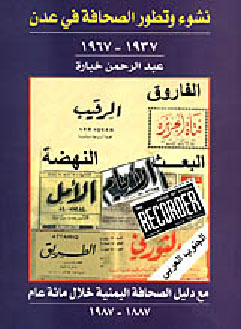
"Nushou'
wa Tatawur Al-Sahfa fi Adan" (the burgeoning and development of journalism
in Aden), 1937-1967, is a new book by Abdulrahman Khobara (175 pages, published
by Al-Amal for Printing and Publishing).
Adel
J. Moqbil,
Yemen Times
Aden, with its special geographical position, social structure and cultural
development, represents a focal point for all kinds of cultural and scientific
endeavor. 'My satisfaction with this important book is not complete due to a
very deep feeling that such a project remains incomplete if it does not cover
all the country's geography and history,' wrote Saeed Awlaqi, the renowned Aden
writer and journalist, in his introduction to the book. He goes further by
suggesting that his 'friend and colleague' can write a second or even a third
book to fully complete his 'very important project.'
Moscow Thesis
Al-Sahafa fi Adan - part of an MA thesis submitted to the Moscow State
University (Lomonsov) - consists of 12 chapters divided over two sections, in
addition the appendices. It also relies on a number of reference books, a series
of articles on this subject published by Al-Thaqafa Al-Jadida (modern culture)
during 1984-85 in Aden, and direct personal interviews with some of the
publishers and editors.
Aden... the Lodestar
Before delving into the book's main topic, Abdulrahman Khobara gives a brief
review of the city's modern history, its political, economic and social
conditions and the population structure during the period covered by the book.
'Due to Aden's unique geographical position, the British sent their navy to
occupy under a rather feeble excuse - the looting by the locals of a British
ship. By the end of the 1940s, there were more than 60 British companies and
trade agencies operating in the city,' wrote the author.
Even before the British military hegemony, Aden was the home of several
communities: Jews, Hindus, Somalis and Parsees, in addition to the indigenous
Arab-Muslim community. With its increasing military and economic importance,
Aden attracted people from different races and backgrounds. 'It was a truly
cosmopolitan city, in which foreigners did not only live, but also enjoyed the
privileges of nationality and other political and civil rights,' indicated
Khobara.
Early Beginnings
The first publication ever to appear in Yemen was Sanaa (1887), consisting of
four pages printed in both Arabic and Turkish. It was no more than a gazette
publishing new Ottoman decrees and communiquŽs.
The first official newspaper to appear during the Imamite period was Al-Imam
(1926). It was printed in Sanaa right up to 1957, with a five-year stoppage due
to the Second World War. The first independent newspaper, Al-Hikma, was
established by Ahmed Abdulwahab Al-Warith in Sanaa, 1938.
Other
publications in northern Yemen, listed by the book, include the weekly Al-Nasr (Taiz,
1955), which was strongly pro-Imam. Al-Tali'a, on the other hand, was originally
a left-wing, anti-colonial Aden publication. Due to increasing restrictions by
the British administration, its publisher Abdullah A. Ba-Dheeb had to move to
Taiz in order to continue his work.
The second part of Appendix C of Al-Sahafa fi Adan is devoted to Hadhrami
journalism, both in Hadhramaut itself and abroad (Indonesia, Singapore, etc).
More than 15 periodical newspapers, magazines, and other publications are
listed, some of which - especially the satirical ones - were published in the
local Hadhrami dialect. The first such publication was the weekly Al-Islah -
published by Mohammed Bin Aqeel Bin Yahya in Singapore, 1916.
The book is concluded with four extensive lists recording all the publications,
along with their year of establishment and chief editors, in the Aden Colony
(45), the Aden Eastern and Western Protectorates (2), the former Yemen Arab
Republic (more than 40), and the former People's Democratic Republic of Yemen
(about 20).
1st
Publications Law
The first section of the book covers the period from 1940 to 1956. In 1939, the
governor of Aden, Bernard Reighly issued a number of laws, rules and regulations
to organize the colony's political, economic and social life.
The Publishing and Registration Law No. 27 was one such legislation.
Accordingly, a 12-month renewable publishing license had to be obtained from
Aden's chief judge. Matters did not end at that, however. 'A written permission
had also to be given by the British governor of Aden, a thing usually left to
his personal discretion.'
Enter Automation
Manual type-setting was first introduced into Aden in the first decade of this
century. 'It was in the mid-1930s that the modern automated printing presses
were imported from India. One of the first private printing presses was owned by
Ibrahim Rasim, which played a prominent role in publishing several of the early
publications in Aden. These include Fatat Al-Jazira, Al-Qalam Al-Adani, Al-Dikrah
and the northern Sawt Al-Yemen.'
The first Linotype printing press was imported in 1957 from Britain by the late
Mohammed Ali Ba-Sharahil, the publisher of Al-Raqeeb and Al-Ayyam (still
published by his twin sons). 'It was the first of its kind in the whole Arabian
Peninsula.'
The rapid growth in the literary movement in the former British colony led to a
similar rise in the number of printing presses. The book lists more than 20
major printing presses and several minor ones.
Mother of All Weeklies
Twelve newspapers and magazines were published during 1940-1956. First
published and edited in January, 1940, by the lawyer Mohammed Ali Loqman, 'Fatat
Al-Jazira was the first weekly newspaper in Yemen.'
Six years later, Sawt Al-Yemen (voice of Yemen) was published in Aden by the Al-Ahrar
Party - headed by Al-Zobairi and Noman. It was closed in 1948 following the
failure of the uprising against the Imam. Another newspaper, printed in the
south but devoted to northern issues, was the satirical Al-Fudhoul (published by
Abdullah A. Noman, 1948-50).
Other publications mentioned by the author include Al-Nahdha (1949), Al-Shabab
(1949), Al-Qalam Al-Adani (1952), the Chronicle (in English, 1952), and Akhbar
Al-Janoub (1953). 'Al-Janoub Al-Arabi and Al-Baath (both appeared in 1954), can
be considered the first wholly partisan newspapers' in the southern part of
Yemen.
The book follows with a technical, artistic and literary appraisal of these
publications, along with samples of the published material.
Women's Issues
Chapter 8 of Al-Sahafa fi Adan deals extensively with coverage of women's issue
in the Yemeni press during the 1940s and '50s. 'Most of the publishers and
editors of that period belonged to enlightened families. They studied abroad and
were influenced by the social developments there.' They advocated many important
reform issues, including women's.
Probably the first article on women appeared in issue 29 of Fatat Al-Jazira on
July 24, 1940. It dealt with the serious social issue of early marriage. Another
example cited by the book is an article on rural women that appeared in the Al-Janoub
Al-Arabi issue 72 of October, 1949. Whole paragraphs were included within the
text to give a flavor of the way journalists, writers, and social reformers saw
things at that time.
Turbulent Times
The second section of the book covers the period from 1956 to 1967 of Aden's
history. 'With the city's rapid economic development as a free-trade zone and an
important transit point, the people's demands - supported by the press - became
more pronounced,' explained Khobara.
With the completion of the Aden refinery, trade unions were formed in the early
1950s (25 such organizations were established during 1954-56). This period also
witnessed a sharp rise in the public's political awareness, with the pan-Arab
nationalist movement - led by President Jamal Abdulnasser of Egypt - reaching
the zenith.
'Towards the end of the 1950s, Aden workers went on 118 strikes, demanding
shorter working hours, higher wages and more favorable social insurance.' By
1962, there were 32 trade unions with a membership of 22,000 operating in Aden.
More political parties, covering almost all of the political spectrum, were also
formed. Civil strife culminated in the outbreak of 14 October 1963 Revolution
against the British.
Informative Appendices
The book also boasts three rather large appendices. The first appendix
generously gives rich examples of essays and journalistic writings from that
period (1937-1967) by such well-known and outstanding writers, journalists and
poets as Mohammed Ali Loqman, Lutfi Jaafar Aman, Ali A. Ba-Dheeb.
Appendix B briefly lists the biographies of 16 of Aden's most famous political
writers and journalists, in addition to listing the names of more than 30
others.
A full directory of Yemeni journalism during 100 years (1887-1987) is provided
in Appendix C of the Al-Sahafa fi Adan. In this part of the book, Khobara deals
with journals and publications issued in all of Yemen since the Ottoman
occupation of the country.
First Step
'Despite my effort and assistance by several of my colleagues, this book is just
a first step towards a larger and more comprehensive research,' wrote the author
in his prologue. He cites lack of specialized libraries, research centers, and
some very important reference books as the main obstacles that hindered his
work.
For Abdulrahman Khobara, choosing Aden did not come out of a vacuum. 'It was the
cradle and shelter of the modern Yemeni political movement - from Saada to Al-Mahara,'
he explains
|
