 |
|
 |
 |
| Looking For Alibrandi: The film |
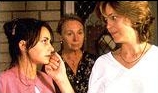
| "Looking For Alibrandi" is esentially a film about identity. In a family, in a school and in a society. Josie Alibrandi (Pia Miranda) is a 17 year old teenager dealing with issues that effect many teenagers - school, family, dating and angst, lots of angst. Whilst dealing with these issues Josie also has to deal with her heritage, and her place in the world. As an Australian from an Italian background Josie is subjected to not only the rules of 'her society' but also those of her family's society Australia is a multicultural society made up of many different races, within the film the cultural differences are presented as more of a class based divide. Josie, the Italian-Australian, is juxta posed with the character of Carly Bishop(Leeanna Walsman), an Anglo upper-class Australian. It is Josie's class insecurity that stops her from admitting her true feelings for the upper-class John Barton. However Josie and John's strange relationship personifies the insecurities posessed by all teenagers. Although they share a great affection for one another their relationship does not develop beyond their friendship. "He has a really strange relationship with Josie where they both have an affection for eachother but nothing ever develops beccause of stuff that blocks him and the insecurity that blocks her." - Matthew Newton on his character John Barton John's suicide comes as a shock to both the characters of the film and the audience (who have not read the book). In many ways the topic of suicide is not generally discussed in teen films, and when it is always obvious. Because John is such a "well balanced" and likeable character his death is realistic in the fact that many teen suicides come as a shock to those who were closest to the victims. I believe that the film deals with John's death in such a way that the audience is moved to feel emotion, maybe not for the character of John himself but certainly for the character of Josie. John's suicide can be seen as the rejection of the 'ideal' world of Josie's dreams. "Looking for Alibrandi" (both the novel and the film) are a uniquely Australian look at being a teenager. Unlike the cliched American attempts to reveal and deal with the subject "Looking for Alibrandi" successfully shows the pain and happiness that comes with growing up. "In pre production we looked at a number of films that were relevant, especially at the teen film genre. Films that encapsulated the balance between comedy and drama...Then when the footage came in I think the tone of the film was a bit more serious than some of our touchstone films, a little bit more reflective" - Editor Martin Connor Although it is an extreemly funny film, at its core "Looking for Alibrandi" is more of a drama than a comedy. The comedy comes from the situations and the audiences ability to relate to what is happening on the screen as opposed to anything written in the script. This quality is representative of many Australian films, and for this reason it is possible that this charm may be lost on overseas audiences. However I believe that the heart of the story is accessible to all. "There are alot of scripts you read that are self conscious about being Australian, or slip into some jokey sorts of ways of looking at Australians. I think this is a very complex and sophisticated way of looking at what it is like to be an Australian today" - Costume Designer Michael Wilkinson The relationship between Josie and Jacob (Kick Gurry) is a realistic representation of the confusion that takes place when one first falls in love. Although she is attracted to Jacob, Josie can not understand this attraction. Miranda and Gurry have a smoldering chemistry that lights up the screen. Although they initially seem to have nothing in common the characters grow closer. After the death of John Barton the audience is able to see the care and love that Josie and Jacob have for one another. "Looking for Alibrandi" is a rare film in the mix of previous Australian releases. Unlike other films it does not present a touristic idea of Australia, instead it is a suburban realistic representation of Sydneys western suburbs. "I wanted to have an urban Australia, but I wanted a working urban Australia. I really didn't want to have the pretty picture postcard. The most important thing in this film is its authenticity...These are real people's lives and thats how I want to depict them." - Director Kate Woods. At the heart of the film is Josie's relationship with her Mother, Christina (Greta Scacchi) and her Nonna, Katia (Elena Cotta), and also her new relationship with her Father, Michael (Anthony LaPaglia). It is these relationships that are the foundation for any child's development in society. What is unique about this situation is that all the relationships are tainted by lies. Christina and Josie have hidden Michael's identity from Katia, Michael doesn't know that Josie exists, Josie develops a relationship with her father behind her mothers back, and perhaps the most interesting of all, Katia had an affair with an Australian man from which Christina was concieved. When all the lies are exposed and the truth is revealed Josie is able to find her place in the world, even though one can assume that she was always there. The truth behind the lies help Josie to establish her sence of identity, and over the course of her final school year she evolves into adulthood. One of the most influential factors in the division between teenhood and adult hood are the performances of both the older actors and the new faces. Pia Miranda's performance as Josie is naive and sincere, she brings a freshness and innocence to the role of Josie. Casting two established actors in the roles of Josie's parents helped to present the characters as having depth and presence. Greta Scacchi brings a warmth and calming effect over the film, and Anthony LaPaglia is striking as a man who recently discovers that he has an almost adult daughter. The casting of both Scacchi and LaPaglia would also help to ensure that the film would recieve funding and that people would be more inclinde to go and see it. "Anthony LaPaglia was always going to be Michael Andretti and Greta Scacchi was always going to be Christina...We wanted to have a mix of experienced adults and inexperienced and authentic young actors. We saw this as providing tension between the formal world of the adults and the anarchic roller coaster of the young people. It reinforces the thematic coming of age core of the script." - Producer Robyn Kershaw "Looking for Alibrandi" is a touching look at what it is like growing up in Australian society today. The film although aimed at a teenage audience is not condescending to either the teen characters of the film or the teen audience. It is a uniquely Australian film for Australian audiences that can also be successfully viewed overseas. Two hearty thumbs up. |
 |
 |