 Return to Chapter 6 |
Return to Table of Contents
|
Return to Chapter 6 |
Return to Table of Contents
|
Some 400 years before Galileo, the Irish friar Roger Bacon noted incidental comments in ancient writings describing close objects appearing distorted, inverted, diminished, and magnified when viewed through glass baubles. His curiosity aroused, experiments and research identified basic lens shapes and the primitive methods needed to grind and polish glass into a lens. Soon after making the first "burning glass" in 1215 CE, he presented his friend, the Pope, with a burning glass and detailed instructions (describing a magnifying glass that could be used to enlarge grains of sand, examine things in fine detail, or in concentrating sunlight at a focus, for lighting fires and burning holes in paper and wood.) From the observation that certain lenses improved his sight, he invented spectacles, giving sight back to the aged. While teaching at Oxford, by 1269 CE, he had apparently produced the microscope and refracting telescope, as well as gunpowder and firecrackers (which his students used to scare and frighten others).
History also recounts that Bacon created many powerful enemies through his boastful and abusive manner. Following the Pope's death, Bacon's enemies (who became The Church Authorities) claimed, "these devices distract students and waste time", and with that, The Church hierarchy attempted to remove from historical record, all traces of Roger Bacon and these wondrous inventions, destroying his equipment, research notes, and records. Historical removal became an almost impossible task as elderly clergy with sight restored wearing spectacles, inadvertently created a market-economy spreading lens-making techniques across Europe. The scanty records that remain in a few precious books, show Roger Bacon as the first modern observational scientist, placing great emphasis on the need to perform experiments and equally, on mathematically interpreting observational results.
For lens-making applications, both surfaces must be similarly treated, ground and polished to a reflective lustre, slowly changing the surface from translucent to transparent with reflective and refractive qualities, allowing the double convex lens to focus sunlight. Without optical knowledge, through trial and error, careful hand grinding and polishing can fashion a reasonably good convex lens. Consequently, it took several centuries before science and technology produced the theory, mathematics, optical tests, and grinding compounds needed in high quality optical surface manufacture.
The biggest problem faced by primitive opticians, appeared to be manufacturing concave surfaces for lenses and mirrors. Some addressed the problem by cutting the required lens shape with sandpaper or a lathe, others sagged the glass through heating, some moulded molten glass into the required shape, and others began using sub-diameter grinding tools. Even Newton had problems making the first reflecting telescope, shaping the concave-mirror with sandpaper and sub-diameter laps. A few instrument makers made the technological breakthrough when they began using previously fashioned convex surfaces as both grinding tools and polishing laps to abrade and polish the concave surface.
Because things often go so terribly wrong using this procedure, analysis of lens-making disasters reveals the simplest technique, where, and as amazing as it sounds, in scraping two flat horizontal surfaces together held apart by a grinding paste, the lower disk takes on a convex curve and the upper disk becomes concave. Swapping the disk positions reverses the process, decreasing the previously formed concave curve's depth. While independently and uniformly rotating the disks, various scraping patterns shape the concave and convex surfaces to specific curves, from absolutely flat to spherical, parabolic, and perhaps hyperbolic. Equally, by over grinding more so along a specific diagonal axis, an astigmatic curve takes shape. Scraping patterns vary from off-axis straight lines, to star, and off-axis figure-8 shapes.
Depending on application, lens-makers call one surface material "the work", and the other "the tool". As good telescope-makers use both the work and tool in different optical applications, not only do they recycle what others discard, they often make more money selling each instrument. As technology improved through the centuries, so did the lens-maker's techniques, testing and recycling procedures. Almost everything (including the expensive grinding grits and polishing compounds) can be recycled and re-used.
Held apart by water's molecular crystal structure, altered by a detergent and a grinding grit (Sand, Silicon Carbide, cubic Boron Nitride, Titanium Silicate, diamond dust, et cetera), the horizontal positioning of the tool and blank gives a gravitational assist in the lens-making process. As gravity presses the surfaces together, and with relative surface movement, a force distribution effect abrades the lower surface edges before the centre, and the upper central region before the edges. Consequently, the lower surface grinds into a convex surface while the upper surface forms a perfectly fitting concave surface with sharp easily fractured edges, illustrated in figure 6-2 below. This active grinding behaviour proves that at the atomic level, tiny pressure differences produce a directed force.
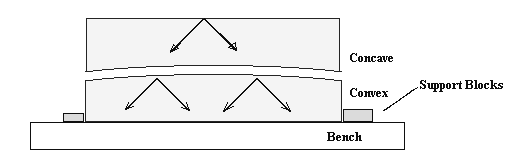 Figure 6-2 Distribution of forces in telescope making. |
The extreme frequencies reached appear in a generalised approximation. For the sake of mathematical simplicity, although wrong, please assume that for each linear inch of solid matter, say, ten million molecules exist along a straight line drawn across the surface. Therefore, when the two disks move at a rate of 24 inches a second, then each atom on that line must be shaken at the rate of four hundred and eighty megahertz. With the surface zone being buffeted to such an extreme degree, the slightest pressure altering magnetic field conditions, could blow atoms and molecular structures from the surface into the environmental molecules forming a scree of unsatisfied molecules. Due to decreasing gap distances, this effect becomes more pronounced with proximity once reflectivity begins to appear. To provide a more exact figure demands that the researcher estimates more accurately the three-dimensional structure and the number of affected molecules in a linear inch. Although 10,000,000 molecules could appear as a line estimate, the effect of an unsatisfied open magnetic field affecting molecules on each side of the line, effectively triples the first estimation. For the budding mathematician, considering Avogadro's number, at normal pressure and temperature, determine the number of molecules along a one molecule thick line one metre in length, and then determine the atomic vibrational frequency when an objects travel at various speeds through the atmosphere up to twice the speed of sound. At what velocity would relative motion cause thermal propagation effects?
Depending on force distribution, as the two surfaces move against each other, molecular proximity and extreme vibration tear, distort and break molecular bonds, ripping crystal structures and molecules from the surface leaving unsatisfied bonding structures. Although acting as a lubricant, the exposed surface bonds and the unsatisfied paste mutually act as an active cutting compound, increasing the cutting rate, local heating effects and scree build-up. Between the surfaces, freed atoms, molecules and crystals from one or both surfaces and the grinding grits link through unsatisfied bonds ripping crystal scree apart, reducing particle size and adding to the scree's reactivity. Although this slippery sticky paste assists in the grinding process, it also becomes a major problem when its relative water content decreases and with increasing quantities of finer active scree building-up with relative motion, the paste suddenly forms an extremely rapid-setting glue resulting in tool seizure, chemically bonding the surfaces together.
Great care and attention to both cleanliness and dust control must be exercised in all grinding, final polishing and recycling stages, for a single dust particle, a remaining larger grit particle, a slithered edge, hair, flake of skin, dirt from under a fingernail, and muck from the grooves in a fingerprint, works its way between the surfaces, scratching the surface. Equally, when working with plastics, chemical contaminants (like fats, oils, insect sprays, and acetone based cleaning compounds that react with the surface material) may weaken or strengthen surface regions resulting in the formation of apparent holes, hills, blemishes, fractures, scratches, and discoloured regions. Owing to the sharp and delicate convex surface circumference causing the edge to chip and break-away (as slithers dump large crystals into the grinding compound, deep scratching occurs), then the sharp edge must be regularly bevelled and flattened during the polishing stages.
Arising from the surface matrix of tightly butting molecular hemispheres matrix, a uniform and homogeneous protective magnetic cushion links the surface to environmental molecules through individual atomic magnetic bonds. With the AD 2000 Æther Theory, removing the invalid optical concept of reflection, this cushion receives and responds to environmental signals-of-change producing transmissions carrying the surface material's response signals, often with altered spectral components and polarisations, giving rise to colour, changed polarisations, and scatter effects (including glare).
For completely different reasons, lens-makers and lapidarists aim to create the smoothest and most uniform air-surface interface possible. In lapidary, the gem polisher aims to display a mineral's rich natural colours and hidden beauty, strange polarisation effects and their personal expertise in mounting the mineral as a gem or fashion accessory, be it a piece of Opal, Jasper, Jade, Ivory, Marble, Serpentine, Granite, Quartz, or whatever mineral seems colourful. In accordance with the AD 2000 Æther Theory, matter's atomic magnetic field orientation and alignment alters the optical properties and the magnetic radiation propagation path through and away-from the solid matter, adding to, removing, rejecting, absorbing, converting and changing colours and polarisations.
However, most lens and telescope makers seek transparent materials where polishing produces a uniform and homogeneous surface that does not change the viewed object's true colour or its polarisation. Consequently, lens-makers choose uniform and homogeneous materials that develop a smoother and more uniform magnetic surface cushion, where the more random the individual atomic field alignment propagates signals without altering polarisation and colour. This random alignment widens the optical frequency pass band and increases the surface propagation effects. Equally, some lens-makers design narrow optical pass-band filters and polarisation changing instruments for specific and unusual astronomical and photographic applications. Although each atomic magnetic cushion responds to environmental signals-of-change transmitting response signals in every direction, cumulative transmission effects reinforce signal propagation giving rise to the illusion of apparent reflection, where in respect to a position at right angles to the surface (the normal at the point of contact), the incident angle equals the transmission angle.
When using too much water, atmospheric pressure can turn the tool into a massive suction cap. Optical interference fringe measurements of the water gap thickness between the surfaces, just moments before the surfaces seize, a monochromatic blue light source reveals a water film thickness between the surfaces verging on an eighth wavelength. Obviously, as too much water washes the scree from the gap, it also removes gas molecules from the solution. With the absence of any material allowing bounce and movement, atmospheric pressure suddenly clamps the surfaces.
As a consequence of dry scree entering the cutting compound from the surfaces and the grit, the relative moisture content decreases, and as the unsatisfied bonds bring the scree particles together in nano sized balls, at a critical moisture content the scree balls suddenly glue the surfaces together. Soaking the work and tool in water may dissolve the glue freeing the surfaces, however, it may require heating the water to boiling, or independently heating the work or the tool creating a thermal expansion that breaks the glue's bonds. In the worst case seizure, it could become necessary to clamp the work and in a direction to the centre, strike the unclamped tool's edge with the open hand or a rubber hammer, snapping the bonds holding the surfaces. Because many grinding tools, including files, sandpaper and emery paper lose their abrasive qualities when the surface clogs with chemically active scree chemicals, as vibration, shaking and a small wire brush often removes the chemically bonded scree from clogged tools, regular scree removal extends the life and effectiveness of sandpaper and tools.
Even though some authorities claim that the surfaces melt and flow during the polishing stages, seems too extreme, when the local surface activity effect cannot be measured, seen or felt, and as the water-detergent-scree mix remains relatively cool and does not boil, despite common glass melting at temperatures from 800 to 1,200°C, Pyrex exceeding 1,600°C, and ceramics at even higher temperatures, hard evidence confirms the surface fusion effect. In the rare and extreme circumstance, surfaces do melt and weld. This may be caused by too much water removing even the finest scree from the water film gap, and then drying suddenly. Full surface-to-surface chemical bonding occurs, welding the surfaces through contact chemical fusion. Any attempt to free the welded surfaces conchoidally breaks each welded area, splintering matter from the surfaces, leaving pits and hills on both surfaces that can only be ground out with coarse grits. As most methods needed to break the surfaces apart fail, extreme methods must be used, including a hydraulic press, or perhaps as the last resort, smashing the tool with hammer and chisel.
Commercial lens-making operations recognise this heating condition and for the sake of production speed use tests that compensate for the heating effect, so that when the surface cools, the surface accuracy borders on the advertised 1/8th wavelength specification. However, these tests only work when using materials of consistent quality. The problem of "which wavelength," then enters such discussions, because the much longer wavelength of red light always gives better results than the much shorter wavelength blue light tests. When tested in red light, an apparently perfect mirror may become useless at higher frequencies owing to wave cancellation and interference effects removing or adding spectral signals.
Due to adhesion effects breaking the surface, it becomes necessary to replace the tool with a softer material lap, that must be formed into the work. Lens-makers typically use pitch or resins, which they cast to the tool, and then press fit into work. For reasons of preventing seizure, the lap must be sectioned, with narrow drainage grooves where the scree can accumulate. Effectively, the lap becomes many sub-diameter laps. Although low-melting point pitch melts as it polishes, responding to the enormous vibration effects, it melts into the moving surface shape, improving the contact zone and increasing the polishing effect. Here the lap acts as both a lubricating medium and a mould, merely deforming to the surface shape. Because the unsatisfied scree becomes the active component, and as the lap acts as a polishing compound reservoir, polishing requires very small quantities of the polishing compound.
Polishing plastic materials appears far more difficult owing to the material's weak structure, and the molecular incompatibility to water. This does not mean that polishing soft materials becomes impossible, rather it demands using materials that overcome the problems. A soft material like mineral Talc with a hardness of 1, can hold a good polish for some time. In 1970, when optical experts decried plastics stating, "It is impossible to polish plastic", the author examined plastics as a lightweight, robust, and viable option for portable telescopes. The problem being the telescope making fraternity's "it must be done this way" attitude, a way that simply failed every time, where rather than looking for the obvious, it proved too much of a bother to look for the simple answer.
The molecular structure and composition gave the clues, for water beads on plastic surfaces. The answer being a material that wets the plastic surface, such as a concentrated detergent [Amway's "Crystal Clear] to assist in the cutting, lubricating and polishing, with the carbide grits as a suitable grinding medium. To prove the method, the author built a small 4" F 6.0 telescope, and then a much larger 12" (30 cm) telescope from 011-acrylic acetate. Rather than hogging the surface, each curve had to be machine cut to the basic curvature, then using resin and cellulose laps to grind and polish the material. Rather than taking on a simple task, the previously considered "impossible" F 0.75 focal ratio spheroidal curve was chosen for the 12" mirror. The final polish and figuring used a paper (compressed cellulose fibre) lap, which, after redesigning the optical testing devices using a borrowed laser, obtained an accuracy of an eighth wavelength in green light. Unlike glass and Pyrex, the concave mirror's sharp edge didn't need bevelling, growing so sharp that it became knife-like cutting fingers. The final telescope made to prove the case, cut and polished from a 50 mm thick Acrylic acetate square, into a 765 mm disk, then fashioned into Cassegrain primary F 2.5 telescope mirror weighing just 19 Kg appeared in 1976, before the Total Solar eclipse journeyed across Bombala, NSW. Independently others made similar breakthroughs polishing and coating plastics, so that today, the durability of plastic optics removes the breakage problems that cursed Roger Bacon's frail glass spectacles.
As sand (Silicon dioxide) and Silicon Carbide break down into finer grit sizes, sedimentation, filtering and sieves can remove and separate the heavier and finer particles. Completed in the reverse order, tapping off the cloudy water after extracting the coarse material, the finer polishes appear as suspended in the solution. This process yields quantities of extremely fine grinding pastes and grits (from 1000 to 5000 grade) suitable for each grinding and polishing stage. Having removed and filtered the floating components from the sinking components, a series of sieves separates the larger grinding grits (from 40 to 1000 grade), while with time sedimentation over several days produces different polishes. The longer the sedimentation, the finer the polish left in solution. Having mixed the solution thoroughly, the solution must be decanted logarithmically into different containers, so, after 3 hours, a sediment shows, decant and leave for 3 + 6 hours, then decant and leave for 9 + 12 hours and decant again, then 21 + 18 hours, et cetera. Each time mixing the remaining solution and letting the solution settle.
Many grinding and polishing materials exist, such as fine grade Sand, Silicon Carbide, cubic Boron Nitride, Titanium Silicate, Iron oxide, and even some clays (Aluminium silicates). Equally, good books can be found in gem clubs, bookshops and telescope shops that further this discussion on telescope making and Lapidary, showing the methods needed to grind and test most optical surfaces.
Words = 3,850
---------------