Currently updating to the e-prime style
CHAPTER SEVEN
Viral Infections.
The causal researcher must be astute and wary of scientific zealots negating logic, reason and change. In presenting arguments that reinforce self-acceptance, scientific zealots promote and defend their self-confirming deluded belief-set with twisted arguments and indoctrination techniques. Some emphatically state, as scientific theory cannot be fully proven, then, being unproven and incomplete does not make the theory wrong, especially when empirical tests support the theory empirically. With this logic, they deny all other theory. In the process of preserving the status quo, zealots openly brand alternate theory as dangerous and unsupported nonsense. Although empirical theory predicts experimental results from observational effects without mechanism, when the alternate theory explains those observations allowing prediction, with suitable mechanism producing the same predictive answers, zealots amuse themselves accusing researchers of crankism and crackpotism. In recognising possible truth, respected scientific zealots win credibility through persistent and relentless attacks, taunts, and misquotes, so that the researcher's anger affects credibility so greatly, the zealot succeeds in sidetracking and negating genuine research conclusions.
With the aim to advance the sciences, the causal research refinement process seeks hidden gems that may explain and reinforce, or correct and supersede specific empirical explanations. Anything new that gives humanity a better understanding of Nature's Universe, perhaps removing and explaining a scientific mystery through scientific means, must be seen as a bonus. This process demands causal researchers compare and contrast various theories, even those suggested by cranks, crackpots and scientific heretics; even those which when applied supersede the scientific paradigm. Although refinement may give credibility to a researcher's specific concepts, because humans with human weaknesses do make mistakes (especially researchers holding onto pre-existing beliefs, notions and grudges), the refinement process does not necessarily give credence to that author's entire work, concepts and beliefs (examples; Kepler's Music of the Spheres, and Newton's Alchemy). Scientific history reveals many other examples where during subsequent research, errors in an authority's original work (and cited as suitable reference material) not only affect the conclusions drawn the introduced errors enter the sciences creating havoc. Consequently, researchers must be particularly vigilant when citing reference material where errors occur.
When identified as virally infected tendentious theory, rather than accepting that theory and working around known errors, the scientific method demands treating the theory as if, in a quarantine, with the research focussing on the infection's cause, and while supplanting ignorance with knowledge, in treating the symptoms the researcher must search for other infections that the infected theory produced. As error tracing reveals an error trail, the identification of junction points begins the mapping process, tracing an entire error tree spawned by an invalid notion or noumenon infecting the sciences. Only with this map can the causal researcher suggest the repair, removal, and supersession to more appropriate theory. Electrical theory reveals a prime example of an error tree, where as a matter of respect for Benjamin Franklin's scientific and political achievements, authorities promote his superseded theory. As technological change occurred so rapidly, when finally identified as in-error, rather than fixing the errors, as consensus of opinion nurtured the infection, the scientific community breached the Scientific Method.
Well before the errors, mistakes and necessary corrections became evident, the virulent infections had unfortunately jumped scientific demarcation barriers, appearing in other sciences as working explanations. Because empirical mathematical descriptions concern physical effects, and correctly use those effects to make predictions, as the true electric field description remained a scientific mystery, invalid theory and observational effects spawned more delinquent theory. Although the previous Chapter describes the electric field as a 7-layer failure effect forming a molecular alignment field, the causal researcher must carefully examine the evidence leading to this conclusion, simply because such a theoretical change must produce enormous ramifications throughout the sciences.
Although the Ancient Greeks first noticed friction's electrical effects when rubbing ebony with a dry cloth, scientific credibility for this strange phenomenon only occurred in 1600 CE, when Gilbert examined magnetic and electric fields in his work, De Magnet. The "charge" developed so great, electrical sparks can jump several centimetres, and small pieces of paper seem to defy gravity and aerodynamics, some pieces being picked up, before adhering to the charged rod until the charge neutralises, or after a time adhering to the rod being thrown suddenly with great force travelling several metres. In comparing and identifying intrinsic differences between the dipolar magnetic field and the apparently monopolar electric field, Gilbert dismissed many ignorant and superstitious beliefs.
Not only did he determine methods to artificially magnetise Iron, he identified the Earth as a giant magnet. As described in other Chapters, the ignorant took Gilbert's word as truth, and through indoctrination, in disregarding ALL current observations falsely maintain, the Earth as having a solid Iron magnetic core. With the technology of the day, Gilbert had no way of knowing that the Earth's moving magmatic magnetic generator produces magnetic reversals, and that the magmatic convective currents producing this magnetic field rotate at a different speed to the Earth's surface. In not realising that electric fields exhibit charge polarities, he describes a surface field effect without longevity that radiates in all directions from the charged surface until the surface loses the effect. He showed the magnetic pole as different, originating from an ambiguous region within the magnetic material, irrespective of the material's size. No matter how many times he cut a magnet, each fragment appeared with two or more independent magnetic poles.
When describing magnetic polarities, many who speak and write about magnetic North and South poles accept an invalid interpretation relating the magnet's North Pole to the Earth's axial North Pole. In being specific, they state that a compass needles' North Pole points to the Earth's North Pole. Because like magnetic poles repel, then the Earth's Geographic North Pole must actually be a South Magnetic Pole. Equally, in defining a North Seeking Pole, many fail to realise that the magnetic North pole under consideration must be a South Pole. To add to the misery of confusion caused by ignorance, respected authors and scientists often illustrate the Earth's lines-of-force pointing in either direction, some in terms of North Seeking Poles, with magnetic lines-of-force radiating away from the geographic North Pole to the South, when others direct the lines radiating from the South Pole to the Earth's geographic North Pole. Incredibly, as many reference books, maps and educational programmes (including those released by NASA) often display the Earth's Magnetic Field with different field directions, one must question the published magnetic directions of other planets described by NASA researchers, by way of North Poles, or by North Seeking South Poles. Equally, when manufacturers label a magnet's North Seeking Pole as the magnet's North Pole, they add to the already confused situation. To correct the situation of by-convention, so that all artificial North Seeking Poles truly exhibit North Pole qualities, then, the Earth's Geographic North Pole must be defined until the Earth's next magnetic reversal, as a magnetic South Pole.
Around 1750 CE, Benjamin Franklin accidentally identified two distinct electric field types. Due to the day's primitive technology, Franklin introduced several notions that became entrenched in mainstream Science as the theoretical foundations. Fifty years before the concept of an atomic model and sixty five years before the identification of polarised light confirmed Huygen's Æther Theory, Franklin defined a series of classic observational illusions and misconceptions, where terrestrial effects shaped his interpretations and beliefs, giving credit to the electric field as the mechanism causing a force. The short-term effects of like charges repelling and unlike charges attracting seemed almost mysterious, as did the strange effect observed in the space between unlike charged surfaces, where a dipolar electric field appears to form a point-to-point field structure along and around the line joining the closest points of contact.
Unlike the magnetic field emanating from beneath the surface, the dipolar electric field structure emanates from the surface. Franklin further noted that electric and magnetic fields co-exist at the same time in the same space, seemingly without altering the properties of the other. As Franklin had no way of realising the electric and magnetic field's optical polarising effects, he asserted that magnetic and electric fields do not affect light. Despite hard evidence showing electric and magnetic optical polarising effects, scientific programmes and reference texts still use Franklin's deluded assertions as fact.
Without suitable technology or proof, Franklin introduced other notions to explain his observations, such as electrical "current flow" with electricity flowing like a fluid through a conductor. Using the mathematical operands of addition (+) and subtraction (-), he expressed his ideas denoting the electrical charges as positive and negative, with neutral being a balance between positive and negative. Without anyway of determining the electron's true electrical charge potential, he assumed too much in the experimental design stage defining both charge polarity and field direction, where he incorrectly asserted that Positive meant having additional electrons, and that Negative meant having too few electrons. With this definition and without proof he drew far to many important conclusions far too early! Incorrectly he concluded, "positive electrons flow in currents from the positive terminal to the negative terminal," and that the electric field emanating from either a positive or negative charge source travels from the positive to the negative charge. From that moment, awkward problems beset and defied this invalid electrical theory, such as when frictional effects occur as air circulates, with like charges accumulating in charge pools until a discharge condition neutralises the charge differential.
For over a century, Franklin's beliefs, errors, and unproven notions rampantly spread as the very foundations of electrical theory, being the mandatory concepts used to explain all new observations. As these infections crossed demarcation barriers with new electrical observations, the virus mutated into the electrochemical theory defining atomic valency, cations (-) and anions (+). However, with technological evolution came the realisation that Franklin made a tragic mistake; that electrons carry a negative charge, and therefore the more negative, the more electrons; a fact that reversed electrical current flow, from negative to positive! Throughout this entire period, the sciences defined friction with generalisations and observational effects without mechanism. Rather than correcting the sciences, making the necessary changes universally, sycophancy, expedience, cost, and scientific laxity ruled. In perpetuating and maintaining the viral infections within the scientific community as scientific artefacts and the basis for electrical and chemical explanation, superficial corrections and indoctrination spread Franklin's deluded and invalid notions without real change.
Despite Electrical theory and Chemistry working backward, care must be taken with the predictive mathematical descriptions, as educators and reference texts often vary explanations between Franklin's electrical current flow and electron flow without notification. Subsequently, consensus of opinion states that electrons travel from the negative to a positive terminal, while electrical currents flow in the reverse direction. (Please see exercise 1 at this Chapter's end.)
As a young bookbinder, Michael Faraday's interest in both the magnetic and electric fields led him to Sir Humphrey Davy, and a career change working for this noted English Chemist. He learnt a great deal from Davy, and through Faraday's public lectures, his simple down-to-Earth approach inspired many. As Faraday's academic and research stature grew, in 1820 CE, Hans Christian Oersted's serendipitous observations directly connecting electrical current flows to the production of magnetic fields came as a surprise that re-ignited Faraday's passion to explain magnetism. Under Davy, he had only dabbled in both research areas, and as he found so much misinformation he took on the onus to qualify, quantify, and define magnetism and the electric-magnetic link through electrical means. Despite identifying and classifying the then known elements and many chemicals into three magnetic groups, he could not see the link that would upset Davy's electrochemical theory.
Unfortunately, in establishing the conventions needed for explanation, his experimental method and assumptions (explaining various conditions and complex scientific principles in simple terms) reflected the limited scientific knowledge and primitive technology of the day. Although he defined as much as he could, basing much on Franklin's errors establishing the scientific foundations needed for electromagnetic explanation, his most impressive descriptive analysis and research conclusions suffered, for he accepted certain notions without proof that simplified explanation, drawing important conclusions far too early. As his own errors extended Franklin's errors and entered mainstream science, with indoctrination cementing many invalid assumptions, assertions, and speculations into the minds of those who followed, cancerous viral infections confused, complicated and mutated the sciences.
To explain the magnetic field, Faraday treated the magnetic field as having properties similar to the hypothetical Æther. He noted that as Iron filings sprinkled onto a sheet of paper above a magnet group in lines, he concluded that their number and concentration accurately indicated the magnetic field strength. Although Franklin's view of charge states, "like charges repel", Faraday noted that when like charges flow along parallel electrical conductors, the opposite occurs. Electrons flowing in the same direction draw the conductors together, but when the flow of one conductor reverses, with the electrons flowing in opposite directions the conductors repel and move apart. To explain this effect, Faraday blamed the strange circular magnetic field lines that experiments showed appear to exist around the current carrying wire. When he wound the wire into a coil, and passed a strong current along its length, he noted that each circular magnetic field produced a cumulative directed environmental magnetic field in free-space along the axis of the coil, a field not supported by any ferromagnetic matter. When he inserted the three known ferromagnetic materials into the coil, the field strength increased and the material maintained the magnetic field long-after the electrical current stopped flowing.
In the description of the air-core electromagnet, Faraday failed to describe the presence of the Earth's paramagnetic atmosphere assisting the field's propagation, and more seriously, affecting his other research classifying matter's various magnetic effects. By increasing the electrical current in the coil, as the magnetic field strength increased, he confirmed his previous view that both the concentration and the number of lines indicate the magnet's field strength. In defining these indicator lines as magnetic lines-of-force, inadvertently, he gave them the property of being unique physical entities.
In establishing the conventions, treating each line-of-force as an unbroken physical line with a uniform intensity along its length, flowing from the North Pole to the South Magnetic Pole, he created several knowledge viruses, making each line directly responsible for electrical induction. Because Faraday cited an observational indicator of the field's presence as the actual mechanism, his invalid and wrong physical interpretations led to descriptions and subsequent explanations that released a series of mutating knowledge viruses, infecting all theoretical extensions made by Maxwell, Marconi, Thomson and Babcock. This dispute deals exclusively with Faraday's physical descriptive theory (not the empirical mathematical theory), for in removing all natural explanation these invalid descriptions created scientific mysteries and delinquent sciences.
Just as a weather map's isobars join points of equal atmospheric pressure and do not represent a physical entity, lines-of-force that join points of equal magnetic field strength do not represent a physical entity. As one can use the isobar's apparent closeness to predict an atmospheric pressure cell's relative wind strength and direction, the same must be said about lines-of-force, where as closeness indicates field strength, then accurate predictions become possible from observing this effect. Unfortunately, in simplifying the description, Faraday's view established a preternatural science where deluded theory replaces Nature.
From the invalid concept of the line-of-force being a physical entity, the Babcock dynamo effect actually considers the magnetic line-of-force, as a solid entity that enters the Sun causing sunspots! Furthermore, as lines-of-force also occur across the surface of a pond with water flowing from an inlet pipe to a drainage pipe, the application of Maxwell's equations correctly predicts the forces exerted around this three-dimensional flow structure. Then it must be said that even though both water and air circulation currents reveal these flow lines, the lines do not possess uniform intensity or velocity along their length, unless certain conditions prevail.
Please contemplate the processes responsible for the observable lines-of-force. When placed in a directed external magnetic field, Iron filings develop sympathetic magnetic field structures that align to and link as a chain forming a magnetic N-S-N-S-N-S circuit that connects between the external North and South magnetic pole pieces.
If that seems logical and true, then what happens between two or more adjoining magnetic chains? Obviously as the Iron filings establish sympathetic magnetic properties (as tiny N-S irregular magnets), then three-dimensional gap fields develop and link each Iron filing along the length, as in N-S N-SN-S. The illusion becomes apparent, as these directed magnetic gap-fields extend into the surrounding environment producing repulsive effects separating parallel chains forming the illusion of unique lines. Because repulsive conditions and magnetic throughput balance, line concentration and the number of supported magnetic circuits indicates a magnet's cumulative field strength, and therefore, from this observational illusion with physical manifestations, predictions become possible. The same applies to the electric field, where molecular magnetic alignment and motion produce the electric field effect. Rather than emanating from within a body, electrical fields radiate in an environment, as like charges accumulate, from a body's surface, or from a region within a medium.
Electrical charge must be identified as a relative effect, since several forms of charge relativity exist. Although a charge can seemingly appear neutralised with respect to the local environment, many charged situations escape identification because the local environment reaches the same charge potential, at which point, the electric field appears to have been neutralised or the charge dissipated. At this potential, the local environment could be in a fully charged condition and be uniformly discharging into the greater environment. Because surface effects involve molecular activity and motion, the electric field leaches away, distributing the available charge into the surrounding environment.
Due to the mathematical signs used to display both the operands and the charges, with charge relativity effects and then both electron flow and-or electrical current flow complicating description, some students find the work so confusing and complex, they dropout from necessary courses. The problems become evident when charging an object, to add (+) negative electrons (-) to an existing charge, making the existing charge more negative (-), or while removing negative electrons (-) through subtraction making the charge more positive (+). The following truth table clarifies a rather awkward situation that needs interpretation and explanation. Due to charge relativity, three independent situations must be considered, as individual electron charges, charged bodies, and as charged environments.
| | | | | Electron Charges. |
| (+) | + | (-) |  | (+) | To add electrons to a positive charge, the positive charge becomes more negative. |
| (+) | + | (-) | | (0) | To add a number of electrons equal to a positive charge, the charge becomes neutral. |
| (0) | + | (-) | | (-) | To add electrons to a neutral body, the body's charge becomes negative. |
| (-) | + | (-) | | (-) | To add electrons to a negative charge, the charge becomes more negative. |
| (-) | - | (-) | | (-) | To remove electrons from a negative charge, the negative charge becomes more positive. |
| (-) | - | (-) | | (0) | To remove a number of electrons equal to a negative charge, the charge becomes neutral. |
| (0) | - | (-) | | (+) | To remove electrons from a neutral body, the body's charge becomes positive. |
| (+) | - | (-) | | (+) | To remove more electrons from a positive charge, the charge becomes more positive. |
| | | | | Charged Bodies. |
| (+) | + | (+) | | (+) | To add a positive charge to a positive charge, the cumulative mean charge remains positive. |
| (-) | + | (-) | | (-) | To add a negative charge to a negative charge, the cumulative mean charge remains negative. |
| (-) | + | (+) | | (-,0,+) | To add a negative charge to a positive charge, the cumulative mean charge depends on the greater charge. |
| (-) | + | (0) | | (-) | To add a negative charge to a neutral body, the body's charge becomes negative. |
| (+) | + | (0) | | (+) | To add a positive charge to a neutral body, the body's charge becomes positive. |
| | | | | Charged Environments. |
| (E+) | + | (+) | | (E+)(-) | A less positive charge in a stronger positive environment makes the charge negative. |
| (E+) | + | (+) | | (E-)(+) | A stronger positive charge in a weaker positive environment makes the environment negative. |
| (E-) | + | (-) | | (E-)(+) | A less negative charge in a stronger negative environment makes the charge positive. |
| (E-) | + | (-) | | (E+)(-) | A stronger negative charge in a weaker negative environment makes the environment positive. |
| (E+) | + | (0) | | (E+)(-) | A neutral body in a positive environment becomes a negative charge. |
| (E-) | + | (0) | | (E-)(+) | A neutral body in a negative environment becomes a positive charge. |
| (E0) | + | (-) | | (E+)(-) | A negative charge in a neutral environment makes the environment positive. |
| (E0) | + | (+) | | (E-)(+) | A positive charge in a neutral environment makes the environment negative. |
Explanations become very confusing when charge distribution effects within the local environment charge the environment creating false neutralisation effects. Observations show that at the centre of a charged hollow sphere the electric field does not exist, yet other observations dealing with coaxial conductors reveal capacitance effects with the field radiating from an inner conductor to the outer surface. Relative charge and such contradictory observations support environmental alignment effects.
Owing to Franklin's errors, and the sciences accepting from positive to negative directions, some authorities get it wrong with their published reference texts giving the field the opposite direction, incorrectly treating the dipolar electric field as having lines-of-force that travel from the negative charge to the positive charge, (a situation similar to the North Pole and North Seeking pole mix-up). When diagrammatically illustrated as a monopole, with convention putting the problem in the too-hard-box, the scientific community generally maintains that positive charged monopoles radiate lines-of-force into the environment from the surface while the negative charge draws the lines-of-force onto the charged surface.
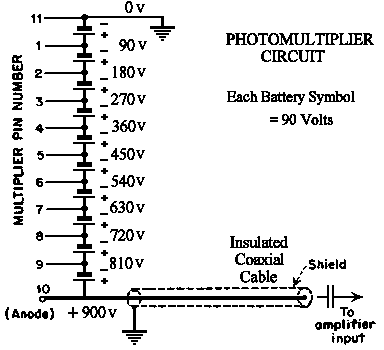 Although positive and negative electric fields exhibit slightly different properties, a negative charge acts as a positive charge when exposed to a stronger negative charge. The weaker field becomes more positive to a stronger negative charge, or becomes more negative to a strong positive charge. This means that any charge could simultaneously exhibit both positive and negative charges. Example: In the photomultiplier tube exists a series of electrodes, called dynodes, each connected in an increasing positive voltage ladder circuit. Although the electric fields extend through a terrestrially produced vacuum, the nature of charge relativity becomes apparent along the ladder. As the voltage on each ladder rung progressively increases by 90 Volts from the image screen (the negative cold cathode) down the ladder to the signal detection point (the positive anode), in a nine-dynode system the overall difference in charge may be a very dangerous 900 Volts DC. As relative charge differences of only 90 Volts appear between each dynode, a dynode at the ladder's centre exhibits an effective voltage of 450 Volts to both the anode and cathode, as both a positive and negative source, but only as a 90 Volt source to the closer neighbouring dynodes, creating a positive 90 Volt electric field to the more negative 360 Volt dynode, and as a negative 90 Volt electric field to the more positive 540 Volt dynode. Simultaneously each dynode presents a positive charge and a negative charge.
At the expense of the important light sensitive semiconductor image screen where the photoelectric effect occurs, to prove the photon theory many reference text authors spend a great deal of time discussing the photomultiplier's ladder circuitry and the electron cascade effect. Perhaps these authors see the cascade effect as being the more exciting active working component, attributing the observed photoelectric effect and the ladder circuit's amplification to the wrong processes. As illustrated more clearly in other Chapters, despite the various photon theories claiming ownership in giving contradictory photon particle concepts totally different properties and attributes without adequate mechanism, in failing to explain how electrons could possibly leave the cold cathode's under surface, confused and ignorant zealots simultaneously promote a hotch-potch contradictory mulch with the generalised remark, "a photon's impact knocks an electron from the surface." These problems stem from several observational interpretations recorded in scientific history, which appear in the quantisation discussion shortly.
Without adequate proof, common misconceptions and inappropriate ill conceived and expedient it-will-do theory developed. Consequently, despite many conditions proving otherwise, many wrongfully accept as true the invalid assumptions that the electric field must be sub-atomic in origin and that electric fields stem from the sub-atomic components (with theory assuming the electron itself as having a negative charge and the proton as being positive). However, simple observations tell a totally different and powerful story, where the loss or gain of an electron at the atomic level alters the atomic magnetic structure so greatly, the molecular environment responds, and here, like charges attract and unlike charges repel, so a molecular alignment field becomes apparent. Please consider the following points about electric fields:-
Longevity
- Energy must be continually applied to maintain an electric field, as the field exhibits no longevity.
- Even in the best terrestrial produced vacuum, the apparent charge dissipates with time.
- If electrically excited, the gas molecules remaining in a terrestrially produced vacuum produce spectral emission lines typical of that gas.
- The electric field carries electrons between relative charges reducing the charge differential.
- A conductor suspended in the electric field acts to discharge the field at a greater rate.
- The apparent charge dissipates when the charges apparently neutralises as the local environment reaches the same charge potential.
- As illustrated above, the charge of the electric field depends on the surrounding environmental charge.
- The electric field strength depends on the area over which the charge distributes.
Fields
- Electric fields radiate from the surface of a material or from a charge pool in a medium, not from within the material.
- A dipolar electric field occurs between the closest points of contact.
- An electrical current flows as the charge discharges into the neighbouring environment.
- A charged body's shape alters the electric field's structure.
- The properties of positive and negative electric fields differ.
- As illustrated above, electric charges produce relative effects.
- The apparent charge becomes neutral when measured within the relativity of an evenly distributed surrounding charged environment.
- Neutral bodies in the charged environment reveal a sympathetic opposite charge, forming dipolar electric field with the charge source.
- In a monopolar electric field, a conductor takes on the opposite charge, forming a dipolar electric field with the charge source.
- In a dipolar electric field, a conductor sympathetically forms a dipolar electric field aligning and supporting the field direction.
- In a dipolar electric field, stand-alone conductors develop a negative charge.
- Many dipolar fields can simultaneously originate from a single point of charge.
- A diffuse electric field occurs at low electrical potentials.
- All materials (including those in a vacuum) can be charged by frictional effects.
- With matter's crystal alignment change produced by altered local atomic magnetic conditions, changes occur in optical polarisation, physical dimensions, chemical compatibility, state, and conductivity.
- Both the ice experiment and a chemical battery at the limit of its shelf-life reveal corrosion effects, where migrating electrons carried by atmospheric molecules produce chemical reactions that eat away the exposed electrical terminals.
- Even in a vacuum, with high voltage direct currents, electrolysis effects appear with material sprayed from one electrode deposited on the containment vessel's walls and more so on the other terminal.
- An electric field acts to remove pollutants and particles from the air.
Sparks
- The initial spark breakout point occurs from the negative terminal.
- The shape of the charged body alters the nature of the breakout point.
- Although the field radiates between the closest points, a sufficiently powerful spark may vaporise the closest point and the field may continue to emanate from that site.
- The spark does not flow along the electric field.
- Unless excessive voltages produce the spark, the spark does not travel between the closest points by the most direct route.
- The spark appears to spiral in a magnetic field whose direction parallels the electric field direction.
- The spark produces a strong molecular vortex (or tornado effect) on the terminal's surface, as illustrated in the plasma ball.
- Numerous radiating sparks appear and circulate about a fully charged Van De Graaff generator's spherical charge ball prior to a total discharge event.
Thermionic effects.
- All thermionic valve effects can be replicated in normal atmospheric conditions.
- As gas pressure reduces in a thermionic valve, the random noise produced by molecular bombardment decreases.
- The thermionic valve must have sufficient volume to allow molecular convective flows.
- The anode must have ventillator holes to allow molecular convective flows.
- To increase the thermionic valve's operating frequency, the volume requirements must be reduced.
- Molecular bombardment destroys the grid and the anode of an over driven thermionic valve.
- Molecular bombardment and high frequencies often cause the remnant gas molecules to glow.
- Molecular wind effects can be accurately predicted.
Electronic optics.
- Electronic optics do not obey the laws of optics.
- The physical and optical properties of matter can change when exposed to electrical current flows.
- A magnetic field at right angles to the direction of a molecular electron carrying beam produces a deflection perpendicular to the magnetic field direction.
- An electric field at right angles to the direction of a molecular electron carrying beam produces a deflection with the electric field's strongest molecular wind curtain direction.
- Electronic focussing occurs when the electron carrying molecular beam passes through the centre of several charged ring electrodes situated between the cathode and the anode, producing in-line dipolar electric fields.
- Magnetic focussing occurs when the electron carrying molecular beam passes along the central axis of an electronically produced variable magnetic field.
- Electronic focussing through magnetic or electrical means, produce image rotation effects, identifying the beam's spiralling molecular flow.
- The resolution of an electron microscope depends on the atomic size of the vacuum's remaining gas molecules.
- The laws of refraction and reflection only apply to frequencies in the magnetic spectrum.
- Molecular scatter and certain diffraction effects occur when electron carrying molecular beams strike an object. (Note: Unlike electronic diffraction, optical diffraction produces the diffraction fan effect.)
Environments
- Sound transmission properties change when an electric field stresses the environment.
- An electric potential does not seemingly produce an electric field structure in water.
- The Doff effect occurs when an electric field deflects a fine stream of falling water.
As the basic properties of the electric field, taught in school and at University, deny all sub-atomic electric field origins, the terms scientific mystery and by convention, actively replace Nature's truth with a deception. Each point in the above list relates to specific effects and conditions that must be explained fully by the theory. To defend the sub-atomic notion and debunk Nature, scientific zealots ignore the important points, arguing against those points they believe weak, or when similar items seem related, probably voice the following rebuttals;
As water is a good conductor of electricity, the electric field will never occur in water.'
and
The Doff effect applies to a fine stream of falling water because of water's electro-chemical nature
and the distribution of water's molecular charge.
Such naive arguments attempt to explain away and describe deluded theory and claimed scientific
mysteries, with other scientific mysteries and more deluded theory. Although treating water as a scientific mystery, it remains a scientific oddity, being considered as both neutral, and as an electrical insulator in its purest form. Water deserves a great deal of respect, being a thorn in the side of modern science due to its energy, structure and the many forms of water that cannot be explained using conventional theory. Even though water's neutrality occurs halfway between an acid and an alkali, water cannot be considered as a neutral molecule. Water can become a vicious acid, an intense alkali, a powerful corrosive agent, dangerous explosive, a deadly poison, vicious cutting material, an erosive chemical, cleaning agent, means of transport, lubricant, a powerful adversary, food, enemy, or a good friend. Water's attributes require special treatment in other Chapters.
As for water's electrical conductivity, pure water acts as an impressive electrical insulator that becomes electrically conductive and extremely corrosive when the presence of an impurity alters its crystal structure. The zealot's concept that electric fields only develop in, on, or around, an insulator seems to be an urban myth, since any metal conductor can hold a powerful electric charge, and therefore be an electric field's source. As humanity made scientific rules, Nature broke them to reveal something far more exciting; matter's magnetic interaction to matter through magnetic means. When exposed to a sudden high voltages, water's crystal structure alters to the conductors supplying the electrical current flow, producing magnetic alignment changes, followed by chemical disassociation, and in the Hydrogen-Oxygen environment any spark initiates a recycling explosion releasing tremendous energy, as water breaks apart, combines, then breaks up again and recombines until the electrical current ceases, and the electrodes corrode.
Due to a classic observational illusion, terrestrial electric field observations reveal several physical environmental wind-flow effects that only during the moments an electric field establishes, but then when the charge and environment stabilise to the changed conditions, the cumulative wind effects seemingly give way to an apparently unchanging radiating influence field despite certain strange effects occurring in the environmentally aligned and seemingly stressed conditions, such as human body hair standing up, and as environmental molecules buffet the skin with considerable force, accelerated evaporation cools the skin. Although many authorities categorically deny major environmental wind effects, molecular observations led to technological change revealing the electric field's powerful motion and activity.
In negative ion generators and commercial electric field air purification and cleaning systems, without any moving parts pumping the air through the device, the electric field not only circulates the air at a tremendous rate producing a circulation effect, it extracts smoke and other pollutants from the air. Equally, when applied with a high electrical charge, a simple bare metal strip mounted in the correct ground hugging housing produces a wind capable of extinguishing extremely dangerous oil layer fires. In the electric wind fire stopper, the wind strength and velocity can be further increased by several radio valve tricks, creating a triode with a biased narrow open wire mesh grill mounted parallel to a negatively charged heated bare metal strip. The term bias describes the mesh carrying a not so great charge of the same polarity. Despite the belief that like charges repel, applying a negative charge to this mesh actually attracts and accelerates the negatively charged aligned molecular wind passing through the mesh. For this to work, the housing must have sufficiently sized breather holes returning atmospheric molecules to the heated Cathode.
In the days of radio valve technology, when young technicians had to accept the notion that like charges repel, when it came to discussing radio valves, they had to accept the opposite, because electrical relativity and molecular flows fail the general theory. Although radio valve technology demands breathers and suitable volume for molecular flows, the reasons for this failure being chalked up to scientific mysteries and pure electron beam effects. In the radio valve, with a heated cathode reducing the energy needs to maintain the electric field flow, low voltages (from 95 to 1,000 V DC) accelerate molecules carrying electrons across a terrestrially produced vacuum to the positive anode. As more fully explained in another section on thermionic electrical valves, all vacuum tube radio valves initially depend on contact conduction at the negatively charged cathode and then molecular motion across a physical gap for their operation. Many observational illusions occur that generated contradictory theory, and the false belief that only electron beams breach the valve's gap, passing in one direction from cathode to anode.
Unheated cold cathode devices like the electric fire stopper and photomultiplier tube require much higher voltages to produce this contact conduction effect, where the concentration of altered magnetic molecules adhere more strongly to the cathode, than around the thermionic valve's thermally excited cathode. As the cold cathode, the photomultiplier's semiconductor image screen responds to increases in local molecular activity caused by incident light allowing gas migration effects to move hitch-hiking electrons from the surface to the first dynode, at which point the dynodes promote a cascade amplification effect. As increased surface activity affects the vacuum's gas molecules (increasing each free molecule's activity and space requirements), the gas viscosity decrease promotes an energy distribution circulation effect that assists in directing and accelerating molecules across the gap to one or more anodes.
The electric field's many effects, such as the Doff effect, can be best-described using aerodynamic principles and the
Bernoulli effect. Molecular wind-flows blow across and around objects placed in the molecular electric field. In the
terrestrial environment, aerodynamic flows and magnetic-linking of atmospheric molecules produce the illusions of like charges repel and unlike charges attract. Environmental motion of molecules around the charge, gives the appearance that a monopolar field radiates, from, or to, the charged object in all directions. The electric monopolar field stands as a molecular field of discovery. As molecular alignment and convection cells
distribute the charge into the environment, the illusion produced gives one the impression that the field seeks-out conductors and opposite charges. The electric wind not only transfers the charge to other materials, the aerodynamics in the molecular winds can move, pick-up and carry heavy items, thus explaining the Doff
effect, and the pieces of confetti being thrown several metres.
In "De Magnet", Gilbert describes a simple balanced non-magnetic metal needle which when suspended in an electric field points in the direction towards the electric monopole. Although some may relate Gilbert's needle to charge relativity, several other conditions apply that produce charge relativity. In the field, because non-metal non-conductive needles also turn toward the monopole passing molecular winds play the greater role in both turning the needle and in producing the charge distribution effect along the needle's length. As the highly conductive needle simultaneously becomes positively and negatively charged with molecular alignment, an electrical current flows as the needle's conductivity creates an electrical circuit that breaches the environment's high resistance, increasing the discharging rate. As molecular flows and alignment produce differential frictional effects and charge distribution, environmental energy distribution effects with matter responding to the changed environmental energy give rise to aerodynamic effects producing a force that rotates the needle to the prevailing wind direction.
When Franklin observed the dipolar electric field, he found that Gilbert's needles align along the dipolar electric field's lines-of-force direction. But like the line-of-force illusion, each needle establishes its own environmental alignment field that extends into the surrounding environment, with gap fields producing differential forces. The line-of-force illusion becomes apparent when a sprinkling of seeds floating on an oil's surface and exposed to various electric fields, flow into the field shape. With friction and alignment effects producing positive and negative charge distributions along each seed's surface and as environmental throughput maintains the repulsive force between the apparent lines, the closeness and number of lines becomes indicative of the field strength with molecular wind buffers between the charged seeds forcing parallel seed chains apart. The aerodynamics of the moving charged environment about each seed produces repulsive wind effects between neighbouring seeds that collectively align the seeds along the lines of least resistance where internally, each seed evenly distributes the maximum environmental throughput. Thus, two reasons explain why objects point towards the charge-point.
Conductivity across the field's potential difference establishes an alignment short-cut for the field to distribute the charge as an electron flow through the conductor, discharging the field at a greater rate. At the strongest point of charge (the closest point to the field), the conductor takes on the attributes of an oppositely charged source, while the most distant point acts as a source to continue the original field direction, with environmental molecules aligning to that charge, creating surface effects and contact conductivity, migrating electrons carried by molecules to the next relative charge point. The flowing charge gives
rise to a weak magnetic field as spiralling molecular flows develop between the conductor and the charge source. Plotting a balanced needle's direction in the electric field adds to the illusion of lines-of-force. Molecular
streamer flows create the illusion of a field that seems to radiate uniformly in all directions. The force at a given radius from a charged monopole abides by the inverse square law, due to charge distribution effects and migration effects within the environment, until the field becomes stressed by a conductor's shape and presence.
If at the most distant location from the charge point on an electrical conductor, momentarily earthing negates that charge, forcing the conductor to exhibit the remaining electrical polarity. If removed from the field, this charged plate forms a monopole that produces environmental molecular activity around it, and as a discovery field connects as a dipolar field with the surrounding objects through charge relativity distributing the charge. In this terrestrial situation, Heisenberg's uncertainty principle comes into its own, as the mere attempt to measure an electric field's molecular activity, changes the field activity, altering calibration and measurement parameters. Therefore, as all measurements alter the system's molecular properties, all measurements of the electric field become relative illusions, whose strength depends on the surrounding environment.
The procedure of earthing the conductor in an electric field, to create an opposite charge, forms the basic principle behind the operation of the Gold-leaf electroscope. Exposing the electroscope's test plate to an electric field promotes a non-reading charge, until earthing produces a re-distribution effect throughout the electrical conductor, from the test plate to the electrode's hanging folded gold leaf foil. To momentarily earth the exposed test plate, atmospheric molecular movement across the air gap between the folded foil arms, force the arms to open like a jaw, as does the base of the Greek letter l. The greater the opening angle, the greater the relative field strength. This primitive analogue device must be considered as having a low order of accuracy due to environmental effects and calibration errors. Atmospheric charge leaching, humidity and relative charge effects make the Gold-leaf electroscope virtually impossible to calibrate.
---updated to here----->31%
As electrons are forced
along a metal conductor, the addition of a single electron to the
metal atom alters the magnetic state promoting a local
environmental magnetic molecular response. Neutral molecules will
be affected by the altered magnetic state, to be attracted and
aligned. The greater the charge, the greater the alignment, the
greater the attraction. As the atmosphere is crystalline in
structure, any magnetic change to the metal atoms in the charge-ball
will alter the metal-air interface. The effect will affect and
extend into the surrounding atmospheric environment as a bucket-brigade
of alignments, but only if the environment permits such change.
The greater the surface charge, the greater the molecular
pressure at the surface interface. This change in the alignment
will affect molecules in the conductor. As more metal atoms are
magnetically altered, the molecular pressure about the charge-ball
increases, further altering the surface interface alignment of
matter in contact with the charge-ball. Metal atoms may be
attacked and transported across the dipolar molecular field. The
Ice Experiment identifies that at low electrical potentials,
electrolysis occurs in the dry air solution.
A negatively charged electroscope is discharged by alpha-particle
radiation. Rutherford identified the alpha-particle as a large
positively charged particle. He showed that alpha-particles can
be captured and collected inside an evacuated glass beaker.
Helium is found in the beaker when the alpha-particle's double
positive charge is neutralised. Correctly, Rutherford concluded
that the alpha-particle with a mass of 4 amu is a Helium atom
stripped of its two electrons. With this observation, Rutherford and others began looking for the atom's missing neutral mass, as atomic number increase at a constant rate, the atomic mass increases disproportionally due to the presence of hidden neutral particles.
Nuclear decay through atomic
fission reactions led Bohr and Chadwick to determine the alpha-particle's
composition as two protons and two neutrons. A slow velocity
alpha-particle is ejected during radio-active decay, as two high
speed Beta-particles (electrons) are ejected.
When Rutherford proposed his atomic model, he used a Gold-leaf
electroscope to measure the strength of the alpha-particle
radiation passing through the metal foil. Rutherford's lack on
knowledge about matter and the primitive technology of the time,
caused him to wrongfully conclude the atom as being 99.9999%
empty space. Many years later, the differences between metallic
bonds and normal chemical bonds were identified. Unfortunately,
Science turned a blind-eye to the fact that the electron cloud
atomic models are wrong.
When a neutral electrical conductor is introduced into an
existing dipolar electric field, the bizarre influence of the
field is noted. The conductor becomes negatively charged through
the Edison effect. Soon after this effect was first noted, it was
realised that the electrical current flowing in the electric
field could be controlled. In the radio valve, one or more
conductive wire fences (grids) are positioned across the field. A
small charge applied to the grid produces a large change in
electrical current flowing in the molecular field. As these
effects can be achieved and measured in normal atmospheric
conditions, an electron-hitchhiking molecular field is identified.
Electric fields exhibit another form of charge relativity.
Several phases in the development of the electric field will be
observed as the apparent charge increases. This relativity is due
to different mechanisms as different energy-forms come into play,
at different voltages, activity levels and pressures. At low
voltages, the molecular field is nebulous. With a temperature or
charge increase, the field illusion seemingly develops the point-to-point
flow between the closest points of contact. This is purely an
illusion. From these closest charged points, called the stress or
break-out points, with higher voltage, the spark will form and
jump across a gap, appearing disjointed or jagged, perhaps forked.
The spark does not need to travel along a direct path until the
voltage is increased to a point where the spark will be seen to
follow an absolute point-to-point path. Conventional theory
maintains the belief that a dipolar electric field always
exists as a point-to-point field. It will be shown that a point-to-point
field is only established when certain conditions occur. The
convective wind cells establish a funnelling streamer flow
structure across the gap.
Reference texts often state 'a cloth will wipe electrons
from the surface of an electrical insulator (ebony, plastic
and glass) to produce a static charge.' Just as it takes a
great deal to return the electron to the affected atoms of an
electrical insulator, it takes a powerful magnetic jolt to
dislodge an electron from the elprons of the insulator's atoms.
The vigorous rubbing of a surface with a cloth produces a
proximity event involving very high frequency intense magnetic
shocks. Just as this buffeting can dislodge entire atoms, it can
also dislodge the electron from an elpron, to be thrown from an
elpron's surface onto the other surface. As to which way the
electron jumps is dependent on the molecular strength of the
insulator used to charge the rod. After rubbing, a glass rod can
later be found to exhibit either positive or negative charges
depending on the material used to charge the rod. When an
insulator carries the charge, magnetic attraction at the atomic
level initially causes air molecules to align and be attracted to
the insulator's charged surface, stressing the atmosphere.
Cannon fire and large firework displays produce a great deal
of noise, often heard downwind at distances thirty kilometres
from the source. However, the atmosphere before a violent and
extremely loud electrical storm is quiet, still and heavy.
Although no winds are felt, a great deal of molecular motion can
be detected that restrains sound propagation. The intensity of
sound produced by an Earth shaking lightning clap may be ten
thousand times louder than that of a cannon, yet its propagation
is limited to about ten to fifteen kilometres. As will be
illustrated, vertical wind funnels increase the sound propagation
resistance as different rates of dispersion restrict audio
refractions and transmission. If, during a lightning storm, one's
body hair stands up, exercise extreme caution for this only
occurs moments before lightning strikes.
As air is forced through the nozzle of a vacuum cleaner, or a
jet of steam is expelled into the atmosphere through a wooden or
insulated metal pipe, the friction of moving molecules develops
an electric charge on the nozzle. Noteworthy is the fact that
when using a wooden or metal nozzle, a positive charge develops
on the nozzle, however when a small quantity of oily matter is
introduced into the steam, the charge becomes negative. It was
believed that the greater the elastic force of the steam, the
greater the voltage produced. The greater the molecular agitation
or frictional forces, the greater the charge. Evaporation does
not produce a charge, however, when rain falls on a plant, the
leaves develop a positive charge however, the plant's internals
and roots develop a negative charge. As water vapour is removed
from the air by an air-conditioning system, motion in the dry air
will often promote the development of very intense static pools
in that environment. This effect is painfully enhanced by
artificial carpets and insulated footwear.
In the atmosphere, the motion of convergent convective cells
produce high frequency proximity events in each flow, where
differing moisture contents and molecular alignment may promote
molecular vibration and a massive charge build-up at different
locations. Molecules held in the air's moving crystalline matrix,
shaken so violently can fling electrons from one structure into
the oppositely moving convective cell. In attaching itself to
another molecule, the electron changes the magnetic structure of
both cells to initiate mechanisms that load each directional flow's
crystalline structure. As more electrons are blown-off, the
molecules align to the altered magnetic conditions, causing far
more electrons to be blown-off. The head of the vertical cells
rapidly develop a different charge to that at the base and to any
Eddy cell that exist between the convective cells because like
charges attract.
In much the same way, the Van de Graaff generator rapidly
develops an extremely high static charge. From the base of the
generator, an electrical circuit forcibly adds electrons to, or
removes electrons from, a high speed endless insulated belt (typically
made of silk, nylon or rubber). This is analogous to the
direction of the moving air's convective cell's crystal matrix.
The charge carrying belt travels into the centre of an insulated
metal charge-ball, where the charge is seemingly deposited before
the belt returns to the base. As like charges gather together,
this generator mechanically rectifies and pumps electrons to, or
from, the charge-ball, as does the atmosphere's moving convective
cells.
The Van de Graaff generator produces what some consider as a
stand-alone positive or negative monopolar electric field. As the
field seemingly radiates in all directions into the surrounding
environment, it illustrates several short lived environmental
illusions. According to conventional electrical theory, electrons
applied as a negative charge to an isolated metal charge-ball,
flow evenly over and saturate the charge-ball's outer surface.
Once the field is established, the negative charge is leached by
the environment until the charge is redistributed. In reality,
the opposite terminal is the local environment, because the
circuit used to add or remove electrons, pumps electrons from or
to, the local environment' ground state. The charge will leach
until a point of charge equilibrium is reached.
Conventional theory similarly states that a positive charge
spreads itself over the charge-ball's surface to form a stand-alone
monopolar electric field. The positive charge does not involve a
physical particle that would flow over the surface. The positive
charge similarly leaches away as free-electrons in the
atmosphere neutralise the charge. Such a simplistic overview is
without basis in Nature. As air is an insulator, where do the
free electrons originate? The mechanisms that allow electrons to
flow to, or from the surface, must be examined process by process.
The Ice experiment identifies a weak nebulous electric
field activity in a frozen dry atmosphere where microscopic
charges promote molecular movement and corrosion. This compares
with the reasonably large charges used to pick-up confetti and
fluff by a charged rod. The confetti demonstration is more
dramatic around an operating Van De Graaff generator. The intense
molecular field attracts a pile of confetti on mass as individual
pieces. Some confetti that contacts the charge-ball immediately
flies-off, while other pieces adhere for a considerable period
before being blown-off with the same considerable force. The
strong electric potential can seemingly do the impossible,
throwing the confetti from five to ten metres. As this selective
blowing-off is blamed on the differences between individual
pieces of confetti, the principles behind this fascinating effect
are ignored. At higher charge potentials, a spark will jump
through the atmosphere, and at even higher potentials a rotating
coronal display develops on the charge-ball. Although confetti is
attracted to the charge-ball, the same does not seem to apply to
the air molecules. This story identifies an illusion of several
parts. The first part of the illusion is where air molecules seem
to stress and align to the direction of the field. Smoke is
typically used to display air movements, however in an electric
field smoke appears to vanish as it is either rapidly blown-away,
or attracted to the charge-ball. This is noted with the negative
ion generator.
Although the air is a reasonable insulator, when neutral
molecules gain or lose electrons they alter their magnetic
structure. After being attracted to the charge point, they adhere
in a swirling mass before travelling away in convectional flows.
Neutral molecules replace the magnetically altered molecules.
Flows of molecules travel each way to and from the charge-ball.
Continuously, the charge is being leached and transported by the
environmental convective flows. These molecular winds are best
illustrated in other devices.
Before exploring matter's innermost workings, the lower resolution limit must be reviewed. At the time of writing, a single electron's voltage establishes the finest technological limit, needed to observe small events. At this scale, measurements quantise in steps or graduations, denying accurate measurements between each graduation. Consequently, a quantised value of 1, could be any value between 1.0 and 1.9999.. Although the sciences spread a knowledge virus teaching quantised energies and forces as a property of matter and a natural truth, a quantised measurement scale does not quantise an event's force or its energy. Please contemplate the hypothetical situation where two atoms separate producing a decreasing force.
| distance | | actual force | | quantised force |
| 1x | = | 3 | = | 3 |
| 2x | = | 2.8 | = | 2 |
| 3x | = | 2.5 | = | 2 |
| 4x | = | 2.1 | = | 2 |
| 5x | = | 1.6 | = | 1 |
| 6x | = | 1.0 | = | 1 |
| 7x | = | 0.3 | = | 0 |
To illustrate the differences between quantised measured force and actual force, suppose that at distances, 2x , 3x and 4x , atoms (each of mass 1) accelerate together, where the impact forms a molecule. Logic declares that due to vector resultants, quantised variants cannot and do not exist. As Newton's empirical relationship defines force (F) as the product a the mass (m) and an acceleration (a), through the equation F = ma, the accelerations become 2.8, 2.5 and 2.1, not the quantised results, 2, 2 and 2. Empirical mathematics also defines impact energies through momentum and kinetic energies as ( mv2 ) being dependent on the final velocity (v). To roughly calculate the impact velocity, half the acceleration at each point along the path and sum the values to that point.
| at that point | | total | | quantised | | half | | quantised | So, | | quantised | Actual |
| (1.5 + 1.4 ) | | 2.9 | | 2 | | 1 | | 1 | 2 + 1 | | 3 | 2.9 + 1.45 | = | 4.35 |
| (1.5 + 1.4 + 1.25) | | 4.15 | | 4 | | 2 | | 2 | 4 + 2 | | 6 | 4.15 + 2.075 | = | 6.225 |
| (1.5 + 1.4 + 1.25 + 1.05) | | 5.2 | | 5 | | 2.5 | | 2 | 5 + 2 | | 7 | 5.2 + 2.6 | = | 7.8 |
When statisticians examine an activity's distribution across some population, the typical bell or Gaussian distribution response curve appears as defined by the limits and the mean, be it research into traffic flows, the masses of motor vehicle types, a populations use of breakfast cereals, or bowl capacities actually consumed. When seeking the top 10 responses, quantisation effects shape the final summation, disregarding all other answers. Please consider the number of responses possible when answering the question, "What colour pleases you the most?" When described by standard sized building blocks defining precise boundaries and the placement from the highest response to the lowest sample size, as first, second, third et cetera, the distribution curve takes on a blocky quantised staircase shape that disregards all values between the defined boundaries and those below the tenth position cut-off point. In a race, although the separation between the place holders may be 0.001 seconds between first and second, then a 10.023 second gap to third, yet on the award dais, the winning contestants stand on precise blocks of equal separation, showing placement rather than completion time and achievement.
Unfortunately, quantised measurements of non-quantised scales often produce such distortions and unexpected errors. The photon illusion stands as a typical example where a one electron potential difference sets the lowest resolution or finest measurement graduation in the electronic measuring package. This graduation creates the illusion of quantised light particles. Depending on the surface reactivity to receive and respond to approaching optical signals-of-change, photomultipliers manufacturers incorrectly rate these devices sensitivities as low as one photon, despite the fact that the photomultiplier loses sensitivity with age, phosphor-burns, incorrect voltages, and use. The telescope's active optical surface area (or its light gathering power) also limits measurement sensitivity.
When Galileo first examined the night sky with the telescope, he observed more stars than he could see with the naked eye. As his observations changed and extended the visible Universe to a greater limit, he inadvertently created enormous social, cultural and religious problems. When comparing the eye to a small 6 inch diameter telescope (with its 28 square inch capture area), and a 200 inch telescope (with a capture area of 314,159 square inches), totally different physical sizes exist simultaneously for the visible Universe. The technological resolution limits vary so greatly between the human eye and these two instruments, that an unseen star becomes barely visible in the 6-inch telescope with magnitude of 13.56, and relatively bright in the larger instrument.
Owing to the photomultiplier's output signal being dependent on electron potentials, quantised photometric measurement of one photon graduation per second made with the small instrument must not be considered as an accurate indication of the star's true brightness. A one photon graduation gap in the smaller instrument's measurement represents a gap of between 1,122 to 2,243 photon graduations per second when the larger instrument measures the same star. If actually measured on this large instrument at precisely 2,000 photon graduations per second, then the six inch telescope should observe 1.636661211 photon graduations per second. Obviously, the quantisation error produced by the quantised graduation scale removes the problem from the source. Therefore, when the scientific community use electronic measurement and accept that the results as proving quantised force and energy as a function of the source, Science made a fatal mistake that removes all credibility. Blind acceptance of quantum states must be seen as scientific suicide.
Logically, when an atomic structure gains or loses an electron, then, a quantised mass change of 0.00054 amu must occur. Although negative and positive monopoles produce different electric field effects, the explanation comes with an understanding of the altered atomic or molecular magnetic field producing responses that alter alignment, position, motion, or some other trigonometrically related attribute or environmental response. Matter's 3-dimensional geometry always produces a diverse range of non-quantised effects, reactions and illusions attributed to changes in the electric and magnetic components.
degrees produces a non-quantised vector In the next section, it becomes apparent that energy, force and position cannot be quantised!
Before exploring radio valve effects, several popular
misconceptions about the vacuum must be corrected. Many
wrongfully believe that a vacuum is produced when all
atmospheric gaseous matter is removed leaving an empty volume. On
the Earth, several tricks must be used to form a vacuum. When a
piston is pulled out of a sealed cylinder, a partial vacuum forms.
The Mercury in a filled metre long tube, when inverted, acts like
a piston in a cylinder, flowing as a mass, forming a partial
vacuum in the tube's sealed top. If the Mercury flows into a bowl
in such a way that air is prevented from entering the tube, a
point of balance occurs between atmospheric pressure and the
pressure of the Mercury column. Normal atmospheric pressure
supports a vertical column of Mercury, about 760 mm in height.
The lower the pressure, the smaller the Mercury column it
supports. When the column is tilted, although the weight of the
Mercury in the column increases, the vertical height of the
column (measured from the liquid's surface to the meniscus)
remains the same. Since this effect proves that the equilibrium
is related to pressure not weight, it has become the standard for
measuring atmospheric pressure. Irrespective of the purity of Mercury, the vacuum
formed contains Mercury vapour and atmospheric gases including Helium.
As the pressure is reduced, the voltages needed to produce
specific effects are progressively lowered. Since pistons leak,
two or more pumps are often connected in series to deepen the
vacuum. Progressively, it becomes more difficult to increase the
vacuum, so tricks are used to improve the pump's deep vacuum
pressure plateaux. before removing any gas, air molecules can be
displaced by flushing and wetting the vacuum chamber's surfaces
with another gas. After reaching the pump's pressure plateaux,,
the first trick is to seal the chamber from the pump. A Magnesium
wire getter is burnt, forcing chemical reactions in the
vacuum chamber to form solid precipitates. The flame draws Oxygen,
Nitrogen, oil and Mercury vapour from the vacuum chamber's wet
surfaces to produce solid precipitates. The definition of a high
vacuum is less than a micron (10-3 mm) of Mercury.
Once the deepest possible vacuum is obtained, an oil diffusion
pump dissolves the remaining surface gasses. Astronomers use
extremely deep vacuum pressures (between 10-5 and 10-8
mm) to coat metals and other chemicals on optical surfaces. Even
at these low pressures, there is a great deal of free matter
remaining in the vacuum. In the region of the Earth, in the
vacuum of the Solar System, the Solar wind circulates and
deposits matter.
At low voltages, the electrical resistance of the vacuum is
impressive, however, in the right conditions, matter's alignment
permits the vacuum to conduct voltages. Conductivity, ionisation,
fluorescence, phosphorescence, luminescence and incandescence
must not be confused. Ionisation does not need to produce
conductivity, and then conductivity does not always produce ionisation.
Ionisation does not need to produce an observable event. Ionisation
occurs when the atom or molecule gains or loses an electron. This
changes the magnetic structure of molecules and atoms. Different
mechanisms are responsible. Conductivity is a property of matter
allowing electrons to be transported through a medium as matter
gains then loses excess electrons. The medium presents several
different levels of electrical resistance, depending on the
magnitude of the electron flow. Although pure water is an
impressive insulator at low voltages, at extreme voltages it
becomes a violent explosive. This is not a statement of
ionisation increasing conductivity. Several powerful mechanisms
are responsible for the different forms of conductivity,
resistance and the complex chemical reactions taking place about
the spark.
Luminescence is any event that liberates light. There
are different forms of luminescence. Matter can be forced to
reach a luminescent state through impact, friction, radiation,
heating, chemical, electrical and magnetic activity. Luminescence
occurs at any temperature and may be attributed to a biological
source
Incandescence is a property of dark matter's activity
in the Universe. A material's standing state thermal activity
liberates magnetic radiation across a non-resonant broad band of
frequencies. Incandescence is partly responsible for the colour
of an object. Incandescence materials have a characteristic
thermal spectral peak related to the temperature or activity of
matter. Black-body radiation is dependent on the chemical and
atomic construction of the affected matter. As an object's
temperature is increased its colour changes as the altered
thermal peak travels from the red to the more active blue end of
the optical spectrum. Although matter is continually signalling
its presence at precise frequencies, an accumulation of matter
produces a cacophony of random frequencies without definable
spectral lines. Incandescent radiation effects are observed in
the Edison filament lamp, in charging a chemical battery and the
strip heater. A hot filament can excite the molecules of a
rarefied gas to a point that will trigger phosphorescence.
A Phosphorescent event involves a solid or liquid
phosphor that liberates light for a period of time after an event.
The material can be excited by X-rays, ultraviolet, light,
friction, particle radiation or electrical activity. As a typical
phosphor, Zinc sulphide will continue to glow in the dark for a
period of time. Different trace impurities alter the duration and
colour of the phosphor.
Fluorescence is a reinforced resonance effect, where
individual atomic magnetic fields respond liberating specific
sideband frequencies, unique spectral lines indicative of the gas
molecules and atoms present. Certain conditions must be met
before a reinforced resonance occurs. Matter must be aligned by
pressure, motion, chemical reaction or through a crystal lattice.
Atomic and molecular impact events, mechanical stress, high
temperature chemical reactions, relative motion, and magnetic
stimulation all produce resonant effects. The magnetic fields of
affected atoms or molecule resonate for a period of time,
magnetically transmitting a signal into the environment. A
transmitter's aerial becomes resonant in the radio spectrum when
certain conditions are met.
To promote fluorescence in a discharge tube, a voltage of 10,000
to 20,000 Volts DC is required to align and vibrate the molecular
crystal lattice. The effect is enhanced by molecules gaining or
losing electrons, pulsating the magnetic field at frequencies
unique to the molecules in the vacuum. However, the same
evacuated chamber can be stimulated into fluorescence at much
lower voltages by rapidly switching the voltage. The alignment of
the gas crystal structure switches so rapidly, the atoms and
molecules reverberate and liberate magnetic radiation in the
microwave, Infrared, Light, or Ultraviolet regions of the spectrum. In an event
wrongfully described as a coronal discharge, normal air in
contact with a high power radio transmitter's aerial will
fluoresce. Resonance can also be achieved in a radio valve
through molecular impact velocities, frequency around the
cylindrical anode's breather holes.
Some gasses are stimulated by
a 50 Hz 110 Volt signal, such as the household fluorescent lamp.
This hybrid phosphorescent-fluorescent tube uses a fluorescing
gas to excite a phosphor coating. The illumination of a
fluorescent lamp may be changed by altering the frequency and
applied voltage. At low frequencies, the rarefied gas may give
off a dull light, while at higher radio frequencies, the gas
glows brilliantly.
The illusion of quantum energy states can be explored with
portable battery operated fluorescent lamps. It will be noted
that the brightness seems to increase in precise steps as more
electrons are seemingly liberated by the gas. This is in part due
to the portable lamp's poor electrical circuit design. Quantum
steps demand increasing the voltage by a precise figure to remove
more electrons from the atom in the rarefied gas. In this
situation, as the fluorescent tube is connected as part of he
oscillator circuit, the tube's characteristics alter the
oscillator's radio frequency signal. The radio oscillator's
frequency increases at a constant rate due to the tube's
decreasing molecular viscosity. The radio signal can be detected
with an AM radio receiver, or a frequency counter. As the gas
warms, the resistance decrease produces a steady increase in the
radio frequency which alters the overtones and harmonics in both
the radio oscillator and the luminosity of the lamp. The apparent
stepped illumination output occurs as new overtones are produced
at different frequencies.
As the radio frequency increases greater atomic shocks eject
electrons from some molecules. This ionisation reduces the
resistance of the vacuum in promoting a more rigid crystal
flipping structure. The electrical resistance of the gas
marginally drops as each illumination change occurs. New
harmonics and overtones allow the electronics to work more
effectively and efficiently. The evidence does not support
quantised steps or packets of energy as demanded by Quantum
Mechanics. The electronics package responds to a slow change
in the molecular and atomic activity, producing what appears to be
apparent quantised events throughout the gas. Although the
electrodes are not heated, they are physically vaporised by
resonant molecular shocks. A form of electrolysis rips metal atoms from the
surface depositing them on the phosphor as a dark coating.
As high voltages are applied to an evacuated discharge tube,
the altered magnetic states will upset the mechanical magnetic
stability of the atom and it molecules. This does not mean that
magnetic radiation will be liberated. At the moment a small
charge is applied to an electrode, molecules in wet-contact with
the electrode's surface, are attracted to the surface where they
gain or lose electrons depending on the applied charge at the
electrode. Molecular pressure around the electrode forces
magnetically altered molecules to be ejected from the molecular
matter cloud. As the pressure and activity increase, the atoms
may re-sort, break and form magnetic chemical bonds, re-structure,
change molecular alignment, alter the magnetic field shape, and
transport the charge. If the energy-form is strong enough, or the
frequency of change great enough, fluorescence occurs as the
magnetic fields reverberate and resonate passing magnetic vibrations to, and through, surrounding matter.
Nuclear decay, chemical bonding, impacts and structural
changes are some events that initiate specific resonance
responses. When such an event occurs in matter, each affected
atom and its magnetic field reverberate like a precisely tuned
bell. In stimulating any object into resonance, the fundamental
tone, overtones and harmonics are produced. The nature and
magnitude of the energy-forms stimulate a modulation of the
harmonics and distortions in one or more frequency bands. As an
action occurs in one time frame and the reaction in a subsequent
time frame, the resonance event occurs throughout the subsequent
time frame. The reaction consists of the initial transient (the
attack), sustain (the production of the harmonics) and the decay
(fade-out). When graphed, this reaction forms an amplitude
envelope. All resonance events have an envelope shape. The mass,
structure, physical dimensions, chemical bonds, energy transfer
rate, magnetic field generator and loading, all contribute to the
resonance of the molecule or atom.
In larger gas molecules, as it takes time for any change to be
transferred through the atom, different tones, transients,
harmonics and over tones, identify different isotopes and
molecules. The isotopes of the elements in the Periodic Table
could be imagined as some four hundred different bells, from the
tiny fairy bell (the Hydrogen molecule) to the giant bell of Big
Ben (Lawrencium). Each will have a characteristic ring when
struck normally. When struck differently or damped by chemical
bonding, the ring may become a clunk. Due to the structure and
size of each atom, magnetic bonding, pressure and throughput, (as
with a tuning fork) the resonance can be tuned or changed by
loading. Loading establishes a criterion for resonance. Anything
that changes the mechanical loading in the atom will change the
atom's resonance. In the three-clock relativity experiment, as the atomic
clocks flew around the Earth, relative rotational effects loaded
each atomic clock differently.
As an analogy, many different energy-forms can excite a guitar
string into resonance. The fret board allows one to alter the
resonance by changing the effective length and stress in the
string. Suppose the resonant string produces a fundamental
harmonic of 440 Hz. It has natural harmonics of 880, 1760, 3520,
7040, and 14080 Hz in the audio spectrum, and in the ultrasonic
range, 28169 and 56320 Hz. The vibrating string also has sub-harmonics
of 220, 110, 55 Hz, and infra-sounds of 27.5 and 13.75 Hz. The
string may be picked, plucked, strummed, bowed, scraped, pulled,
muffled, muted, stretched, vibrated, shocked, struck, wacked, and
broken. All of these applied energy-forms will cause the string
to resonate. Although the same basic audio spectra appear,
other resonances in the string and guitar body add to the effect,
introducing modulation and overtone distortions with distinctive
harmonic amplitude distributions. The dynamic effect of the
instrument creates a characteristic spectrum (called the
timbre) where the fundamental note and harmonics are
modulated with the instrument's sideband information. The 440 Hz
guitar note is quite different to the same note produced by a
bass viola, due to differences in the resonant chamber's shape
and the mechanisms promoting different pumping and amplification
mechanisms propagating the sound. Spurious resonances produce
their own harmonic spectra that modulate and beat with the
fundamental note and its harmonics. In the hands of a novice, the
440 Hz carrier frequency may be produced with other parasitic-fundamentals
that dramatically change the timbre into a discordant sound where
the sideband modulation distorts a note into a screech.
To a profoundly and selectively deaf human ear, where the
person can only hear the frequency band from 800 to 1200 Hz, it
would be extremely difficult to reconcile the sounds heard as
this band carries single sideband harmonic frequencies. The 440
Hz note may sound wonderful to the normal ear, however, to the
profoundly deaf person, cross modulation and beating of the
perceived frequencies, of the sideband series, 880, 900, 912, 920,
926 and 930 Hz are heard as an irritating muffled discord. Many who need
a hearing aid complain about low level sounds booming, cutting through
conversations, and as a means to overcome this booming effect increase an
amplifier's volume to levels that hurt and injure normal hearing.
Narrow band research presents massive problems for the
researcher. To a colour blind person with Red Achromasia, the
image of a rainbow against a Blue sky appears in perfect focus
but is perceived as a fine bright arc over a dark sky. Everything
appears as shades of Red because Orange, Green, Blue and Violet
are perceived as Black. The visual light spectrum is a very
narrow band in the magnetic spectrum, yet is considered as
different to all other magnetic radiation. When molecular
Hydrogen (H2) is chemically burnt in a blow torch flame, the spectra is the
same as that produced when the gas reaches fluorescence in a
discharge tube, providing the flame is hot enough. In viewing the
optical spectrum as a selective band, classical physics will not
reconcile the Hydrogen molecule's spectrum because Hydrogen has
just one electron.
To view the entire magnetic spectrum, molecular Hydrogen's sharp
spectral groups appear and can be reconciled harmonically.
Across the magnetic spectrum, various regions carry the harmonics
of Hydrogen from the standing state 21.1061 cm Hydrogen line (1.420406422
GHz), well into the X-ray region. In each harmonic region, the
individual series of overtone and sideband frequencies seems to
bear little or no harmonic relationship, though there is an
apparent sideband relationship as the lines in each series grow
closer together. Across the magnetic spectrum, these spectral
groups are known by their series name, the Pfund, Brackett,
Paschen, Balmer and Lyman series.
Rather than looking at the big picture of resonance across the
entire magnetic spectrum, in 1913, Niels Bohr attempted to
resolve the Balmer series in the optical spectrum using empirical tricks and best fit mathematics. The first nine
major lines of the Balmer series presented science with a mystery
because the wavelengths do not bear the obvious harmonic
relationship found with most resonant objects (ie. 4x, 2x, x,
0.5x, 0.25x, 0.125x, etc.) The Balmer series wavelengths are
given as;
6562.79, 4861.33, 4340.47, 4101.74, 3970.07,
3889.05, 3835.39, 3797.9, and 3770.63 (Angstroms )
(1 Angstrom = 10-10 metres)).
This mathematically related sideband structure should be considered as a chromatic scale.
In 1913, there was no knowledge of microwaves, single side
band transmissions, frequency modulation, nor was there any
knowledge of radio astronomy, and very little known of
frequencies above ultra-violet or below infrared. It is accepted
as fact that 'all the theories in Physics have limitation that
breakdown and that these theories become less accurate as the
speed is made to approach the speed of light'. Without any
rules to guide him, without following the scientific method, Bohr
suggested a radical hypothesis. He quantised mass, energy and the
orbital parameters, including the
speed of the electron in orbit, at a quantised orbital height, that excited Rutherford and would be accepted in giving credence to
an unnatural atomic model.
Through direct reasoning Bohr derived a mathematical short-cut to
describe what seemed to be Hydrogen spectral lines. His solution
is a ruthless empirical short-cut or mathematical trick that
appears to work. He did so without involving any natural
mechanism or contemplating Hydrogen's molecular and crystalline
state. Bohr deduced, the larger his quantum number, the larger
the atom and the slower the orbital frequency, thereby increasing
the period of time for the atom to transit from one state to the
next. Quantum theory needed to explain light in quantum steps, so
from this deluded notion about Nature and matter, came another
deluded notion.
It is asserted that a single massless-dimensionless photon is
ejected when the orbital height of an electron changes. For a
photon to be detected on the surface of a sphere surrounding a
central event, at a single site, the probability of ever
detecting a photon is less than factorial 466,560,000 to one.
There are 466,560,000 square arc seconds in a sphere. To get
around this minor problem, it is accepted that as the single
photon event occurs, where ever there is a detector positioned on
the surface of the sphere, parallel universes cause each detector
to observe the event. Because each detector responds to and
registers the energy of the single photon event, it must be that,
if 'n' is the number of detectors, the total energy released
by a one photon event must be equal to the product of the number
of detectors. As the photo-sensitive surface releases one
electron for each photon detected, an infinite number of
detectors will liberate an infinite amount of electricity.
Consequently, the massless-dimensionless photon does not exist in
science.
The frequencies in each series tell a different story, one of
harmonics and sideband overtone resonance in the Hydrogen
molecule and its crystal lattice, observed across the entire
magnetic spectrum at harmonically related positions. Take the
Lyman series and double the wavelength. There is no recognised
series here. When the wavelengths are doubled again, some of the
Balmer series appear, (Lyman x 4). So, there seems to be a
missing series between the Lyman and Balmer series. To reach the
Paschen series, the Balmer wavelengths need to be multiplied by 3,
not two. Something appears to be wrong because the fundamental
note is not in the Lyman series, for these are the shortest
wavelengths, the upper harmonics of some other fundamental.
Starting with the standing state Hydrogen line in the Universe,
a wavelength of 21.1061 cm, a frequency of 1.420406422 GHz,
doubling produces the following sequence of harmonic frequencies.
The harmonics, fifteen through to twenty appear in the upper IR
and light regions of the spectrum.
(109) 1.420, 2.841, 5.682, (1010)
11.363, 22.726, 45.453, 90.91,
(1011) 181.81, 363.62, 727.25, (1012) 1454.5,
2908.99, 5817.98,
(1013) 11635.97, 23271.93, 46543.88, 93087.76, (1014)
186175.51, 372351.02, 744702.04,
(1015) 1489404.08, 2978808.17, 5957616.33, (1016)
11915232.66 ...
Since resonance works each way, the 1.420 GHz frequency may
not be the fundamental note. A 440 Hz audio tone introduces
resonance into chambers that normally resonate at 220, 110, 55
and 27.5 Hz. This argument will soon lead to a discussion about
light and the means of propagation. The Hydrogen atom has only
one electron, so to remove an electron or two from the Hydrogen
molecule at the positive anode should create a molecule of one or
two protons. The anode glow will be an emission of both light and
protons. To saturate a vacuum tank with Hydrogen before
evacuating it, wets the surfaces with Hydrogen molecules. An
anode glow should deepen the vacuum as high speed protons would
be ejected and travel into and through the walls of the
containment vessel making the vessel radioactive. An external
Geiger counter should detect the proton emission.
When a suitably high voltage is directly used to excite a gas
in the partial vacuum, the magnetic radiation liberated (light,
UV, IR and microwave regions) by the spark itself presents the
atom's unique spectrum. This categorically states that the spark
contains matter and that the magnetic radiation originates from
the specific atoms and molecules that make up that matter. The
atom's magnetic radiation signature is transferred by matter to
other matter and may be absorbed in part or in full by other
matter with the same magnetic radiation signature.
Certain chemical arrangements force susceptible atoms to eject
electrons during frictional attack and external impact. The atom
must be aligned correctly for the electron to be removed.
Although the inert gasses fail to chemically react, when aligned
in certain conditions temporary molecules may form. Temporary
molecules occur when the inert gas experiences a magnetic change,
however when the ionisation energy ceases, molecular instability
causes the inert gas molecules to break apart. Although this is
an ionisation effect, luminescence is not always observed.
Ionisation produces positive and negative molecular changes where
the magnetic field of the atom changes dramatically, and when it
does, there may be an emission of magnetic radiation.
Even at extremely low pressures, free gas molecules and atoms
will be seen from their emissions as forming a wet coating on all
the surfaces inside the vacuum chamber. As it takes a great deal
to dry these surfaces, deeper vacuums take longer to produce.
Although the force of gravity is great, at the atomic level,
molecules in contact with the surface experience a higher local
magnetic effect. These wet surfaces allow the rarefied air
molecules in contact with the electrode's surface to gain, lose
and conduct electrons as a wet conductive region. As the voltage
is increased, the wet surfaces of the insulated containment
vessel become more conductive.
The Plasma Ball (figure 7-1) is a cold cathode vacuum tube.
Since the Plasma Ball has no real applications, it is considered
a novelty item. It is an evacuated glass spherical chamber or up-turned
bell jar. At the centre is a negatively charged spherical
electrode, a charge-ball. Although glass is a transparent
electrical insulator, the molecular wet inside surface becomes
conductive and acts as the other electrode. The glass confinement
dome of the Plasma Ball, protects the observer from the extreme
voltages, maintains the vacuum and allows observations. The extra
high tension (EHT) voltage applied to the central electrode, the
charge-ball, can be adjusted, so various electric field
structures can be viewed in the rarefied gas.
The altered magnetic state of matter due to the high charge,
in causing matter to become visible, the electric field can be
observed, so that the mechanisms involved can be physically seen
and described. As this device is relatively easy to make, other
electrode designs and combinations can be incorporated to
demonstrate the numerous electric field effects observed around
and between different electrodes with different charges,
temperatures and pressures. Franklin's observational summation of
terrestrial events, like charges repel, ... does not apply
at the atomic level. Such effects occur at the terrestrial level
due to aerodynamic effects. The Plasma Ball identifies the
aerodynamic principles involved and will better the understanding
of the electric field as it reveals many of matter's hidden
mechanisms, displaying the most important component of the
electric field, charge cloud rotation. Due to the nature
of the magneto-mechanical atom, the effects of atomic and
molecular rotation, local-gravity and molecular pressure at the
surface interface can be observed.
Magnetic molecules turn and align to other magnetic molecules,
increasing the surface attraction by technically increasing the
surface contact zone. charged rarefied matter groups magnetically
together as a cloud with an increased molecular pressure on the
charged surface. This allows electrons to migrate onto other
rarefied gas molecules through magnetically induced collisions
and molecular pressure. The addition or loss of an electron by
the mechanical atom produces a rotation of the atom and molecule
promoting a common rotation in the electrode's growing charge
cloud.
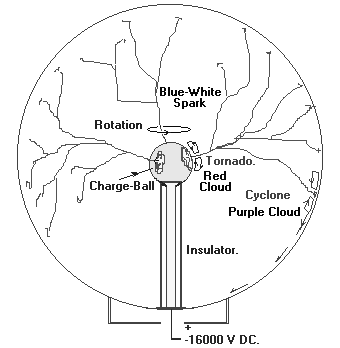
Figure 7-1 The Plasma Ball
Previously, when describing two opposed fan motors (such as
the Hydrogen molecule), it was stated, the fan-pair will
produce a rotation around the structure's central axis. In
linking magnetically, an electron added to or taken away from an
atom produces an off-balance magnetic mechanical condition.
Magneto-mechanical instability increases the rotational effect
linking affected molecules in a spiralling structure. The glowing
cloud structure rotates as it spirals to the centre if negatively
charged. The positive charge creates the opposite effect, where
the charged atoms rotate and spiral away from the centre.
An atom moving over a negative electrode picks up an
electron and rotates to attach magnetically to other atoms, so
these rotate around a common axis. Other affected molecules
magnetically link with them, forming a growing spiral, picking up
other electrons as the rotation increases along the structure's
length. From the outer radius, the negative rotating cloud
increases its rotational velocity and axial speed while
travelling across the electrode's atomic surface to the cloud's
centre. On reaching the centre, constriction produces a
perpendicular projection, as an uplift from the surface to
establish a convection cell as electrons migrate on molecules
from the updraft into the rarefied atmosphere.
The colours displayed in the Plasma Ball are dependent on the
gas molecules present. Normal rarefied air produces reds, blues
and white. The primary rotating cloud is seen as a reddish
glowing cloud swirling over the charge-ball's spherical surface.
A form of Coriolis effect applies, which dependent on applied
charge, the convective rotating cloud develops a particular
rotation around the charge-ball in the Earth's magnetic
field. The applied charge polarity develops as two completely
distinct and unique cloud structures as molecules either gain or
lose electrons.
The negative cloud is much like the tornado's storm cell with
a central updraft. As the negative voltage is gradually increased,
back pressure and rotation establish a central uplift vortex, a
stress point through which a perpendicular tornado appears. The
tumbling action so great, the tornado appears as a single red
coloured streamer. The streamer is the precursor of the bright
blue-violet spark. The rotating magnetic column adheres together
due to the altered magnetic state of each molecule in the column.
The convection cell mechanism limits the streamer's length.
Between the central charge-ball and the inner glass surface,
swirling sympathetic and parasitic convection cells or Eddy
currents form in slipping layers that move at different speeds
over the lower currents. Placing an insulated bar magnet near the
charged electrode alters the break out point where the spark
appears, as charged matter cells move around the charge-ball.
When the streamer's upper cyclone meets another convective
cell's vortex, the streamer's length increases along that route,
feeding two or more convection cells. As the streamer enters a
different convection cell, its direction changes. The Plasma Ball's
geometry promotes the formation of fork-arc structures of this
type. Once the streamer establishes a discharge route, matter
moves with great speed as a spark. The length of the tornado's
streamer is dependent on the applied voltage, and the effective
velocity and direction of molecules in the rarefied conditions.
At this moment, consider the problem with the confetti that
adhered to the Van de Graaff generator's charge ball for
different periods of time. Confetti only adheres to regions of
low molecular winds. When picked-up by the rapidly spiralling
moving air cell, the confetti is carried over the surface and
blown off in the uplift streamer, travelling for a considerable
distance at a considerable velocity on the streamer.
As the voltage is increased, the diameter of the convection
clouds in contact with the charge-ball decreases as the number of
streamer tornados increase. Due to magnetic and Coriolis effects,
the swirling clouds on the spherical surface force the classic
coronal discharge event to rotate around the charge-ball. When
viewed from above in the Southern hemisphere, the rotation of the
coronal display is anticlockwise. (ie. The observed left side
approaches the observer.)
The Plasma Ball shows that many stress points can exist in the
electric field at the same time as small convection cells form
across the charged surface. In every sense of the word, the
electric field is molecular. Freed electrons do not jump from
atom to atom or move independently. Rather electrons hitchhike on
molecules, changing the molecule's magnetic moment and
crystalline structure to force a fluid flow in mediums that
allows such motion.
The obvious differences between positive and negative electric
fields are observed when the charge-ball's polarity is changed. A
positive charge-ball means that the inner surface of the glass
produces the tornado structures for it must carry the negative
charge. On the positive charge-ball, molecules with more
protons than elprons develop magnetic rotational instabilities
where the positive cloud rotates in the opposite direction.
Molecular strings develop and travel from the centre across the
charge-ball's surface as a cyclone having an eye. Neutral matter
is drawn into the rotating convection cell's centre. As a cyclone
establishes, the vortex pulls matter into it from the upper level
of the convection cell. The cyclone rotates in the opposite
direction to a tornado. When oppositely charged surfaces face
each other, the cyclone and tornado link. A rotating blue-white
matter stream will flow with common rotation. This funnelling
column takes on a disjointed shape at first as cyclonic and Eddy
cells converge on the tornado, routing the molecular path to
different cyclone sites allowing conductivity. With very high
voltages, a point is reached where the flow becomes so great, a
burst-out event forms a single point-to-point electrical bridge,
or continuous spark. When similar charges face each other,
opposite rotation of molecular flows produces a repulsion.
However, a stronger charge forces a common rotation between the
surfaces. So, a more negative charge forces a negative charge to
act as a positive charge until the charges are distributed when
the environment reaches equilibrium with the charge.
The transfer rate of electrons from the negatively charged
surface molecules to the rarefied matter and from the rarefied
matter to the molecules on the inner glass surface, release
surface atoms and molecules into the rarefied atmosphere, takes
time. The increased activity of matter, molecular pressure and
the altered magnetic state produces surface melting and ablation
at each vortex Although there is deep pitting at the impact sites,
the point-to-point flow grows stronger. The base of each pit no
longer exists at the theoretical closest point. Vaporised matter
extends the height of the conductive surface above the surface.
The molecular impacts can be so intense, liberated magnetic
radiation can range into extremely high X-ray frequencies.
Another molecular phenomenon can be measured as the voltage
increases above the point-to-point single direct path.
Magnetically altered molecules carrying hitchhiker electrons move
from the negative surface, spiral along a tornado to the inner
glass surface. Since the action occurs in one time frame and the
reactions occur throughout subsequent time frames, Nature
establishes a transfer limit. The electron must cross two or more
interfaces before returning to the electrical pump, from the
charge-ball to the rarefied gas and from the gas to the other
electrode. At first, the rate of electron transfer progressively
increases with voltage while the electrical resistance decreases
until an optimum rate of electron transfer is reached for that
vapour pressure. Above this optimum voltage, the matter-electron-matter
transfer rate is limited as the electrical resistance increases
with molecular wind speed and impact exchange.
In partly accepting the electrical theory of the day, (electrons
exist in an electrical current as pure electrons) Lorentz
failed to link very high voltage resistances to the properties of
matter at the atomic level. To explain a vacuum's increase in
resistance with voltage, he described a mathematical short-cut
that gave near-enough answers. His research identified an
upper limit to matter's electron exchange rate, however,
Lorentz incorrectly argued, 'as electrons neared the speed of
light, time is altered'. The mathematical short-cut of time
dilation promotes as the mechanism, a mathematical illusion. At
this time Kirchoff was still identifying the spectra of different
atoms in flames and ionised gasses. The technology of the
mid to late nineteenth century did not include atomic clocks,
accurate counters, computers, an understanding of matter, the
Periodic Table, or any means to confirm or deny Lorentz'
unfounded notion. The time dilation effect is an unproven
speculation without basis in Nature yet this deluded belief is
intrinsic to the foundations of Einstein's
Special Theory of Relativity, and more recently to Quantum theory.
When short-cut mathematical approximations are used to prove
something as true in Nature, without considering Nature, the
conclusions must be challenged, for they are most probably wrong,
unscientific and deluded. To be scientific, irrespective of the
atomic model, considering the available knowledge, primitive
equipment, the state of technology, the researcher and student
must ask of such research,
- 'How were the time and electron speed actually
measured?'
- 'What is the accuracy of the observations?'
- 'How, and to what standard, was the equipment
calibrated?'
- 'What proof supports a change in time as voltage is
increased?'
At the start of the twenty-first century, the resolution of
the technology is such that the speed of electron transfer across
a gap can be measured with some accuracy. It is noted that
electron transfer is measurably slower at normal atmospheric
pressure than in a vacuum.
When the Plasma Ball's design is slightly changed, different
phenomena are observed. With three electrodes in the rarefied
atmosphere, connected through a switchable ladder circuit, the
first electrode can be made to carry a positive charge, the
second made electronically neutral and the third a negative
charge. In this configuration, the glass envelope will only be in
circuit by way of surface wetting effects. As the neutral
electrode exhibits a dual charge, electronically positive to the
negative electrode and electronically negative to the positive
electrode, it glows. The positive side of the neutral electrode
forms a cyclone and the negative side forms a tornado. As each
electrode can be switched out of circuit or its voltage varied,
different effects can be observed, especially when all electrodes
are configured with the same polarity. The ladder circuit can be
examined with increasing potentials of the same polarity to show
charge relativity.
The mirrored rotations of the oppositely rotating convective
cells link the charge points together to produce an in-line
rotating molecular tunnel. A conductor, when placed within the
electric field, establishes a dipolar field with the charge. This
is a magnetic induction effect. To illustrate the magnetic
effects of the moving electric field, the magnetically altered
atoms, a small conductive object, such as a coin, can be placed
on the top of the Plasma Ball's transparent dome. Due to magnetic
induction through the glass, an electrical current flows in the
coin. The coin becomes so excited, it promotes a great deal of
streamer activity, throwing sparks into the surrounding
atmosphere. This capacitance effect has molecular magnetic
origins, producing induction.
The electric field attracts molecules and atoms to the charge
terminals (from the free surfaces), transferring charge through
pressure in a field amplification effect. The affected molecules
develop an altered magnetic state. The turbidity of the charged
molecules is so great, they may fluoresce. The rotational inertia
of the molecules and atoms promotes a molecular vortex, whereas
the voltage increases, a spiralling tornado break out region
develops at the centre of the vortex in a direction perpendicular
to the rotation. The terms monopole and dipole become irrational
in this situation, for electric fields form vortexes, pressure
fronts, burst-out-points, cyclones and tornado flows. The
magnetic flow-through field structure is not visible in electric
field structures.
The electric field, as a molecular alignment field, its shape and properties are dependent on
the voltage and the local environ's ability to produce an
electric field. The shape is also modified by the shape of the
electrode. When the Plasma Ball's central conductive sphere is
replaced with a spike, the flow pattern or the vortex forms along
and around the spike, forcing the stress point to the spike's tip.
This confirms the fact that the electric field is molecular in
origin, not sub-atomic.
The spark always originates at the negative charge tornado.
With increased activity, a molecular electric field develops
radiating outward from the electrode as matter aligns to the most
efficient magnetic arrangement for the highest magnetic
throughput. Neutral atoms are pushed onto the electrode by
displacement and back pressure from atoms carrying hitchhiker
electrons, altering the gas' chemical and crystal structure. As
molecules and atoms impact, twist, roll-over, make and break
bonds, different structures form.
Resonance, electrical conductivity and mechanical energy, can
be observed in the classic discharge tube display. The air at
normal temperature and pressure, in a half metre discharge tube,
seemingly does nothing when 10,000 volts DC is applied to the
electrodes. The electrical resistance decreases as air is removed
and electrons begin to flow. The air immediately in contact with
the electrodes begins to fluoresce due to molecular pressure
impacts. A tornado air cell develops on the surface of the
cathode while a cyclonic flow develops on the anode. At a Mercury
pressure near 15-20 mm, the spiralling gas forms a coaxial
convective cell. With a deepening vacuum, (10-15 mm)
the cathode tornado progressively grows as a blue streamer spark,
forking and routing. The spark does not travel directly to the
anode, being deviated by the Coriolis effect and the Earth's
magnetic field, spiralling and twisting as it slowly migrates
along the length of the tube towards the positive electrode
through disjointed convective cells. The shape of the spark is
related to the position of the convective cells. Sympathetic
coaxial Eddy cells develop at mathematically related positions
along the length of the tube. With the spark reaching the anode,
the electrical resistance decreases as a pink-red fluorescence
grows from the anode.
As illustrated in figure 7-2, at pressures of 5-10mm, the
coaxial convective mechanism segments the pink glow into dark
regions and fluorescent striations. In the convergent region
separating convection cells, fluorescent bands appear as atoms
and molecules impact, collide, reverberate and change direction.
Mechanical molecular resonance does not occur in the Crookes and
Faraday dark spaces because the convection cell alignment
prevents internal collisions taking place. In the bucket brigade
of convergent zones, impact and hitchhiking electron exchange
promotes resonance in the convergent zones. The cusp shape of
each perpendicular column identifies the coaxial convective flow
directions in the convergent zones, where the cells obey the
principle of equilibrium as matter reaches the point of highest
energy throughput and interchange.
The striation bands suddenly vanish when the vacuum is
deepened to 0.01 to 0.001 mm, as the entire tube appears to
fluoresce with a uniform intensity. Since the standing wave
resonance characteristic of the rarefied gases can be observed in
a spectroscope, this glow is not an effect of cathode rays
hitting the glass, else the glass-spectra would be seen. The
inside glass surface is wet by gas molecules. As the momentum of
the molecules travelling in the beam will produce rotation in a
small mica paddle wheel, the return flow can be observed in the
Plasma Ball as the gas molecules flow across the inner surface.
In the discharge tube, the increased molecular activity
establishes the single coaxial convection cell between the
cathode and the anode. Hitchhiking electrons migrate on the
magnetically altered gas molecules so rapidly, resonance is
sustained on both the direct and return paths.
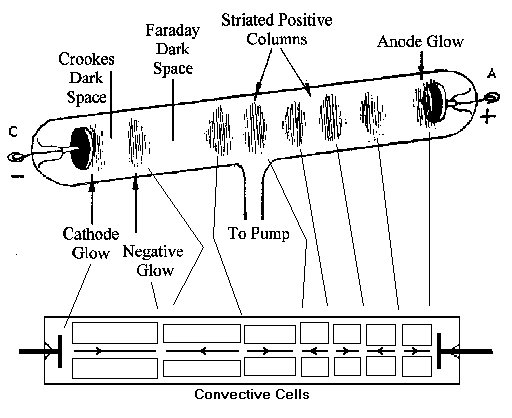
Figure 7-2 The Classic Illustration of
Fluorescence in a discharge Tube
(A structure that remained a niggling mystery defying logical
analysis)
When a balanced magnet is held on a gimbal frame, it can swing
in every direction around the balance point. As a similar magnet
is made to pass by, both magnets spin about. If the velocity of
the second magnet is increased, the magnet on the gimbal may not
move as the second magnet passes by, however the magnetic fields
of both magnets will be distorted. This effect is seen when
moving atoms momentarily load the elprons in both atoms, causing
a shock and subsequent reverberation, liberating magnetic
radiation. As the magnetic repulsion of these atoms is so great
the particles possess the wrong magnetic orientation for
collision. There is a great deal of motion here, however
collisions are avoided due to the convection cells moving in
opposite directions directly at each other. The shape of the tube
and its magnetic walls assist in creating the directional resonances events.
It is scientifically claimed that the gas laser works as a
consequence of atomic separation and emission reinforcement of
the liberated wave length. The gas laser is not a resonant
chamber, and works irrespective of pressure changes. Resonance
continues on the molecular sideband frequencies of the molecules
involved, irrespective of molecular separation. It must be argued
that if molecular separations were the cause, a separation
increases with deepening pressure (from 10-3 to 10-8
mm) must cause the laser to sweep through resonant points and
peaks. This being due to the structural requirements needed to
produce a resonance at each wavelength. With a separation
increase due to deeper vacuums, the frequency must progressively
become lower. This is not observed! Once the gas begins to
glow, pressure changes do not alter output frequency, intensity
or produce beating. Figure 7-3 shows the construction of a
typical gas laser.
1,000 --> 5,000 V
Figure 7-3 The Gas Laser
The laser tube is a simple discharge tube, where the light
beam is deliberately made to travel along the length of the tube
before finding a semi-mirrored transparent hole. This allows the
light beam to reflect backwards and forwards along the axis of
the tube before it escapes. The gas is fluorescing, not the glass
walls. The same spectral lines are seen when the particular gas
is involved in a normal discharge tube event, in rapid chemical
reactions, and again when nuclear events involve the production
of the same atoms and molecules. Often, home electronics
constructors toy with gas laser kits that run lethal voltages,
when the laser tube can be stimulated into resonance using a low
voltage radio frequency.
Oddly, the same argument of molecular separation is used to
explain the Ruby Laser. The Ruby is a crystal of Corundum, an
Aluminium Oxide (Al2O3), the same family as
sapphire and emery. The red colour is due to traces of Chromium (parts
per million). This solid crystal has a much higher density than
any rarefied gas. A crystal rod of ruby is similarly coated with
a mirror at both ends. The crystal is stimulated into emission
with a bright flash of light.
It is necessary to appreciate matter, magnetic radiation and
resonance, before any mechanism involving molecular separation is
contemplated. In the atmosphere, atmospheric pressure will change
the tuning of a pipe organ. If the true laser supposedly produces
a coherent beam of light, then the beam must be monochromatic.
Irrespective of the means promoting the laser beam, every laser
has a spectrum composed of unique spectral lines. This states
that irrespective of pressure and temperature, specific molecules
and atoms are responsible for their specific resonance. There are
several types of lasers, including gas laser, liquid dye, LED,
and optically pumped lasers. Matter will be examined in the next
chapter.
Thermionic Radio Valves : The Plasma Ball is a cold
cathode device and as such can be made to simulate many radio
valve effects. Cold cathode radio valves generally require high
voltages to work. When the charge-ball is heated, the lowered
viscosity of matter in the convection cells allows affected
matter to travel faster, exchange electrons and permits atoms and
molecules in contact with the heated atomic surface to carry more
electrons. Heating a reduced voltage electrode may form multiple
streamers in the coronal discharge event.
The simplest vacuum tube is the diode.
Heating the cathode allows magnetically altered molecules to flow
better in one direction than the other. This key point of the
design creates the conditions needed to rectify an alternating
current and to force a directed molecular current flow. Electrons
are carried on molecular winds from the hot cathode to the cold
anode at increadible speeds. This is also experienced in normal
air. Although the Tesla coil is an air core transformer produces
extremely low current ultra-high voltages, perhaps 1,000,000 V AC,
local thermal warming of the air produces the conditions
necessary for the atmosphere to act as a diode valve. Heating may
arise from the trigger spark and the Tesla coil's resistance.
As illustrated by the Plasma Ball, around a single cathode,
several anodes can exist at the same time, producing some very
complex field situations. Another key point is that any metal
electrode placed in the electric field (and not connected to the
circuit) links with the field to develop a negative charge. This,
the Edison effect can create several cathodes around the primary
charge, allowing the field to discharge at a greater rate. The
Edison effect is in part due to magnetically altered molecules
settling on the conductor, where molecular pressure deposits
electrons.
When a third element, a wire screen, open mesh or a spiral of
wire, is placed between the cathode and anode, the
characteristics of the diode valve are dramatically changed. Due
to the Edison effect, this mesh fence or grid develops a negative
charge and as the charge builds up, the flow of matter to the
anode at first increases, but then the current flow begins to
reduce. As the grid is not heated, it forms a cold cathode as it
becomes more negative. A charge build up causes the valve to shut
down. (Although this is said to be an effect of charge
polarisation, it is an example of charge relativity. The local
environment between the cathode and the cold grid becomes
saturated, forming a localised molecular flow between the cathode
and grid. Once the environmental conditions stop all conductivity,
the cold grid discharges slowly into the greater environment.
Since a cold cathode requires a high voltage, the molecular gap
forms a high resistance that retards the molecular flow to the
anode. This is a case of like charges attract, to the
point where too much like charge stalls the effect.
In a triode valve, this problem is overcome when
a bias voltage is applied to the grid. The desired effect
is to lock the grid bias voltage at a point slightly more
negative than the cathode. A negative voltage source, or a
resistor placed externally between the cathode and the grid,
maintains the bias voltage on the grid and a rapid throughput of
charge carrying molecules to the anode. The value of the resistor
depends on the valve's molecular circulation characteristics.
These characteristics change as the vacuum is slowly contaminated,
or as air leaks spoil the vacuum.
Although radio valve theory only concerns the motion of
electrons moving across the gap, there are big differences in
similar radio valves due to each valve's molecular circulation
properties. Without this knowledge, radio valves evolved through
trial and error. To obtain higher frequencies, radio valve
manufacturers made the valve smaller and smaller. To increase the
electrical current control, the valve's anode must be made from
more resilient materials with more breather holes and ventilation
space. The molecules must travel across the vacuum, from the
cathode to the anode, and return to the cathode. Radio valves
work in the voltage region below the level needed to create a
spark or to fluoresce the gas, yet the molecular approach speed
is so great (near the speed of light), molecules fly by and find
themselves in the cyclone of the anode. At much higher voltages,
the Plasma Ball shows these effects in the fluorescing gas. This
is quite different to the belief that electrons form an electron
cloud around the anode.
The negative bias voltage is important as hot molecules are
accelerated in the convection cell away from the cathode. These
magnetically challenged molecules enter the region of
magnetically compatible molecules, hanging on the grid. This
creates a great force of attraction, so the gas molecules
accelerate and stream through, perhaps grabbing additional
electrons on the way, to be caught in the anode's cyclonic flow.
Magnetic molecules strike the anode with such velocity, the
charge is exchanged. As they cross the anode, molecular pressure
allows the anode to rob more electrons. Although these molecular
effects are not normally observed in the vacuum tube, they can be
observed in the Plasma Ball.
If it were that like charges repel and unlike charges attract,
one would assume that to accelerate electrons across the gap, the
grid should be made more positive than the cathode. If this
happened, and the grid became positive with respect to the
cathode, the grid becomes an anode. The results are most dramatic
when this is attempted experimentally. A triode with a positive
grid is a diode. This grid suffers the consequences of molecular
bombardment, causing the grid circuit to dissipate so much energy
that the effect may destroy the valve, melting or vaporising the
grid. The grid must be more negative, but not too negative. This
effect can be illustrated in a modified plasma ball.
Amplification is achieved in the basic thermionic triode valve
amplifier circuit, (figure 7-4) as molecules carry electrons from
the cathode across the vacuum through the negative open grid to
impact with the positive anode, establishing a convection cell
that must pass back to the cathode. The size of the convection
cell and the physical resistance to molecular currents in the
valve give the device its response time, resistance and
establishes the valve's characteristics. Constricting the
molecular flow through poor anode ventilation dramatically alters
the valve's characteristics. Any voltage applied to the grid
produces a change in the grid's matter cloud density. This varies
the matter currents flowing across the valve. Effectively as the
magnetically altered matter is carrying additional electrons, a
small change in the grid voltage greatly alters the ability of
the convection cell to transport electrons, thus, the output
voltage and electrical current flowing in the valve are changed.
This simple system allows the radio valve to amplify an
electrical signal. Triode valves are not perfect amplifiers. To
improve the response, more grids are placed between the signal
grid and the anode. These can be used to accelerate matter and
increase the output current, or to mix several signals together.
The second grid is typically treated as another cathode.
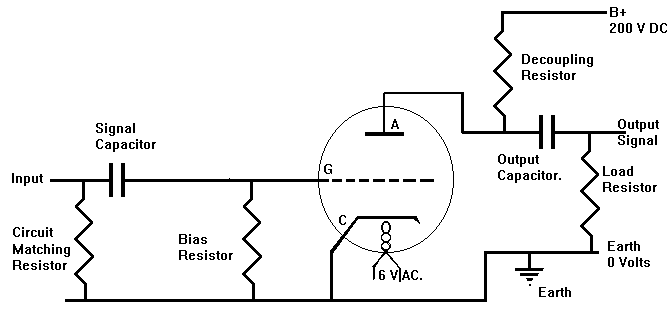
Figure 7-4 A simple Triode Valve amplifier circuit
All the effects that occur within the thermionic valve can be
made to occur in normal atmospheric conditions, however, the
voltages needed are extremely dangerous, owing to the magnetic
forces needed to overcome the crystalline resistance of the
atmosphere (a form of inertia). As the electric field develops,
similar events occur at voltages proportional to the number of
molecules affected and the proximity of molecules in the
environment. Electrons are flowing because molecules are
physically carrying them.
Most of the active elements in a television picture tube exist
in the neck of the tube. This is a simple thermionic valve with
several anodes. The beam is formed in the electron gun (figure
7-5) by a heated cathode, which is attracted to and through a
grid. The optics of the electron gun do not obey the laws of
Optics. The focusing method employed in the picture tube must be
described as either pseudo-optics or particle-beam optics.
To create the picture, a beam must
scan the image and then another beam must recreate the image,
position by position across the screen. The scanning image
recording beam must be synchronised and deflected to the same
position on an image screen by either electric or magnetic means
to recreate the image. A single frame is made of individual lines,
where the analogue signal altering the beam current change
carries the picture intensity information. The beam is made to
move across the screen from left to right (depending on the
nation's television standard), as 525, 625, or 1024 horizontal
lines, while tracing a path down the screen, 50 or 60 times a
second. Most television sets and monitors use magnetism to
deflect the electron beam. An electromagnetic yoke, mounted at
the base of the neck is used to deviate the electron beam. By
altering the electrical current, opposite coil pairs form a
magnetic field across the spiralling molecules in the beam. The
interaction of each directed magnetic field to the beam's
spiralling magnetic field causes the vertical coil to deviate the
beam horizontally and the horizontal coils to deviate the beam in
the vertical direction. Molecules carrying additional electrons
are accelerated towards the first anode. The matter beam passes
through the focussing rings. Matter adhering to the various
circular grids affects the beam due to the commonly aligned
magnetic fields aligning the beam. The spiralling tornado beam is expanded and
compressed to be focussed as an extremely thin matter beam.
Voltage variations on this control grid produce brightness
changes as the beam current alters. A hole in the electron gun's
first anode allows the molecular beam to continue down the neck
of the tube, carrying electrons to the screen. The high potential
of the second anode a2, pulls the beam apart, while the voltage
on a3, pushes the beam back together. Voltage variations on the
third anode from -250 Volts (as a cathode) to +250 Volts, focus
the beam as a fine dot on the screen. To discharge the screen, a
pseudo-fourth anode, the molecular flow carries the charge to the
fourth anode. This fourth anode, a4, is removed from the screen,
and mounted around the cone shaped bell of the tube. It is
electrically connected to the second anode.
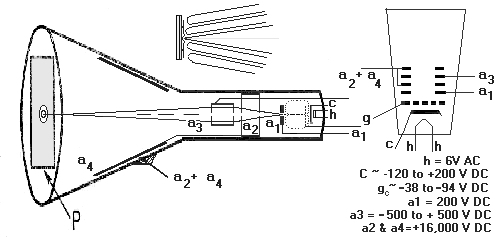
Figure 7-5 The Optics of the Electron Gun
The optical effects and phenomena associated with the electron
beam involve mechanisms belonging to Particle Physics in forming
a synthetic or synthesis image. Wave optics form an entire image
on the focal plane, where at any time, any part of the image can
be observed. Particle optics use tricks to scan an image or the
object. When light is focussed in a video camera, it is a wave
optical image that is initially focussed. This is then converted
into an analogue sequential string of voltage intensities for
each position of the screen. To restore the image demands
recreating the image intensity at each position on the screen, by
altering the intensity of the electron beam.
Due to the disparity between wave and particle motion, the
optics are completely different and should not be confused.
Geometric ray tracing of the optical path may indicate similar
effects and similar laws. Although similar optical effects are
seemingly produced, the mechanisms and the responses differ
markedly. Completely different mechanisms produce refraction,
reflection, diffraction, transmission, propagation, and
transparency. Particle optical events have characteristic traits
not found in wave optics. Similarly, the mechanisms of wave
optics produce effects that cannot be explained through particle
theory. Some wave optical effects are mimicked by particle optics,
while many others are not. As waves are formed from the motion of
much smaller particles, the effect of the component particle may
alter the wave's response. Wind curtains and conical flow
structures are used in particle optics.
To produce the picture, very high voltages are required. Most
monitors and television sets carry warnings about dangerous
voltages, often between 10,000 and 30,000 volts DC. A high
alternating voltage from the EHT transformer (similar to a Tesla
Coil) is rectified to produce a directed electric field. The
primary anode is around the screen itself. The electron beam is
aimed at and focussed on the screen, so as to force the phosphor
particles to glow. The molecular wind then flows across the
screen's internal surface to the surrounding anode circuit. Only
when a television set is initially turned-on, as the electric
field establishes, are the static effects of the charged screen
noticed, attracting dust and hair. Once the field is established,
no longer does the screen seem to present the same force,
although the dust particles continue to adhere to the screen.
When the device is powered-down, the screen presents a charge
that discharges. Some dust particles will fall from the screen.
Although the electron microscope should "see" atoms,
because the electron is believed to be 1840 smaller than the
proton, its resolution is dependent on the gas molecules in the
evacuated space. The smaller the molecules used, the better the
resolution. The second problem with particle optics is one of
image rotation, where the image formed by a scanning particle
beam twists as the beam intensity alters. To twist an optical
image around the optical axis, does so around the direct line of
sight, and this requires reflection. Optically, an image
inverting prism does the trick, where a total internal reflection
on a flat surface rotates the image. Although optical
polarisation can be rotated, intensity and polarisation do not
rotate the image.
In some B&W television sets of the 1950's, and most
cathode ray oscilloscopes (CRO), two sets of deflection plates
positioned inside the neck of the tube, but closer to the screen
deviate the beam. The beam must pass through an altering electric
field. Inside the picture tube the Bernoulli effect and
aerodynamic principles deviate the beam as molecular wind
curtains blow and bend the electron beam to a new direction. A
vertically mounted pair of electrodes blows the beam from top to
bottom, while the horizontal plates blow the beam from left to
right. This introduces a fascinating optical problem. As the beam
current alters the brightness on the screen, the changed beam
current causes an image twist. This is not conducive with a
theory that states the beam is moving electrons. The rotation is
due to the beam's spiralling magnetic field interacting with the
directed molecular wind curtain across the tube.
Disconnecting the scanning mechanism of a TV set stops the
beam's motion. A small very bright dot appears at the centre of
the screen, showing the cross-section of the beam. The small spot
is surrounded by several disks of diminishing intensity, much
like the Quantum mechanics Wave-particle description of the atom
or a "bull's eye". If left to operate like this for any
great length of time could result in a permanent phosphor burn.
A strange phenomenon, also called a coronal discharge is noted
on some older monochrome television screens when a working
television set is turned-off. Appearing as a bright spot a space
charge or coronal discharge may appear and persist for several
minutes. This is not the same effect as the coronal discharge
found at the tips of an aerial, at the tip of the Tesla coil or
above the charge-ball of a Van de Graaff generator or in a Plasma
Ball.
As the rarefied gas has been contaminated by metal molecules,
it presents a more conductive path to discharge the stored EHT
voltage. A small bright dot appears at the centre of the screen
surrounded by a pair of rings of decreasing grey-scale. The
intensity of each ring is uniform (figure 7-6). The cross-sectional
geometry of the picture screen reveals that the centre of the
screen is the closest point. Molecules carrying electrons are no
longer focussed by the circuitry. They travel through the
rarefied gas to the screen, discharging into the environment.
This motion is confirmed by placing a small magnet near the
bright spot. As the moving atoms carry electrons in the direct
beam, a spiralling magnetic field is developed around the beam.
The directed magnetic field causes the entire concentric
structure to move and roll as a unit away from the magnetic pole.
This reveals that each concentric ring is produced by similar
magnetically altered molecules moving to the screen in the same
direction with the same velocity. When the molecules strike the
screen, the excited phosphor liberates light depending on charge
intensity. The geometry of the electron gun at the back of the
picture tube reveals the answer. As the electron beam normally
travels from the cathode through the grid to the focussing anode,
when the set is turned-off, the anode and grid become negatively
charged due to the Edison effect. Three or more different
cathodes now exist in the neck of the tube and discharge to the
picture screen.
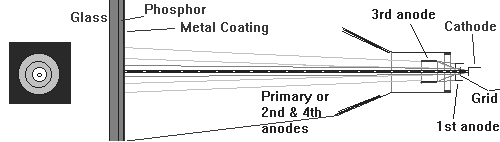
Figure 7-6 The Television's Corona discharge
Although many cosmologists believe that blackholes and neutron
stars are the only cosmological objects that naturally produce X-ray
emissions, the Sun, Jupiter and the Earth are known X-ray sources.
Detectable in space are X-rays liberated by the enormous voltages
and high currents in the lightning spark. As the Plasma Ball
indicates, the spark is not just a flow of electrons, it is a
flow of hypersonic matter. When matter strikes matter with
sufficient force and atoms physically collide, X-rays and other
magnetic radiation frequencies are produced by resonance. The
beam needed to create the television picture causing the
illumination, strikes the phosphor with such force, sufficient X-rays
are liberated that a piece of photographic paper wrapped in an
opaque dark material and attached to the screen, will be exposed.
Matter beams were first identified in 1897, by J.J.Thomson in
the positive ray experiment. Using extremely dangerous
voltages (around 50,000 Volts) Thomson's device (figure 7-7)
reverses the basic cathode ray tube design, forcing the tube to
act (as he believed) as a cold anode device. Theoretically,
positive matter leaving the circular anode travels towards the
ring cathode and on through the tube to make the phosphor glow.
Thomson deviated this positive matter beam with directed electric
and magnetic fields. This device produces some very interesting
illusions.
To Thomson, these illusions indicated a reverse beam travelling
from the anode to the cathode, so he argued that as the energies
required to produce cathode rays, being much less than for anode
rays, then the two beams are intrinsically different. He
concluded that one beam must be electrons and the other must be
atoms. Because of the disparity in energy levels, and that
different masses seem to strike the phosphor at different
positions, the deflection must be related to the atomic mass. As
this effect is indicative of the mass, then an indicator is used
in the mathematics, so the mathematics seem to work. The problem
is Thomson's descriptive analysis.
To reconcile Thomson's positive ray device with the rotating
molecular clouds of the Plasma Ball, it is possible to explain
this device and the illusion completely. The instrument's design
promotes the observed effects and produces several observational
illusions. One must throw away the notion of a cold anode
and replace it with a cold cathode ring. This is pure
particle-beam optics using conical flows. Irrespective of the shape of
Thomson's anode, because a cyclone wind is formed, the anode
becomes a ring. With an increase in voltage, the convective
molecular field shape between the negative cathode ring and the
positive anode forms a high velocity centralised swirling return
flow. For the over-shoot beam to focus demands applying a
considerable amount of energy.
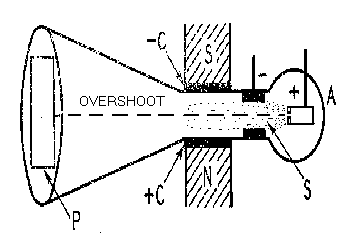
Figure 7-7 Thomson's Positive Ray experiment
Neutral and positive matter returning from the anode ring is
forced to constrict along the axis of the tube as a spiralling
tornado-like return flow, from the hypothetical centre of the
anode, the apparent anode ray illusion will appear. The anode
does not need to have a hole at its centre. The high voltage
applied between the cathode and anode increases the molecular
flow and back pressure at the anode's circumference. This forces
the spiralling mass to cross the anode in the reverse direction
as it is neutralised. On reaching the centre, the compression is
so great, the return molecular flow forces a perpendicular
fountain, a return flow. When the voltage is sufficiently high,
an overshoot condition occurs and the beam focuses on the screen.
In the Plasma Ball situation, similar ring electrodes serve to
identify the conical molecular flow structure formed in the
positive ray tube.
As the beam current increases, the picture twists. When the
magnetic deflection fields are suddenly switched-out of circuit,
the beam deviation ceases. Because moving magnetically altered
atoms form the beam, when the beam travels over an irregular pole-piece,
the atoms are deflected in opposite directions. This is
conclusive proof of the motion of atoms in the electron beam. It
does not identify the electron's shape, any new particle, or
magnetic electrons, yet was cited by Pauli as the penultimate
reason for accepting quantum spins because the Rutherford model
of the atom could not explain the effect. Pauli gave the orbiting
electrons opposite spins.
--------------------- END CHAPTER SEVENN
------------------
Size 17,440
Exercises.
1."By comparing two chemistry texts published a Century apart (say, 1870 and 1970 CE), by noting the valencies of common elements, please determine whether Chemistry made the necessary corrections when the scientific community changed the electron's charge to negative."
Chapter Notes
The Electric Wind Layer Fire Stopper
The layer fire must be considered as the most dangerous and most difficult fire to extinguish. Typicaly caused by spilt fluid igniting on a floor, as the fuel becomes less viscous, the fire rapidly spreads, to all objects above floor level. extremely difficult to extinguish. Due to the area and rate of spread, most fire extinguishers fail in this situation. Often, fire-fighters become engulfed in these fires due to a sudden flash-back where the extinguised fuel ignites. As a ground hugging device with no moving parts, the electric wind produced not only blows the layer fire away from the fire-fighter, increasing the safety aspect, the aligned molecular wind prevents Oxygen entering chemical burning reactions.
Return to Text
---------------

Removed Text
The sciences must be based in Nature's Universe to correctly explain Nature. However, rather than describing natural events at the atomic level through a common mechanism's natural effects, scientific explanations use contradiction and complexity based on deluded physical and mathematical models derived from predictive parallel short-cuts, approximations, generalisations, empirical expressions and tricks. In spite of Nature and natural processing operations, with notions and ill-conceived theory explaining observations, early researchers hijacked and promoted terrestrial observational effects as the responsible mechanism. Since the sciences accepted these terrestrial illusions as Nature's very being, the scientific community enforces the use of this invalid scientific belief-set as the means to explain all new observations. In failing to adequately describe Nature's Universe, tendentious theory grew stronger as the sciences became more contradictory and preternatural. The scientific community's practice of accepting and maintaining invalid historical artefacts, as unquestionable scientific beliefs, actively spawned much deluded theory and created greater mysteries. Scientific mysteries only exist because Nature does not obey humanity's preternatural scientific laws. Unfortunately, as blind ignorance, indoctrination, and scientific arrogance categorised the necessary fundamental natural processes as scientific mysteries, scientific explanation only becomes possible outside the scientific community.
One must be very careful endorsing the accepted scientific belief-set concerning the physical and chemical behaviour of matter and energy, when the sciences use parallel and unrelated explanations describing a plethora of events and diverse observational effects that incorrectly define and wrongfully attribute numerous process effects as unique mechanisms (such as; current, potential, force, conductivity, ionisation, polarisation and coronal discharge). An observed event need not be produced by a common inferred mechanism, or for an inferred common process without explanation as being responsible for a diverse range of non-related events and effects. To avoid confusion, inferred mechanisms must be qualified by a suitable adjective, attributing the observation to the correct cause and definition.
Under the scientific community's Utopian ideal enforcing historically accepted definitions, where upper and lower resolution effects prohibit certain scientific mysteries being satisfied, despite advancing technology negating all previous explanation, the sciences maintain ignorance. Excellent examples appear in Cosmology where ego, religious beliefs, indoctrination, seeing conditions, and a telescope's light gathering power, establish the upper limit as the size and age of the visible Universe. It must be seen as a naive and egotistical indulgence to accept without basis and proof, the radial size of the technologically limited visible Universe as the actual age of the Universe, (stated as being either, 13, or 15, thousand million years).
-----------
Although the directed magnetic field does not seemingly alter the electric field and the electric field does not appear to alter a directed magnetic field, theory states that when an electric field moves with respect to a stationary object or in a gravitational field, it produces a magnetic field. The direction of the field being dependent on the charge and the direction of motion. With respect to any stationary position in space, every electric field on the Earth must be seen as a magnetic field because it involves moving charges. The electric field cannot be considered as a stand alone field when the surrounding environment establishes the opposite-terminal (even in a deep vacuum). Electric fields only exist in the environment when conditions allow the field to develop. The processes taking place around the charged body at the atomic level become important