CHAPTER FIVE
THE ATOM
As a simulation from a reaction's ignition to its exhaustion point, please contemplate a hypothetical situation using every calculator, home PC, laptop, and mainframe computer on this planet, with each device starting and running the same program at precisely the same local solar time, 9:26:00 AM. In this burning fuse simulation, with each computer using the same algorithm and data, where programmed step-by-step processing instructions invoke specific response events and reaction products, representing a single group of reacting molecules, although started at the very moment the meridian reached the 9:26:00 AM heliocentric position, the local event's physical response effects only begin when the computer activates the printer, whereupon the reaction products follow the Earth's rotation in printouts showing the calculated observational table.
Since the duration of each local event depends on the computer's processing speed and print rate, although the CPU computations may take a few milliseconds, the slowest hand held calculators require ten minutes to perform the calculations, with slow printers and hand writing extending the reaction's extinguishing time by another minute, creating an overall response reaction envelope, on each meridian, producing an almost instantaneous beginning to a slow fade out point some 11 minutes later. During this once-only reaction, computer availability and distribution on each specific meridian allows this simulation to flare up and die away, progressively flickering for 24-hours 11-minutes as the world turns, producing an 11 minute observational error.
Obviously, the reaction envelope's shape depends on the Geographic starting and finishing location. If taken from the International Date Line, the reaction rate slowly increases, with flare ups and die backs, followed by a progressive fade-out, however, if begun on Amsterdam's meridian, the reaction suddenly starts and suddenly concludes with the European flare up. Due to software bugs, data entry problems, different degrees of accuracy, incompatibility, power failures, viral infections, and paper jams, to ignorance, confusion, apathy, laxity, boredom, and animosity, this hypothetical simulation must consider computer problems, human weaknesses and failure. Consequently some data must remain unprocessed and unchanged, while data subject to processing errors mutates into something different.
Apart from the noisy environment during printing, an overview of the world's computer chatter observed from terrestrial power stations and orbiting satellites reveals several different and distinct long range response effects, transmitted as signals-of-change in different mediums. Power stations report higher than usual local power drains during maximum processing and printing times, while satellite operators begin an analysis on the 24-hour 10-minute spurious background radio noise transmission, that beamed vertically into space from the 9 hours 26 minute meridian. Many years later, in far off distant worlds (aligned to objects in the mid-morning sky), alien scientists seeking evidence of intelligent life existing elsewhere in the Universe describe a strange 24 hour event as a bright transmission over the radio spectrum's shorter wavelengths, as a cacophony of overwhelming chaos emanating from a location near that dull yellow star.
Nature's Simplicity
This hypothetical illustrates that many factors influence a natural event's cumulative responses creating an illusion where apparent observational complexity and human interpretation hides Nature's mechanical simplicity, (where mechanical describes step-by-step processes.) Irrespective of a reaction's apparent size, magnitude, longevity and complexity, the primary reference frame for all events involving matter and measurement, exists at the atomic level. With pre-existing knowledge of a common program with common data producing the above simulation, it becomes obvious that only with the correct model of Nature's mechanism, of the atom and its workings producing programmed response reactions affecting other matter, then every event in Nature's Universe becomes an expectation with suitable simple explanation.
Rather than examining the problem's roots, correcting the sciences, devising an atomic model, a mechanism that elucidates Nature's Universe, since the eighteen hundreds, isolated researchers who suggested alternative atomic models faced derision and extreme scientific opposition, despite developing models fitting perfectly into the misleading, deluded and wrong scientific belief-set (one that inspired models lacking the fortitude and primary mechanism needed to explain Nature's Universe). Unfortunately, fearing credibility challenges and scientific rebuttal, academics and researchers adopted the sacred-cow approach, treating particular areas of science and research as hallowed-ground that cannot be walked over.
The Atomic Model.
Perhaps the elastic liquid-drop atomic model, suggested by J.J. Thomson in 1908, could be considered as this period's most interesting atomic model, because it considered the atom somewhat like a bead of liquid-Mercury that can be crushed and squashed, squeezed and stretched into other shapes, or when pushed into another bead forms a larger bead. Due to Thomson's work, chemical theory identified only two atomic particles at this time, the proton and the electron. With the liquid-drop model presenting the concept of an equal distribution of positive and negative charges, since the model does not possess the necessary mechanism to form chemical bonds, it gave dogmatic scientific zealots great advantage.
In calling it an Alchemist's ideal hermetic atomic model, the scientific community directed much unfair criticism at Thomson; some academics advanced ignorant chemical theory proclaiming that Chemistry disproves the model because Gold cannot form from fusion reactions. Although certain chemistry departments defined fusion as chemical bonding, other departments uniquely described fusion as melting, as pressure welding, and as changing state. Using the terrestrial illusion that charge neutralisation must explode the atom, scientific zealots successfully misled the scientific community forcing the removal of this valid liquid-drop atomic model from scientific consideration.
In decoding the basic workings of Nature, one must examine and appreciate a computer's internal workings, for here, mindless simple processing takes place. Although appearing as a complex piece of technological hardware, few people understand how they work, with complex reference texts describing in technical jargon the basic operating rules and the simple mathematical procedures. At the very basic operating level, the computer's apparent complexity reveals just two logical switching states, either off, or on, where sequencing and simple mathematical processing as binary addition and subtraction, establish the principle operations responsible for all calculations, graphical representations, sound production, and peripheral interfacing, (including keyboard entry displaying a single character on the screen). For a better appreciation, please read the article The computer's innermost workings, found at this Chapter's end, in the Chapter notes.
At this circuitry level, turning a circuit on and off appears so simple, involving six Boolean processing logic operations, where the addition of "off" and "on" produces various "off" and "on" conditions, programmers and computer engineers protected position and status, with jargon and non-meaningful buzz-words complicating all explanation. Irrespective of Nature's apparent complexity, the same applies to the scientific community protecting status, position and grants, calling on uncertainty, chaos, negating time, parallel universes, and hocus pocus mysticism. Equally, with sophisticated and convoluted theory built on errors making understanding daunting to the novice, academics use contradictions and self-confirming tautologies to their advantage, rejecting any theory that could decipher Nature's 3-D machine code.
Decoding requires developing a mechanical understanding of matter at the atomic level of Nature's BEING (described in the next Chapter), and the mechanism's primary response reactions affecting matter propagating energy and force-forms (The AD 2000 Æther Theory). Although at this level, the simplicity of mindless mechanical response reaction reveals the atom as a simple scavenger engine, responding to environmental signals, energy systems that work at the terrestrial or galactic level involve untold complexity due to replication, cumulative addition and subtraction between interacting responsive systems. Appreciation comes when considering Nature's atomic level machine code as relating to three-dimensional objects in an aging rotating Universe. In treating Nature so differently, with understanding and appreciation describing simple response reactions at the atomic level replacing much baseless speculation and conventional theory, even the most complex explanation breaks-down into simple processes, operations, modules and systems.
Newton's concept of the action producing the event as an observed reaction fails to consider matter's three-dimensional atomic response reaction sequence, (perhaps changing position, alignment, structure and relationship, resulting in vibration, chemical bonding, motion, et cetera). Since simple atomic processes occur in a three-dimensional Universe, giving rise to molecular change, spin, alignment, vibration, resonance, and magnetic changes, the applicable term machine language introduces mechanical operations and Boolean logic into Nature's mechanical description of the reaction, from the action through numerous mechanical responses to the point of standing state equilibrium, over the entire reaction envelope. An action may be spontaneous (as a critical mechanical failure), under the influence of an altered magnetic environment, or from external events (such as the application of a force where receiving signals-of-change from other matter produces effects that affect neighbouring matter).
In the big picture of the Universe, although occurring one-step at a time, each event at the atomic level adds to the magnitude and complexity of the overall reaction. The greater the complexity appears, the greater the number of reactions and interactions taking place. During a regional event, the reaction's apparent complexity and magnitude result from the number of individual atomic processes where a vast number of similar overlapping process operations releasing various energy and force-forms affecting matter, with ancillary interaction reactions taking place in the vicinity of both the primary event and secondary events. The local event may be so great that the effects appear as a regional event, such as when two bodies collide, an asteroid enters the atmosphere, a child kicks a football, a leaf falls from a tree, a galaxy explodes. Owing to Nature's BEING, as energy-forms move away from the event, the altered magnetic environment transfers energy through matter to affect other matter, and during restoration, as signals-of-change propagate away, they also propagate from that point back towards the matter that originated the initial event.
Due to this forward and reverse propagation medium-specific effect, with a firm belief in Æther existing before matter, Einstein wrongfully made the prediction that the sound from the hypothetical Big Bang explosion being so loud, the Æther should reverberate as the shockwave moves further outward. All manner of observations, from a the workings of a Yagi aerial, to the strange sound produced by a close lightning strike, to the operations of sonar and Doppler radar systems, all confirm this medium-specific forward-reverse propagation effect, as an echo in the medium itself, as distinct from an echo produced by the signal reflecting from a solid object in that medium.
With his acceptance of ignorant Seventeenth Century deluded beliefs and tendentious theory describing light as a unique substance, without considering light as related in some way to Marconni's radio waves, he extended these deluded beliefs giving light mystical properties that defied Nature's environmental relativity. With light showing frequency dependent medium specific almost constant speed, Nature states that to increase the apparent speed of light, an observer in that medium needs to move towards or away from the light source. With Einstein's historically accepted inaccurate beliefs negating refractive dispersion, negating the observer's motion, his notions sent the sciences into a death spiral.
To explain a working environment, such as an ocean beach, the fragmentation of present day knowledge demands drawing on generalisations from many diverse disciplines, through the interaction of many modules from each of the parent sciences describing the corrosive, wind, spray, tidal, thermal, and wave action. To go any deeper, developing a more complete appreciation and understanding of the various forces and energies involved, describing all the reactions taking place, it becomes very evident that Nature's Science simplifies this task.
Rather than relying on faith, since all the physical and chemical reactions occur at the atomic level, explanation for each event appears process by process, forming modules and responsible operations, sub-systems and systems, that eventually describe the macro-event occurring at the terrestrial or galactic level. At the terrestrial level, the overall picture of Nature's Science emerges when modules and systems interact together forming the more complex hybrid sciences, such as Anthropology, Astronomy, Aviation, Civil engineering, Cosmology, Geography, Horticulture, Mechanical engineering, Medicine, Meteorology, Oceanography, Rocketry, Soil mechanics, et cetera.
Although Faraday stumbled across the key needed to break the atomic machine code, poor experimental design and lack of knowledge robbed him of the chance to decode and identify matter's very mechanism. He failed to realise the significance and the implications of diamagnetic matter. When placed between the poles of a strong magnet, across a dipolar magnetic field, diamagnetic substances seem to compress. Faraday failed to consider the effects of the more magnetic air, and magnetic molecules that still exist in a terrestrially produced vacuum, which add to the effect as the magnetically aligned molecules crush the less magnetic materials. Put to one side, and treated as a magnetic property, the scientific community journeyed off on a tangent into a fairyland of make believe.
Some eighty years later, with the identification of the inert gas Helium obtained from oil, and liquefied air, with its spectra observed during the ultrasonic sonoluminescence effect showing Helium existing in normal water, the fact that Helium reveals true diamagnetic effects, completes the picture. Along with the other inert gases, all of Chemistry's new Group Ø, only existing as unique atoms in gas and liquid forms, all reveal true diamagnetic properties. In not forming molecules or other chemical bonds, these gases exist within various solutions and solids, in the atmosphere, in liquid water, and in oils. Unlike magmatic deposits with heavier elements gravitationally differentiating layer by layer with the heavier atoms sinking to greater depths, these heavier gas atoms remained in solution. Blinded by inept chemical and atomic theories, researchers overlooked the obvious.
The diamagnetic properties of the inert gases tell a story that challenges all chemical theory. Consider the Hydrogen atom as described by Bohr, as the Bohr magnetron, as a single turn electromagnetic coil around the nucleus, simulating an orbiting electron producing a directed magnetic field. Under normal conditions the Hydrogen molecule presents diamagnetic properties, however with an increasing throughput magnetic field strength, molecular Hydrogen opens and becomes paramagnetic.
This identifies a loose astatic alignment, with the two Hydrogen atoms existing side by side, forming a circular magnetic field that twists apart giving rise to more magnetic properties. In comparison, Helium's two orbiting electrons about Bohr's central nucleus concept, giving a diamagnetic compression can only occur with the electron orbitales in an astatic configuration, where the magnetic fields produced by each electron form a circular or closed toroidal magnetic field, repelled and attracted in both directions at the same moment, aligning to an angle of 45° to the fields direction, because Like poles repel and Unlike poles attract.
Nature provides but one mechanism capable of producing Helium's observed diamagnetic effects, causing the atom to twist and align across any directed magnetic field. Consider each orbit as a single turn Bohr magnetron, as a single turn coil of wire, along which an electrical current flows. In this model of the Helium atom, the electrons MUST orbit in opposite directions, on a common orbital plane with the same orbital parameters. Figure 5-1 shows that the perigee and apogee of the respective orbits must occur at the same moment on the same side of the atom, else the electrons must collide.
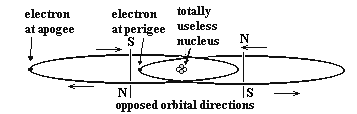
Figure 5-1 Bohr's Diamagnetic Helium Atom.
Astatic magnetic structures naturally form when two similar bar magnets join together, the North Pole of each magnet connecting to the South Pole of the other magnet, forming a magnetic loop field or closed circuit, so that the magnets strongly adhere together. When balanced and supported on an axle, although a conventional bar magnet's directed magnetic circuit responds to the Earth's magnetic field acting as a magnetic compass, when similarly balanced and mounted, astatic diamagnetic structures do not respond to the Earth's magnetic field.
However, when mounted on a universal gimbal and exposed to a more localised powerful directed external magnetic field, the structure mimics the Helium atom's observed response, twisting away from the field direction to an angle of 45°. This three-dimensional effect does not substantiate or give any credence to using the Bohr magnetron explanation.
Rather than accepting this view, Quantum theorists explained diamagnetism with the mysticism of hypothetical electron spin cancellations, where in giving each electron respectively, spins of +½ and -½, Helium's electron spins cancel out, so, "therefore," he says pulling a rabbit out of the hat, "Helium must be diamagnetic. QED." What natural mechanism explains electron spin? Causal researcher students need to ascertain why Quantum theorists accept this deluded spin concept.
Plagued by the effects caused by the Earth's magnetic field affecting electrical measurements, early researchers came up with a novel astatic galvanometer, replacing the simple compass needle with a suspended pair of opposed magnetic compass needles, one mounted above and the second within the current carrying coil (as illustrated).
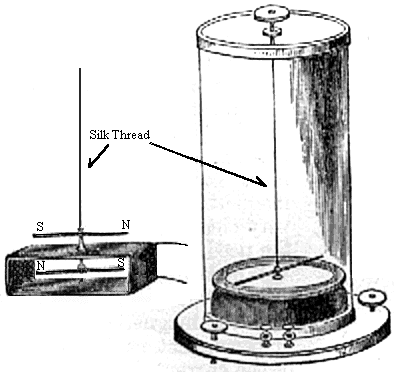
Figure 5-2. An early astatic galvanometer. |
Due to the air gap between the permanent magnet's pole pieces presenting a high resistance to magnetic throughput, although considered permanent, the magnet prematurely aged losing its strength. Placing a soft Iron magnetic bridge linking a horseshoe magnet's pole pieces, closing the magnetic circuit, or across the pole pieces of a pair of coupled bar magnets, increased the permanent magnet's longevity and field strength.
Since Maxwell's equations apply to all fluid flow structures, they can be applied for air, water and oil currents, describing non-magnetic directed and astatic flow structures produced by pumping engines (sails, propellers and turbines). The astatic flow structure appears when using a side-by-side mounted balanced pump pair, with opposite flow paths forming a circular flow structure in the medium. Although this pumping action should produce a rotation around the structure's central axis, in the presence of a directed flow or that of neighbouring similar flow structures aligns the throughput direction preventing structural rotation.
Having determined that electrons must travel in opposite directions, please consider holding the Helium nucleus in one hand and its two electrons in the other hand. Without invoking uncertainty or claiming a scientific mystery, carefully describe in twenty-five words or less, the trajectory of each electron when released, with each negatively charged electron attracted to the positively charged more massive nucleus. Without supplying any proof, observational evidence, or mechanism, conventional theory demands acceptance of the notion that the returning electron enters into a stable orbit around the nucleus.
(In a sarcastic sceptical tone,) Please explain how the electron negotiates a 90 degree trajectory change immediately above the nucleus, to establish from a random encounter, the electrons enter a perfectly balanced oppositely travelling orbital pair, along the atom's equatorial plane, without fuel, retro rockets, thrust and yaw engines, without guidance systems, internal stabilisers, airport controllers, and divine intervention, without gyroscopes, computers, parachutes, a pilot and flight crew, without indoctrination and uncertainty removing the fundamental requirement for evidence and proof. Explain how, irrespective of velocity, irrespective of energy requirements, irrespective of every law of Nature, the electron exists in such an un-natural atomic model without invoking descriptions of extreme gullibility. The biggest hurdle comes as the second electron falls towards the nucleus, as mindless matter follows suit, performing the same impossible 90° course correction immediately above the nuclear surface, entering an oppositely travelling balanced orbit with the same orbital parameters, on the same orbital plane as the first electron without collision. Would such a common ionisation event invoke divine intervention?
When applied to gravity and electrostatic forces, the inverse square law states that with increasing distance, the force of attraction between the masses decreases at a rate proportional to the distance squared, so the reverse applies as the object falls. With arms outstretched, in releasing each electron, the massive a particle, the Helium nucleus, roughly 7,322 times more massive than the electron accelerates each electron on a direct course to its doom. As the distance decreases, deluded theory states that the combined force of electrostatic and gravitational attraction dramatically increases causing the electron to rapidly accelerate towards the nucleus on a direct collision course. So, in 25-words or less, the electron accelerates towards and slams into the nucleus, coalescing with each proton, with internal rotation generating a magnetic field.
"Not so!" says the Quantum mechanic whose mind-set remains so fixed on the use of uncertainty and chaos as the most natural explanation, accepting absolute contradiction as truth. With quantised thought producing sophisticated pixel sampling and quantisation distortion, Quantum theorists state, "The laws of Kepler and Newton do not apply, for at any moment, with the electron defined under Quantum theory and travelling in orbit faster than the speed of light around the nucleus, then it must exist in several parallel universes at the same time, between mini-blackholes, wimps, and time vortexes that string all matter together." Since both Quantum theory and Chemistry maintains the belief that electron shells form the outer surface of solid matter, when dropping any object from a stationary position vertically onto the Earth, with matter's surface described as an ocean of negatively charged electron clouds, then why should that object not enter into orbit around the planet and simultaneously exist far across the Universe in distant parallel universes that occupy the same space at this very instant? Since the observations do not concur with the theoretical predictions, could something be wrong with such sophisticated theory?
The Magneto-Mechanical Atom
Only one logical non-sophisticated conclusion satisfies the diamagnetic properties of molecular Hydrogen and Helium, that being, the terminal collision of the electron entering the nucleus and remaining in the atomic core; no separate nucleus; no orbitales; and no electron clouds. In this modified version of Thomson's liquid-drop atomic model, incorporating the neutron, electrons exist in a magneto-mechanical atom, producing internal and external magnetic structures that organise, sort, structure and give mechanism to the atom, by way of the magnetic field structure linking to other atomic magnetic fields, produce specific response reactions, affecting other matter through alignment, position, field strength, structural change, vibration, resonance, transmission, absorption, rejection, chemical bonding and motion, to name but a few.
Although protons and electrons independently experience magnetic effects, the creation of an atomic dipolar magnetic field demands attaching an electron to a proton forming the Hydrogen atom or an elpron (ELectron-PRotON denoted as f).
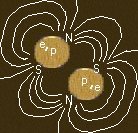
Figure 5-3 Molecular Hydrogen |
As a composite particle and primary magnetic field generator, when two or more elprons exist in larger atoms (where the number of elprons equals the atomic number), their arrangement and magnetic couplings give each atom its physical and chemical properties through the atom's external magnetic field. When two elprons connect through a magnetic flow coupling, the formation of molecular Hydrogen establishes a mutual magnetic circuit or circular magnetic feedback flow structure (figure 5-3) that extends and couples into the local environmental crystal structure.
Open magnetic structures prove themselves very inefficient, binding onto other matter forming a closed magnetic circuit. In the standing state, Hydrogen exists as a diamagnetic molecule consisting of two elprons (H2). As the North Pole of one attracts the South Pole of the other, the two elprons align side-by-side, held apart by magnetic flux currents. When exposed to a strong external magnetic field, the Hydrogen molecule opens-up, as an in-line magnetic structure becoming a magnetic dart.
Even though the true shapes of the proton, electron and neutron may never be realised with present technology, innovative and adventurous technologies may confirm the innermost secrets of sub-atomic structures and matter's mechanism within a few years. Sub-atomic particles may very well be gibbous or convex in shape, producing the illusion of appearing spherical at high rotational speed. For explanation purposes alone, the mechanism causing elpron rotation and the magnetic field may be similar to a racing yacht's sails or that of a progressive acceleration jet turbine. The aerodynamics of the sailboat's jib-mainsail combination amplifies, directs and converts wind power into motion, while fluid motion through a progressive turbine produces increased rotation, thrust and energy conversion. Although many experimenters strive to source energy directly from the environment, the design of a static self-sustaining turbine (replicating the atomic mechanism) in the terrestrial environment, and capable of producing useable power, has yet to reach a level of consideration.
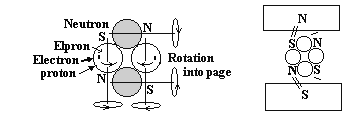 Figure 5-4 The Magneto-mechanical Helium atom. |
In this magnetic mechanism, described by the Helium atom in figure 5-4, the atom operates as a three dimensional construct that through magnetic means, spill fields link, couple, align and position the atom or molecule in the matrix of matter. Obviously, any change to the apparent atomic charge, in adding additional electrons, or by stripping an electron from an elpron, must change the atom's magnetic moment, giving rise to a much different atomic magnetic field structure, affecting the local environment producing the illusion of an environmental electrostatic field, which by way of a molecular alignment field, slowly migrates electrons around a molecular circuit until the apparent charges neutralise, giving such a field a temporary environmentally dependent existence. In this condition, the atom's internal rotation produces the illusion of electrical charge. Irrespective of whatever atomic model one accepts, in correcting Benjamin Franklin's baseless notion of electrical charge, all electrical theory must be corrected and modified in every scientific discipline. In the magnetically neutral state, two electron-proton particles exist in this atomic model;
- the neutron,
- the Elpron (ELectron-PRotON).
In forming a single elpron, through mutual magnetic attraction, the electron attaches itself to the proton's outer surface, which as a solitary magnetic Hydrogen atom, rotates producing a much more powerful directed magnetic field. Each elpron acts like a wind turbine, spinning at very high velocities, transferring the prevailing magnetic field flow and applied pressure into the atom, with atomic magnetic coupling responses altering the elpron's rotational speed. This produces one of several inertial effects, perceived as a reaction envelope with specific energy transfer rates, with a duration from the environmental changes being received, to that moment when the atomic response reactions cease.
As a mechanical scavenger engine, several energy transfer processes take place, the most obvious being when an elpron pair converts and stores energy rotationally in response to changing environmental conditions, with this activity change altering magnetic throughput, field strength, elpron rotation, and perhaps, the overall field shape altering magnetic bonding sites. The magnetic fluid flow gives the atom several basic and detectable properties, including a flow pulsation, a standing state feedback resonance as the field loops between input and output, transmitted through the magnetic fields of neighbouring matter to other matter.
Even though the atomic magnetic field appears captured, closed or hidden, the more intense the applied environmental magnetic pressure applied to matter, the smaller available spatial requirements decreases the atomic magnetic circuit path, which results in a more rapid feedback condition, where increasing elpron rotation intensifies the produced magnetic field resisting the exerted force. Equally, with greater activity increasing the elpron's rotational speed, as the magnetic field strength increases applying a magnetic pressure within matter, the increased spatial requirements produces an expansion.
With each elpron operating as a responsive and sympathetic magnetic flux scavenger pump, magnetic couplings occur between the magnetic environment and molecular Hydrogen's three-dimensional flow structure, with the atomic engine scavenging its energy requirements from the prevailing magnetic environment. In sharing environmental magnetic throughput, the magnetic envelope protects the Hydrogen molecule by holding matter together and apart in the environment's magnetic crystalline structure.
The elpron's magnetic flux circulates from exhaust to intake producing a spiralling pulsing pressure wave flow structure or resonant dipolar magnetic field with North and South Pole positions, where magnetic coupling, sympathetic resonance, environmental magnetic throughput and pressure stimulate elpron rotation and a responsive magnetic field structure. As the elpron's directed magnetic flow couples to the local magnetic environment, pressure differentials align and move the elpron towards the strongest locally available magnetic source, in agreement with Maxwell's empirical equations.
Unlike the forceful spiralling flow structure produced by a propeller in a medium exhibiting different intake and exhaust flow structures and properties, an elpron appears more like a turbine producing and directing a self-stimulating spiralling feedback flow structure. In the Hydrogen molecule, as one elpron's exhaust flow runs into the intake of the second elpron, phase relationship self-stimulate and amplify the magnetic field, so that similar properties become apparent for both the intake and exhaust magnetic field structures.
Although rotation and magnetic resonance establish the conditions for chemical compatibility, intake and exhaust effects establish the means to attract, repel and align other magnetic particles through three dimensional flow structures. As described mathematically by Maxwell's equations which examine the observational effects of flow structures, irrespective of the nature of any flow structure, commonality of flow direction establishes the pseudo-force of attraction, while flow opposition results in a pseudo-force producing separation. Thus, like magnetic poles repel, and unlike poles attract.
(Note Well: Since the same does not hold true with electrical charge relativity in a ladder circuit's progressively increasing electrical charge, the illusion of charge must not be considered as a sub-atomic mechanism, and cannot be applied to either an electron or proton.)
Electrons existing on the spinning elpron's outer surface in a Helium atom may be dislodged through sudden position, alignment, or magnetic change. At extreme pressure reducing the spatial field requirements to a critical limit, despite producing a powerful resistive field strength, critical failure occurs when contact collision strips electrons from the elprons or a mechanical seizure dislodges the structure, ejecting Beta particles (b particles), while throwing the alpha particle (a particle) structure from that position due to the sudden conversion of stored rotational energy into linear motion.
The released a particle at this extreme pressure presents a massive problem to neighbouring matter, with its formation associated with a total magnetic field collapse and an ejection velocity producing further collisions, perhaps breaking neighbouring matter, other magnetic field collapse, magnetic field restoration and response shocks, producing alignment change and motion, as the environment propagates signals-of-change perceived as diverse energy-forms magnetically liberated into the surrounding environment. Although stripped of its electrons, the proton-produced magnetic field maintains the ring's structural integrity, even though the magnetic field may totally collapse or reverse.
Larger atoms require the presence of another composite particle, the neutron, to operate successfully. Being the most stable and active atomic particle configuration in Nature's Universe, elprons gather in pairs as Hydrogen molecules, however, when placed under extreme magnetic pressure, Chapter 8 describes how mechanical conflicts between neighbouring Hydrogen molecules create neutrons and diamagnetic Helium atoms. Built from the same components as the elpron, the unstable neutron only exists outside the atom for a short time before breaking into its component parts. This become evident when a nuclear reactor breaks down, with so many neutrons returning to Hydrogen, a high-pressure Hydrogen bubble forms that as a dirty bomb explosively destroys the reactor, contaminating the environment. (This shows the need for a simple safety valve in reactor design.)
As an overview, the neutron acts as a bearing, a clamp, a magnetic channel and as a separator. In a directed magnetic field, as a non-directed magnetic channel, the neutron may align without showing any external magnetic properties. The Helium atom forms when pressure binds two Hydrogen molecules together, creating 2 neutrons from one Hydrogen molecule. As a square and flat structure, the hitchhiking electron rotates on the proton's surface in the same direction (relative to the magnetic circuit) through the central gap. When viewed from above the square, down the atom's perpendicular axis, the oppositely directed magnetic fields produced by the elpron's toroidal rotation forms an internal directed magnetic circuit that tightly holds the structure together, even when rotational conflicts strip and release both electrons as two b particles, leaving a magnetically responsive a particle. As elprons and neutrons form a magnetically bonded coterie ring, an internal circular magnetic field that runs through the structure, elpron rotation gives rise to a magnetic surge effect, where a natural standing state magnetic resonance affects the coterie ring's external magnetic field, and the atom's ability to link, forming different magnetic bond-forms with other matter. (A Coterie being a set of components for mutual benefit.) As a consequence of environmental magnetic flow or magnetic throughput, proximity and environmental loading supplies energy and removes excess energy from the atom magnetically.
With the proton and electron attaching themselves in temporary configurations with different molecules, their presence alters the magnetic characteristics of each molecule and the local magnetic environment, to such an extent that molecular alignment changes alter the local environment's alignment to one permitting conductivity, through contact exchange, passing electrons to a neighbouring atom's elprons. Explanations of Ohms law and conductivity appear in other chapters. The nature of like and unlike flow directions produce magnetic couplings and directed forces of attraction and repulsion, producing alignment and motion at the atomic level.
In Nature's Chemistry, when temporary molecules come together and the hitchhiking electron attaches itself to the hitchhiking proton, the more powerful elpron forms, which begins taking energy from the local environment. The spin up of a freshly formed elpron with its magnetic field's increased spatial requirements and directed magnetic field, creates a much greater magnetic disturbance presenting a more powerful alignment towards other affected magnetic molecules. The presence of a single elpron may disrupt a molecular magnetic field forming a permanent magnetic bond through the trap mechanism (f + O2  HO2), or through a displacement process (f + Cl2 HCl + Cl), or it may attract another free elpron producing a Hydrogen molecule (f + f H2).
At the sub-atomic level, flow producing mechanisms align, link and couple matter with other matter, in pairs (such as two elprons forming H2 ), in strings (as darts or magnetic chains), in ring structures (as a Coterie), and then together in geometric structures, as molecules and crystal structures. As all nuclear and chemical bonds exist as magnetic bonds, atoms and molecules form inter-connected crystalline structures, irrespective of being considered inert, solid, liquid, gas, or in deep vacuum. In much the same way as a magnetic compass responds to changes in the environmental magnetic field, any environmental magnetic flux change (such as resonance, direction, or field strength), triggers various magnetic responses in matter, affecting matter's local environment.
Internal Atomic Rotation.
Mechanical Conflict and Design Efficiency
For materials under enormous pressure with nowhere to go, through mechanical conflicts, molecular Hydrogen forms both neutrons and Helium, that through compaction reactions build larger and more space efficient atoms that may, or may not, be stable. During the cleaving-ejection process when larger atoms experience mechanical conflict, the conversion of an atom's internal rotation results in linear motion at velocities that may cause fission fragments to coalesce with other atoms. Thus, two distinct fusion reactions occur in Nature, as pressure-fusion, and impact-fusion events.
Equally, when fission reactions occur through impact events and mechanical conflict, the most obvious markers that identify the reaction processes rarely enter the discussion, and when they do, do so at the expense of the other explanations and fission reaction products. Because the sciences disregard the atomic mechanism, a series of contradictions and omissions becomes evident when comparing published information concerning Uranium's fission products. Although discussed in Chapter 8, please examine the table of fission reaction particles, the exclusive description of U-238 fission, and the non-exclusive range of  U fission reaction products. Because the correct atomic mechanism must offer a simple and complete explanation linking Nature's reaction products, and the means to determine a reaction's fission products, then all previously accepted atomic models must be replaced with the magneto-mechanical construct.
Whatever the true mechanisms behind the elpron's magnetic field production and the neutron's magnetic channelling, the geometry and mechanics of similar sized rotating particles massing together in magnetic circuits forms simple mechanical structures that may or may not be successful. Mechanical problems establish the evolutionary processes that shape and refine an element's nuclide series as mechanical survivors having the mechanical advantage, design efficiency, resonance, and stability needed for longevity. Since inefficient and mechanically conflicting designs fail, The Periodic Table's structure and "The Table of naturally occurring isotopes" illustrate Nature's blind evolutionary processes, where successful trial-and-error magnetic mechanical combinations became Nature's mechanical survivors, and equally, where missing nuclides reveal Nature's mechanical failures. (Please note that although the term atomic friction" occurs elsewhere in this work, friction does not apply within the atomic structure.) In a pressurised environment, Nature may retry the same fusion reaction experiment many billions of times, press-fitting isotopes into heavier more compact isotopes until stable nuclide survivors remain.
In simplistic terms, although certain mechanical configurations work very successfully with elpron rotational exceeding 107 revolutions per second, the shock of a sudden mechanical conflict and seizure cleaves the inefficient isotope, ejecting affected particles and unnecessary structural components at high velocities. This statement does not infer a solid mechanical coupling. Since the fission event changes magnetic structures, spatial requirements, and environmental alignment, magnetic field reverberation and magnetic responses produce signals-of-change that affect and propagate through the local environment. Mechanical conflict appears as Nature's greatest evolutionary problem, the source of apparent energy, and the formation of atoms. As this work delves deeper into matter, the trail of indicators and evidence confirming the mechanical nature of mindless-matter's evolutionary processes forming the known isotopes becomes apparent. Chapter 8 explores and simply explains the most obvious indicators of an atom's internal rotation and mechanical conflict, giving complete explanation to well-known and documented scientific mysteries that include;
- the bad number neutron list,
- the odds-and-even distribution of naturally occurring isotopes,
- the distribution and properties of the chemical elements (by mass),
- the longevity of fission reaction products,
- the electrochemical illusion, activity and common reaction Groups.
- the Periodic Table's structure.
Although written in natural machine language code, when deciphered fully, Nature's Science offers an almost complete explanation of matter and its diverse properties. The low-pressure compression of Carbon dust into crystalline solid graphite reveals Nature's trick in forming larger atoms through tectonic, volcanic and gravitational forces, metamorphosing simple chemicals into heavy metals. Nature uses two basic atomic structures, the flat and the layered. As the basis of all Science, these simple internally rotating self-generating magnetic scavenger structures explain the distribution of isotopes and the structure of the periodic table, to the various properties of matter including the electrochemical illusion, the activity series, melting and boiling points, to the element's neutron distribution.
The Atomic Structure and Nuclear Fusion.
Rotation and the atom's internal structure introduce a design flexibility allowing the atom to rearrange its structure for better efficiency in the prevailing magnetic conditions. Matter's response to local and throughput magnetic field flow establishes different structural and bonding configurations to the standing-state structural configuration, maintaining the most efficient magnetic circuit possible obtaining the highest possible magnetic throughput and coupling to the surrounding environment.
The formation of transparent artificial diamonds from Carbon illustrates the first stage of this metamorphosis process. The second step appears in coloured diamonds, where the metamorphosis formed metal and non-metal impurities at specific chemical positions in the crystal structure. Although the third metamorphosis should completely transmute Carbon into a pure metal, mechanical conflicts at the applied pressure produce evolutionary survivors where the formation of several unstable isotopes that re-combine fusing together into a collection of assorted seemingly non-related heavy metals and rare-earths.
Owing to the structure and chemical bonding between many simple molecules, the tectonic compression of sedimentary mineral deposits (such as limestone) produces metamorphic rocks (marbles) containing transmuted veins of elements, including metals (such as marble with Gold flecks). The geological occurrence of metamorphic rocks containing numerous dissimilar metals (Gold, Silver, Lead and Zinc), identifies this evolutionary process where simple limestone and other mud deposits transmute into heavy atoms through pressure fusion reaction. An examination of the world's Ore deposits reveals this same pressure fusion process occurring in the Earth's strata surrounding a volcanic intrusion, crushed rift valleys, geosynclinal deposits, and epeirogenic uplifts, forming almost solid Gold mountains in West Irian, New Guinea and Papua, along with Silver, Platinum, Copper, and Osmiridium deposits.
Since molecular Hydrogen (H2 ), the smallest molecule contains two elprons (f2 ), the individual Hydrogen atom exists as a single magnetic elpron ( H = f). When placed under great pressure, the elpron with an atomic mass of 1 atomic mass unit (amu) undergoes structural changes forming the unstable neutron without changing the atomic mass. This metamorphosis into a neutron converts the elpron into a bearing, separator and magnetic channel, while reducing the particle's spatial and magnetic field requirements.
With compression of the atomic magnetic field's spatial requirements through magnetic pressurisation, the magnetic envelope's circuit length decreases while the flux density increases with elpron rotation and magnetic field strength, effectively opposing, resisting, and protecting the atom (to a certain point from being crushed or changed). Under great pressure, the applied force produces an atomic re-structure into a more efficient magnetic field configuration, where conflicts and the diminished field size produce sweet spots that allow atomic combinations with other atoms in pressure fusion reactions. Great pressure can push Deuterium's remotely held neutrons into the molecule forming the inert atom (f2 n2 ) Helium. Since any change to the local atomic magnetic field affects matter, matter's response reaction to a nearby fusion event propagates various signals-of-change to other matter. In this situation, the endothermic fusion reaction forming Helium produces massive changes in the magnetic field structure and a resonance that appears as an exothermic response reaction in neighbouring matter.
Irrespective of an isotope's atomic mass (measured in amu), an isotope's number of protons (or elprons) denotes the isotope as belonging to a particular element (fn ), having the atomic number (n). An element's naturally occurring isotopes exist as complete atoms across a range of mass values. For reasons of mechanical stability, naturally occurring isotopes must contain an optimum number of neutrons. Massive atoms require more neutrons than elprons to reach internal rotational stability, owing to the increased chance of mechanical conflict producing mechanical seizure.
Although an elpron pair exhibits great stability and longevity, neutron longevity only comes in the mechanical atom's magnetic structure, or when captured in a molecular magnetic field. With pressure crushing two or more Helium atoms together, the periodic table of chemical elements becomes a flat representation of a sphere made from similar composite particles, and therefore subject to magneto-mechanical efficiency, stability and rotational conflicts. The first several elements (to and including Oxygen), in linking magnetically North to South take on flat structures in vacuo, while the remainder (from Fluorine) form layered structures, progressively adding partial and complete layers to the structure, across the atom's physical axis. As described more fully in Chapter 8, as Coterie rings bind about the axis, this re-defines the Periodic Table's structure with layers and sub-layers, Periods and sub-Periods, the production of magnetic gap fields between elprons changes matter's physical and chemical properties.
Chemical Bonding.
The neutron's magnetic field channelling and bearing properties permit the formation of Coterie Ring structures, where two or more elprons establish a circular or toroidal magnetic field around the atomic axis. A complete Coterie ring's circular magnetic field cannot be considered as perfectly toroidal because as the field connects across the gaps between elprons and neutrons, the field bulges into the surrounding environment, linking and coupling it to the local environment. This gives the inert gases limited chemical bonding possibilities and the ability to remain in various solutions until separated through incompatibility ejects those gases.
The circular magnetic field of molecular Hydrogen (H2 ) generally exhibits different properties to Helium (f2 n2 ). As Hydrogen's large gap fields spill into the magnetic environment, molecular alignment forms a tight crystal structure that increases the threshold energy needed to establish chemical reactions. When the Hydrogen molecules open in a strong external field, it forms strings and chains as highly reactive magnetic darts, much like the observational illusion produced by Iron filings in a magnetic environment. As the Hydrogen isotope, Deuterium holds one or two neutrons (n) at a molecular distance (as either f2 n, or f2 n2 ), the presentation of different paramagnetic thresholds makes identification and separation relatively simple.
Coupling through neutrons to other elprons in mechanically compatible rotating magnetic circuits, the number of particles comprising an element produces open and closed magnetic circuits whose structure links and couples with the local environment, giving the atom its properties and the ability to transfer rotational energy differentially into the structure. When completely closed, the toroidal magnetic structure forms a single stand-alone chemically inert and diamagnetic entity that weakly links and attaches itself to the more magnetic atoms and molecules. When disrupted by the gain or loss of an electron, or when deformed by a local powerful directed magnetic field, the inert gas atom's closed magnetic circuit could deform, opening to such an extent where temporary molecules form.
In semi and partially closed magnetic structures like Beryllium (Be), Oxygen (O), Mercury (Hg), magnetic structural change modifies an element's properties producing some amazing effects. Where the atom's incomplete magnetic circuit produces gaps, as the magnetic circuit jumps across a structural gap it produces a gap field similar to that of the tape recorder's playback-recording and erase heads. This directed magnetic field loops away from the atomic surface, which as a spill field invades the local region, establishing matter's magnetic bonding points, linking with other environmental neighbours, including the inert gasses. The more powerful the spill field, the more reactive the element becomes. When one examines the spill field structures of Group 7, the Halogen elements, the most reactive element must be Fluorine (F) due to its small mass and incredibly powerful spill field. Due to the packing and sorting mechanism, both Cæsium (Cs) and Francium (Fr) develop powerful polar spill fields. Consequently, the magnetic structure and mechanical rotation of the atom's components being directly responsible for matter's diverse chemical and physical properties.
In producing a directed field, the magnetic circuit suffers losses, however, Nature compensates for these losses, linking pairs of atoms together with similar throughput, spill fields and resonance, as magnetically efficient molecules
(H2 , Li2 , F2 , Cl2 , O2 , N2 , I2 , et cetera.) These molecules reveal breakout spill fields that emanate from the structure causing molecular alignment and-or chemical reactions with other molecules. The stronger the environmental spill field the more chemically active the molecule's potential, especially when holding the parent molecule together through weak bonds, but then rotational compatibility and resonance play key roles in explaining why many expected chemical reactions do not occur until certain environmental conditions exist.
These weak magnetic bonds allow a molecule like Oxygen to rapidly open, exposing its spill fields to attack other molecules through the trap and double trap mechanisms. The spill fields of Oxygen, Nitrogen, Carbon Dioxide and water vapour, interact and hold the seemingly closed magnetic circuit of the inert gases in the various solutions until activity alters the compatibility dumping the dissolved gas, or in creating a situation where activity increases the spill field's strength attacking neighbouring molecules.
Mindless matter organises itself into a differential engine where precise magnetic structures give the atom the means of energy transfer, its chemical properties and mechanical efficiency. Magnetic elprons linking Pole to Pole in rotating coterie rings around the atom's structural axis require an optimum number of neutrons to successfully transfer energy to and from the structure, while maintaining internal rotation. As mechanical survivors, Chapter 8 shows how the isotope's elpron number and its structural connection with a precise neutron number gives the element a changing magnetic structure that varies the element's chemical and physical properties over its nuclide mass range.
Unless deformed by some external force, with fission reactions, neutron capture and ejection events altering an element's neutron number, mechanical conflicts arising from the sorting and packing processes affect rotational compatibility and the nuclide's longevity. Time eventually leads to a refinement process where the table of naturally occurring isotopes reveals each element's broken range of successful isotopes with various degrees of longevity. Although an element's successful nuclides exhibit similar properties, owing to the active coterie ring's common magnetic field structure and position, a change to the element's neutron number modifies the element's energy transfer system and response rates.
In sharing a common structure, identical nuclides with the same neutron number exhibit identical properties, but slightly different properties to the element's other nuclides, perhaps with different mechanical compatibility altering internal energy transfer rates affecting longevity. As mechanical compatibility limits the isotope's survival rate, odd and even numbered elements produce distinctive regular patterns throughout the table of naturally occurring nuclides. Any change to a nuclide's neutron number may vary the mechanical efficiency so much, isotopes reach self-destructive critical rotational conflicts that cleave the isotope into complete atoms, or complete atoms along with a and b particles. As a consequence of chemical deformation through chemical bonding, in certain chemical situations inefficient isotopes may work efficiently, stabilising and increasing a radioactive nuclide's longevity.
Nature's Primary Mechanism and The Æther.
Like a computer, and in computer terms, since Nature works one step at a time, Nature's "Yes" and "No" options couple to probability options involving analogue degrees of activity, where the event requires a complete data bubble sort each time an event occurs, placing the most active ingredient on the top of the stack in preparation for the next event. As Nature's event begins, it does so with the most simple and most convenient reaction between the most compatible and more magnetically active components. With the flexible atomic structure capable of undergoing internal structural changes with chemical bonding, the changed magnetic structure repositions the products formed placing them further down the stack as other reactions occur, progressively moving up the stack until that reaction product once again becomes the most active ingredient at the stack's top, reacting with itself, or with neighbouring atoms and molecules in the local environment.
Nature's primary mechanism involves the process where the magnetic effects of attraction and repulsion differ greatly from the computer's quantised Off and On states. Nature operates in a poly-state mode having two logical "Off" states, but only one logical On state, and then three-dimensional variants. As like poles repel, a logical "Off" state forms when two North Poles or Two South Poles come together. The logical "On" state occurs when Opposite poles attract, linking a North to a South Pole, however, in three-dimensions, a single Pole may attract several opposite poles that mutually repel. This tri-state poly mode being modified by the alignment of coterie fields and elpron rotational directions.
In the local atomic region, the atom's magnetic generator structure establishes a three-dimensional magnetic cushion about the atom. Although the completed toroidal magnetic circuit appears closed, small spill fields jumping between elprons linking to other atoms and molecules, respond to applied pressure, presenting a force against the local three-dimensional environment. In processing a simple event, matter must receive the signal of change, and in giving rise to a response reaction, the atom transmits the changed conditions by magnetically affecting neighbouring atoms and molecules. The magnitude of an event in matter being dependent on the number of atomic events taking place, and the influence of the force-forms being received. A signal-of-change may form a string of effects, a bucket-brigade giving rise to many other events and physical illusions, through the absorption and liberation of numerous energy-forms, altering position, motion, spacing, alignment, rotation, timing, pressure, the release of electrons, et cetera. Then again, a signal-of-change may be rejected, or progressively attenuated without being absorbed.
Terrestrial signals-of-change produced by the application of a mechanical force, motion, temperature or pressure change, chemical and electrical activity, nuclear event or wave motion, occur as various signals-of-change at the atomic level with unique properties that identify each force-form and the influence of each energy-form, changing compression, activity, alignment, position, structure and magnetic throughput et cetera. All signals-of-change apply at, and produce effects at, the atomic level relative to a Universal stationary position and irrespective of any other reference frame.
Nature's mechanism operates magnetically, with matter responding to and propagating signals-of-change as individual events in matter. Resulting from an event in matter, any change in the environment's magnetic crystalline structure (at the atomic level) produces response reaction effects where a bucket brigade of events propagates signals-of-change through matter's crystalline structure. Depending on a medium's structure, nature and boundary conditions, these signals may be rejected, absorbed, propagated, amplified, modified, converted, polarised and scrambled. Since an action takes place during the first time frame, and although matter's response reaction occur throughout the second time frame, the event propagates as a signal-of-change throughout a third time frame, then all events and response reactions in Nature's Universe occur in real and absolute time |T|.
As a relative event, the third time frame may be taken as the duration of the reaction envelope at the source, or at a distant position considering the propagation period (perhaps as long as 15,000 million years for distant starlight). From the moment of disturbance to the moment when the environment returns to an equilibrium condition, perhaps with a different alignment, during the reaction envelope's duration, matter affects matter throughout the local and greater environments. With this, the definition of energy becomes "an event in matter that propagates magnetically through matter to affect and produce effects in matter." The energy, or intensity of the cumulative signals-of-change produced by a reaction depends on the reaction's nature, speed and the magnetic response reactions producing a rate of signal transfer, communicating the changed conditions to other matter at the atomic level through locally changed magnetic conditions.
Before a response occurs in matter, the action must be received and processed by matter. This establishes Nature's various machine language cause-and-effect communication's protocols, responsible for transferring signals-of-change to and though mindless-matter at different rates; on-passing, adding to, and removing information. When applied as an energy-form or as a force-form, signals-of-change transferred as atomic level magnetic field variations may change matter's alignment, position, rotation, structure, activity and response, or be amplified, absorbed, converted, or totally rejected.
The simple magneto-mechanical mechanism couples the energy definition into a more complete description of matter. At the atomic level, all energy and force-forms propagate as events through matter's magnetic response reactions, stimulated by the changed magnetic conditions produced by each event in matter. This describes all energy propagation and the storage of energy as rotational energy in the atomic mechanism, including the distribution of force in a lever, to motion, wave and chemical effects, and magnetic radiation. This gives credence to the Newtonian belief that every action produces an equal and opposite reaction. Likened to squashing a balloon, as the magnetic field envelope responds to increased magnetic pressure, an increase in atomic rotation increases the magnetic field strength resisting the applied pressure.
Similarly, as magnetic radiation stimulates each molecular magnetic field at radio, light, or X-ray frequencies, due to matter's action-reaction response time, each molecule on the transmission path must receive, respond, and transmit the signal to other matter. Therefore, owing to the time delay, in propagating the forward signal, a molecule's transmission signal also returns a signal travelling in the reverse direction toward the source. Both the forward and return signals from each molecule on the transmission path carry with them that molecule's magnetic response fingerprint, as absorption, rejection, conversion and re-transmission spectra, as described (in other sections) by the principles of Doppler radar, spectroscopy and line transmission technology.
Nature's apparent complexity and chaos comes from the simplicity and order of the atomic structure, and its magnetic affect on other matter producing propagating and energy-sharing effects. In the terrestrial environment, a tough and resilient material, like Carbon-Steel, and flexible materials, like rubber, appear with interchanged properties at the atomic level, (where Carbon-Steel becomes soft and flexible, as rubber becomes hard and resilient.) The apparent disparity between terrestrial and atomic environments being a source of many observational illusions resulting from matter's cumulative responses to changed and changing magnetic conditions, restricted and modified by matter's interconnections, alignment, resonances and physical response ability.
Irrespective of an environment's characteristics (as solid, liquid, gas, vacuo, or plasma), magnetic coupling defines the environment as a magnetically bonded and linked crystalline structure. A brick at the bottom of a pond, couples through all intervening matter to the extremities of the Universe. Any change to the magnetic conditions of the brick, through chemical, biological, or nuclear activity producing various response reactions throughout the local environment, extend into the greater environment. As magnetic signals-of-change couple and load matter, they affect the atom's internal rotation, magnetic field strength, standing state resonant feedback, magnetic throughput, spatial requirements, position, and alignment. As the prevailing magnetic conditions change, matter identifies its presence and the changes taking place.
Described jointly as equilibrium, gravity and the path of least resistance, matter's increased activity and field strength attracts other matter to the highest energy state through the reception of matter's communications, until matter reaches an optimum magnetic envelope and field strength responsive to the prevailing magnetic environment. As matter establishes a feedback situation, the greatest energy level occurs on the surface of a gravitational body and decreases with height above and below that surface. This defines potential energy as decreasing with increasing height and potential difference increasing with increasing height, thereby correcting an obvious mistake in Newton's Gravitational explanation, and explaining temperature differentials with increasing height or with increasing pressure. Newton's laws fail to describe the gravitational effects below a gravitational body's surface, where at the Earth's gravitational centre, the Earth's gravitational forces cancel creating a weightless environment, owing to the Earth's orbital motion around the Sun.
When resonant flow structures align to the environmental magnetic field for greatest magnetic throughput, the elpron's magnetic presence produces a magnetic alignment and loading effect that propagates as signals-of-change through environmental matter aligning the environment to the new magnetic conditions. As environmental molecules initially over-compensate for the effect produced by an additional magnetic structure, or with the elpron's magneto-chemical attachment to another molecule forming a temporary or permanent molecule, signals-of-change oscillate in the environment producing the illusion of liberated energy.
Without calling on divine intervention, as the greatest of all creations, through experiments that either work or fail, Nature exists without written laws, rules, theologies, ideologies, and dogma. Since Nature continually conducts experiments through mindless mechanical processing, any study of Nature's Universe must concern the workings of matter from dismal failures, through mutations to successful results producing natural survivors, where as the Universe grows older, destructive sorting processes recycle and continue Nature's evolutionary refinement processes.
Many factors influenced scientific development, from serendipitous observations, commercial wants, concerns, and real needs, to egotism and self-indulgence. Whatever the reason giving researchers the motivation to identify, explore, describe, and evolve natural processes developing new technologies, humanity's ignorance, narrow-mindedness, and self-importance placed many stumbling blocks on the pathway to appreciate and understand Nature's Universe. In promoting the self, paying homage to personal heroes and ideologies, in seeking pecuniary advantage, self-gratification, adulation and the worship of artificial gods hindered scientific development. Rather than developing a Science within and explaining Nature's Science, humanity claimed ownership of Science, placing various faculties and scientific beliefs on a pedestal above Nature and God.
Although chemical faculties promote "Chemistry" as responsible for all matter, any study of Chemistry and chemical reactions reveals great ignorance accumulated as inert facts, deluded theory, and a total disregard of Nature's chemical science, removing 85% of the Science. Unfortunately, when introducing any scientific extension or advancement, as a new concept, invention, or explanation, humanity's conceited and-or gratuitous approach in naming effects, theories and objects, after themselves or those they honour, in taking out patents, in selling knowledge, in presenting biased education giving themselves, another human, a corporation, State or religion ownership, humanity's self-indulgent motivation attacked and deprived Nature of rightful ownership.
Since the Sciences give credit to those making scientific discoveries, with Nature pre-dating mankind's existence, then it stands to reason that no organization, individual, or theology can claim ownership or seek legal ownership to any of Nature's scientific discoveries. In most situations claimed as a major breakthrough or discovery, the human element merely identified a process, module, or system, already in use. As vehicles of knowledge dissemination, rather than being the advertising platform for humanity's inflated ego, educators, researchers, inventers, and academics must share their understanding, appreciation and extensions of Nature's Science with future generations.
------------------- END CHAPTER FIVE
------------------
Original Size = 6,710
Version 8, Revision 1, word count= 11,915 11-11-2005

Chapter Notes
The computer's innermost workings.
Return to text.
The problem for many requires deciphering a load of meaningless technical jargon when understanding the computer's machine language merely requires following the correct "Black Box" procedures in deciphering the computer's machine language routines, where the program, the input and the output appear as meaningless extensions. As a complex artificial device, the computer operates through several dedicated programs that establish the rules producing certain responses, and those operations directing the processing sequence under those rules.
The seven-layer OSI model describes the computer's workings as a Black Box linking the application or outside world to the processor core where the response takes place. This involves a two-way communications protocol, where the signal-of-change travels from the application, to the core, then back through all the transport, distribution and application layers to the real world. Just as the 7-layer ISO model applies to the computer box, it also applies to the mouse, the keyboard, the monitor, scanner, printer, microwave oven, washing machine, remote controller, motor vehicle, video tape recorder, and even the human brain, because all involve signal processors.
The computer operates by means of several program levels where different procedural operations allow the user to call up and run the desired applications program. Typically, a team of software designers, each specialising in program code fragments, design the computer's operating systems (as hidden master programs) that immediate runs several executive programs at power-on. These executive programs check the computer's health, its memory, various communications ports, the peripheral devices, the availability of data storage devices, before running the human interpreter program which allows the more complex applications to call up games and business programs, where the user's application program works within the bounds of the computer's operating system. Even though the user may believe that Bill's company runs the software on their computer, the operating system actually runs Bill's programs, negotiating and compensating resources within the box.
Existing several levels below Bill's very expensive over-priced, overly complex, memory inefficient, guaranteed-to-lockup software, the operating system communicates through several simple dedicated processor circuits, from memory chips to registers, counters, switches, and interface converters, shift registers, flip-flop circuits, encoders and decoders, turning each letter, each character, each mathematical operand into a number, represented by a parallel binary code. Depending on the processor's design, accepting certain length binary numbers, each number could be expressed to a certain base, or processing lines. Early computers used 4 data lines to express numbers from 0 to 7. By merely doubling the number of parallel data lines to 8, computers represented numbers 0 to 255, giving each number several uses, as numbers, as instructions and operands, which depending on sequencing gave that number its meaning.
Rather than speaking in English, computers decode each letter, each character, each instruction, into a binary number, as a series of "Off" and "On" states across the 4, 8, 16, 32 or 64 data lines. Modern computers use 32, 64 or 128 parallel data lines, in the signal or data buss, and the size of the information package, they call the byte, as in a 16 bit byte using 16 parallel data lines. The older 6502 or Z80 8 bit computers (with just 8 parallel buss lines) make explanation much simpler. Expressed in binary, zero appears as the octal number (binary for 8) as 0000 0000, while 255 appears as 1111 1111. The number 10 represented as 0000 1010 Although stated as moving data, a series of electronically controlled switches (called gates), sequences the buss line's information, so that the binary number 0001 0110 represents an value, an instruction, or an operand. Shifting data only occurs in a shift register.
The logic behind these simple gates gives the computer its ability to sequence, count, control, process, to remember and store information. Described by Boolean logic, simple electrical switches form the basis of this operation, where through various expressions which the English language uses linking sentences, phrases, clauses, and beliefs together. Described as AND, XAND, NAND, OR, XOR, and NOR, three of these terms seem to exist outside the language.
Logically each forms a unique switching truth table, where AND and the exclusive XAND refer to the signals being both "on" to give an "on" output. With the logical OR and exclusive XOR, the output turns "on" when with only one data line being turned "on". The logical NOR refers to Not-OR, which turns the signal "on" when both inputs equal 0 or 1. Likewise, the Not-AND or NAND instruction reverses logical AND. Obviously, the logic of a dedicated switch can be changed using a signal invertor before or after the switch changing a 0 to a 1, or in turning a 1 to a 0. If 1 represents the "on" state and 0 as "off", then the Boolean Truth tables appear as,
This simple logic identifies the original electrical switch that turned the signal lines "on" to accurately represent the number 0001 0110 (above) in all 8 buss line with an "on" signal requires using a dedicated XAND gate. By connecting various gates together, researchers and inventers can experiment with all manner of computer processing logic, building oscillators and flip-flop circuits that through a capacitor and resistor network connect a gate's output to its input, or with a bit of thought construct a decade counter, decoders, encoders, and shift registers that permit simple processing, addition, subtraction and data shifting. At this level of appreciation, an 8-year old computer expert with soldering iron in hand working on a complicated TTL circuit, stated, "aw Gran, all 'pooters 're simple".
When it comes to the computer's memory, the operating system accesses similar switches, inverters, and shift registers, that irrespective of an input line's state, once activated the switch responds to the input line signals at that moment and holds the output level until cleared. By storing data in a linear or two-dimensional mode, the operating system juggles sequential parallel data strings, as numbers, commands and comments, recording, storing and reading each of the 8 parallel data lines in a series of 8 two-dimensional matrices, (such as in squares 255 rows x 255 columns), so that when activated, the buss lines target a particular address which immediately reveals the stored number. When writing to or reading from the memory, the computer scans each memory location stack from 0000 0000 to 1111 1111 along both axes. Having written the data, when the 8-buss returns to that location the active circuits reveal the contents of that memory address and as the gates open the circuitry reveals the stored number to the processor.
The program counter mindlessly defines that binary number to the processor as an instruction, operand or value, which through addition, or subtraction, left shifting or right shifting data signals across the buss lines, gives rise to multiplication and subtraction. As each data line represents a value twice as great as the number to the right, then with data shifting to the left, in moving from a low value to a higher value, doubles the number, so that 0010 0110 becomes 0100 1100, while right shifting halves the number to 0001 0011, illustrated below. Many become confused with binary addition, decoding octal numbers into the more convenient decimal number, at this level, even binary addition becomes simple.
| "on"= | input | | left shift | | right shift | |
| 1 | 0 | | 0 | | 1 | = 1 |
| 2 | 1 | = 2 | 0 | | 1 | = 2 |
| 4 | 1 | = 4 | 1 | = 4 | 0 | |
| 8 | 0 | | 1 | = 8 | 0 | |
|
| 16 | 0 | | 0 | | 1 | = 16 | |
| 32 | 1 | = 32 | 0 | | 0 | |
| 64 | 0 | | 1 | = 64 | 0 | |
| 128 | 0 | | 0 | | 0 | |
|
| S=255 | | S=38 | | S=76 | | S=19 |
So, as 2×19=38, and 2×38=76, or as 76/2=38 and 38/2=19, then binary shifting allows some amazing processing possibilities. Obviously, to right shift 19, further dividing the number by 2 means that the circuitry must carry the overflow to the right, or when left shifting above the value 255, then the additional digits must be carried to the right. Again, switching circuitry channels the overflow into registers that hold each overflow. Likewise, binary addition could shift the number through XAND and carrying logic to the left, with the carry acting as an additional line into the XAND's truth table, while subtraction and carrying from the left, shifts the data to the right, reducing its value. This appears when adding or subtracting 38 to and from 76, as in 0100 1100 ± 0010 0110.
Addition +
| 128 | 64 | 32 | 16 | 8 | 4 | 2 | 1 | =255 |
| 0 | 1 | 0 | 0 | 1 | 1 | 0 | 0 | 76 |
| 0 | 0 | 1 | 0 | 0 | 1 | 1 | 0 | + 38 |
| 0 | 1 | 1 | 1 | 0 | 0 | 1 | 0 | = 114 |
Subtraction -
| 128 | 64 | 32 | 16 | 8 | 4 | 2 | 1 | =255 |
| 0 | 1 | 0 | 0 | 1 | 1 | 0 | 0 | 76 |
| 0 | 0 | 1 | 0 | 0 | 1 | 1 | 0 | - 38 |
| 0 | 0 | 1 | 0 | 0 | 1 | 1 | 0 | = 38 |
One consequence of indoctrination, learning the mathematics times tables by rote, a stumbling block appears as an acceptance problem, where the student accepts the mathematical operands of multiplication and division as completely different to addition and subtraction. Take the number 104 and repeatedly subtract 19 until the remainder reaches a point less than 19. Each time the subtraction takes place, a counter must increment by 1. Obviously, the answer appears on the counter with the less than 19 remainder appearing in the register, so, with 9 left over, the answer must be 5 + 9/19 or 5.4736842105. Likewise, as multiplication involves addition, then 19 added 5 times to the previous answer, starting at 0, gives the result of 95. Both of these operations completed without using multiplication or division.
Although this brief discourse does not give the researcher a complete understanding of the computer's innermost workings, leaving many things unexplained, the research can piece together a full and complete picture from this powerful appreciation. As with Nature, at this simple level of appreciation, linking and sequencing parallel circuits together, in parallel and in series through various switch banks, even in the most complex calculation, every reaction step involves simple processes. The complexity comes from the terrestrial view, where, without understanding a module's dedicated functions, the interconnection of the computer's modules becomes perplexing, confusing, and an example of apparent chaos producing order, when the logic reveals that from order and replicated simplicity comes apparent Chaos.
Return to text.


