Golden Age boxing was a tough yet formal discipline. Although gloves were worn during training and in official Queensberry Rules bouts, bare-knuckle fights still took place. The boxing glove was considered in relation to the bare fist as was the epee to the duelling sword; punches could be judged by the effect that they would have had, should the gloves not be worn. Barton-Wright probably learned the art during his schooling in England.
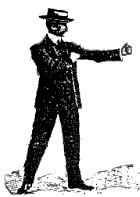
Boxers maintained an erect stance, effectively guarding their centreline with an extended lead-hand while "barring the mark" or covering the solar-plexus area with the rear forearm. The full gamut of punches were employed, with the favourite being the "left lead-off," a more powerful and committed version of the modern jab. The boxer's defence included a sophisticated range of evasions and parrying techniques.
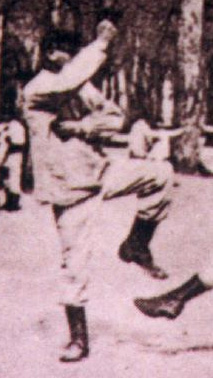
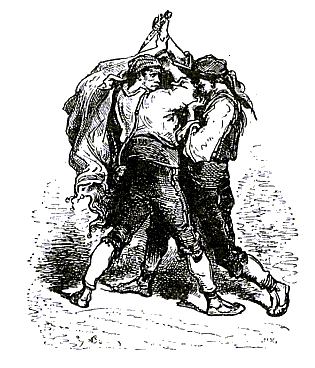
The French art of la savate was originally a collection of street-fighting tricks developed by sailors in the port city of Marseilles. Best-known as a kicking art, la savate was refined by several Parisian masters who incorporated English boxing skills, the physical training of ballet, grappling techniques and the theory of fencing. The result was a comprehensive approach to personal combat both as a sport and in self-defence.
It is not known where Barton-Wright learned la savate, although he was educated in France and later collaborated with savateur Pierre Vigny. Barton-Wright was inclined to use the term "savate" generically to describe kicking techniques.
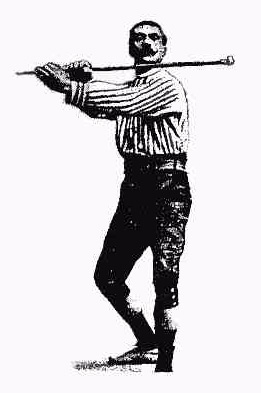
This method was developed by Pierre Vigny, a Belgian master of la Savate who collaborated with Barton-Wright between 1900 and 1902. Little is known of Vigny's life other than the time he spent in London, first as an instructor at the Bartitsu Club and later at his own self-defence school. His stick-fighting art was a refinement of the classical French art of la canne de combat, developed with an eye towards practical self-defence in the street.
Vigny's style included a wide range of offensive and defensive techniques in which the stick could be held in either or both hands, and omitted the moulinets (spinning actions) of the more sportive canne de combat. Much of the art was based on the tactic of inviting an attack to an apparently unprotected target.
Jiujitsu (the art of yielding) was one of the many martial arts developed and refined for use by Samurai warriors. By the 1890s, many distinct styles of Jiujitsu were taught at schools throughout Japan. It is not known which school(s) Barton-Wright attended during his soujourn there, but the Bartitsu Society has tentatively identified one of his teachers as Shihan Yazo Eguchi of the Kyushin-Ryu. Other connections have been made to the Tenshin Shinyo Ryu. These schools later contributed to the development of Judo.
Barton-Wright, who frequently defined Jiujitsu as "a fight to the finish," summarised the basic principles of the art as 1) to disturb the equilibrium of your opponent: 2) to surprise him before he has time to regain his balance and strength: 3) if necessary, to subject the joints of any part of his body to strain which they are anatomically and mechanically unable to resist.
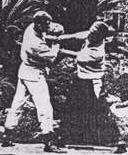
E.W. Barton-Wright maintained a life-long fascination with all forms of personal combat, especially those that could be turned towards self-defence as well as sport. His education in England, Germany and France, and subsequent travels through Spain, Portugal, Egypt and Japan afforded him a veritable smorgasbord of fighting arts. Upon his return to England in 1898, he established the Bartitsu Club as a centre for training in a wide range of combatives.
Along with the four major contributing systems, Barton-Wright was familiar with fencing, wrestling and "the use of the stiletto." He also reported fending off attacks by assailants wielding knives and quarterstaves while he was living in Portugal.
The first technique demonstrated in his 1899 article, the New Art of Self-Defence, has been identified as a trick commonly employed by the French Apaches - street gangsters who frequented the Montmartre district of Paris, known for their devious repertoire of improvised weapons and surprise attacks.
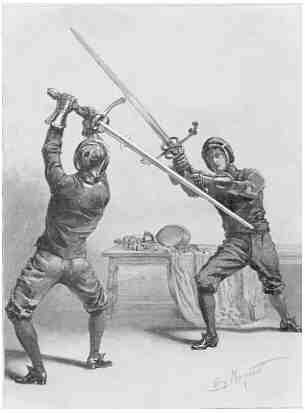
Sir Alfred Hutton, writing in the Sword and the Centuries, referred to the Bartitsu Club as "the centre of antique fencing in this country." Hutton and his colleagues Egerton Castle, Frederick Pollock and Cyril Matthey were involved in re-creating a number of historical fencing systems, such as the use of the two-handed sword and the rapier. They gave frequent exhibitions during the mid-late 1890s and held training sessions at Barton-Wright's academy in Shaftesbury Avenue, London. Although these antique arts do not appear to have been formally incorporated into Bartitsu, it may be assumed that Barton-Wright had some familiarity with them.