|
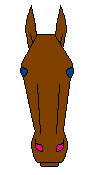
Here is a picture of a horse's head that has no facial markings. Notice that there are no white hairs any where. |
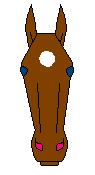 |
A white mark on the horse's forehead that is between the eyes and above the bridge of nose of the horse is called a Star. |
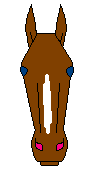 |
A white mark that in on the horse's bridge of nose is called a Strip. The Strip is a stripe on the bridge of nose. Some breeds, like the Appaloosa, use the term Stripe. |
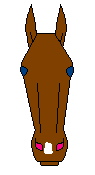 |
A white mark that is on the horse's muzzle between the nostrils is called a Snip. |
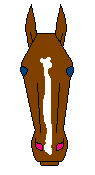 |
All three markings can run together into one long marking called a Star, Strip, Snip. The commas (,) indicate that the markings are connected. |
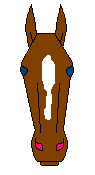 |
Here is a connected Star, Strip. |
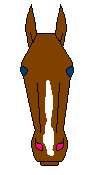 |
Here is a connected Strip, Snip. |
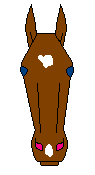 |
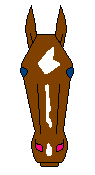
The markings can be disconnected. Here is a horse with a Star. Snip. The period (.) means that the star and snip do not touch each other. |
 |
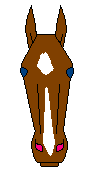
A horse can have all three marking with none touching each other. Here is a horse with a disconnected Star. Strip. Snip. Thus we see, markings can be connected to each other or stand alone. |
 |
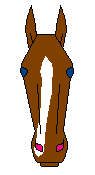
Combos of the two are very common. Here is a horse with a Star. Strip, Snip. |
 |
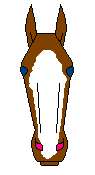
A Star, Strip, Snip do not have to travel straight down the horses face. They can trail off to the side to cover a nostril. This marking is called a Race. This occurance is described as Star, Strip, Snip in a Race. |
 |
A wide Star, Strip, Snip that is still between the eyes, but wider than the bridge of nose is called a Blaze. |
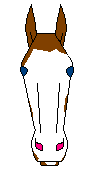 |
When the white extends past the eyes and covers most of the face, it is called Bald Face. The Bald Face may also extend to the lower lip. |
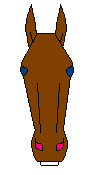 |
White on the lower lip of the horse is called Lower Lip. Pretty simple, eh? |
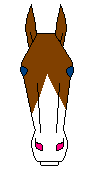 |
White that starts as a small point on the horse's forehead (Star), but widens to cover the horse's muzzle is called Apron Face. |
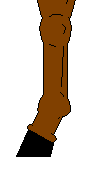 |
Here is a leg with no white markings |
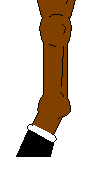 |
When white covers the coronet band of the horse, the marking is called a Coronet. |
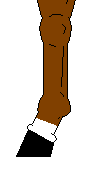 |
White that covers the lower part of the pastern is called a Half Pastern. |
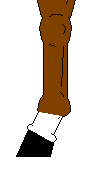 |
White that covers the pastern is called a Pastern. |
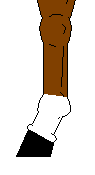 |
White that covers the fetlock joint is generally called a Fetlock. There is some dispute on this marking. Some call it Ankle, etc. It usually depends on how much white there ultimately is on and around the fetlock joint. |
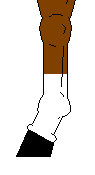 |
White that is no higher than half way up the cannon is called a Sock. |
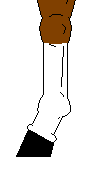 |
White that is more than half way up the cannon but below the knee or hock is called a Stocking. |
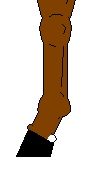 |
Some horses may not have a complete Coronet, but will still have white spots on the coronet band. These are called White Spot(s). These may also be called Heel Spot(s) if they are specifically on the heel of the horse as shown in the picture. |
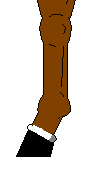 |
Other horses may have dark spots on their white leg markings called Dark Spot(s). These spots usually appear on the coronet band of the horse, as shown in the picture. Other names you can use instead of "Dark Spots" is Ermine or Distal Spot(s). Distal Spots tend to be more towards the heel of the horse. |
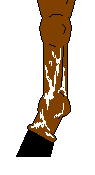 |
Some Appaloosa horses have irregular white on their cannons. These are generally called Lightning Marks. Not all Appy's have Lightning Marks. In fact, most Appys' leg markings fall into the categories shown above. |
This page hosted by Geocities.