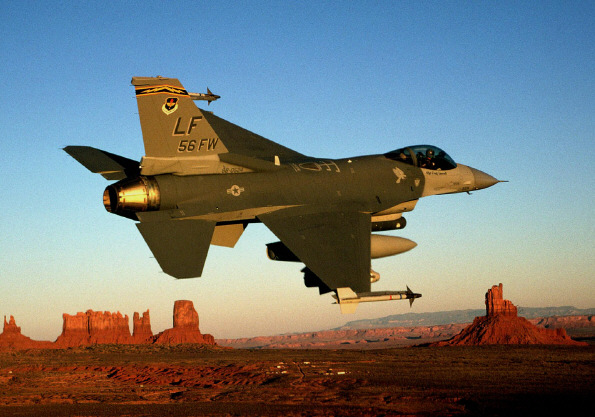
USA Military Aircraft:
F-16 FALCON


The F-16A/B was the first production version of the Fighting Falcon, the A being the single-seat version and the B being the two-seat version. Aside from the second seat, the A and B versions are essentially identical and have the same performance envelope and armament fit.
Unfortunately, the USAF decided not to use the tried-and-true shorthand for describing minor changes to the Fighting Falcon that are introduced on the production line. That is, it did not use such designations as F-16A-10-CF, F-16A-15-CF to distinguish between minor variations in the F-16A series introduced on the production line. Instead, F-16s are referred to by a rather bewildering set of Block Numbers, MSIP stages, and OCUs. The acronym MSIP stands for "Multinational Staged Improvement Program", and is a blanket name for a program in which changes are incorporated in the F-16s as they come off the production line, rather than marrying them to a Multi-Stage Improvement Program, as was done for the F-15 Eagle. The acronyms are the same, but the way that the two programs work is quite different.
The F-16A/B was initially powered by the F100-PW-200 turbofan, rated at 12,240 lb.s.t. dry, 14,670 lb.s.t. full military, and 23,830 lb.s.t. with afterburning. Block 1 F-16A/Bs were the first 43 early production aircraft that immediately followed the two YF-16s and the eight FSD F-16As. They can be distinguished from all subsequent Fighting Falcons by having a black radome. There were 21 Block 1 F-16As and 22 Block 2 F-16Bs.

Pilots flying the early Block 1 F-16As complained that the black radome stuck out like a sore thumb during simulated air-to-air combat and made it easy for the enemy to visually acquire the F-16. On Block 5, the gray radome was introduced, which became standard for all later Fighting Falcons. There were 99 F-16As and 27 F-16Bs built to Block 5 standards, which were ordered in Fiscal year 1978-79. Surviving Block 5 F-16A/Bs were brought up to Block 10 standards in 1982-84.

Block 5 F-16A/Bs destined for Israel have minor (but unspecified) modifications which are unique to Israel. Long after entering service, they may have had improvements which include the installation of Loral Rapport III electronic countermeasures equipment and new chaff/flare dispensers, possibly� AN/ALE-40s. Some Israeli aircraft may have the Elta 2021B radar in place of the APG-66.

Block 10 consisted of 169 aircraft (145 F-16As and 24 F-16Bs), ordered in fiscal year 1979-80. Block 10 aircraft incorporated some minor internal changes. Beginning with the Block 10 series, the USAF introduced a letter suffix within each block, with the letter initially signifying little more than the order in which batches of aircraft were produced. This letter suffix took on greater significance in later Blocks. Most surviving Block 1 and 5 F-16s were later upgraded to Block 10 standards, which included the graying of the radomes. Aircraft belong to the original four NATO users were also brought up to the Block 10 standard. These aircraft are, however, deemed unsuitable for future upgrading.

Block 50/52 Viper Weasel F-16CJ, ability to carry the AGM-88 HARM and the AN/ASQ-213 HTS. AFM: "An extra that makes an F-16 an F-16CJ is the ASQ-213 HARM Targeting System or HTS. It is a small pod, mounted on the right chin station, with sentitive sensors to detect radar energy. It has a 180 degrees forward detection and enables the pilot to shoot the AGM High Speed Anti RAdiation Missile (HARM), its primary weapon, in its most effective 'range known' mode. HTS detects, locates and classifies radars with a high rate of automation. As in other tactical jets, the RWR is an essential warning tool. the RWR provides 360 degrees coverage is the only onboard system that warns the pilot both visually and audibly that he has been illuminated or targetd by the enemy radar. In the F-16CJ it is the ALM-56M. The sensor is much less sensitive than that of the HTS and cannot specify details about or range of the detected radars, other than to give its general direction."
�--PICTURE GALLERY----PICTURE GALLERY----PICTURE GALLERY--�
Hosted by www.Geocities.ws

1