 |
|---|
Luther Terry
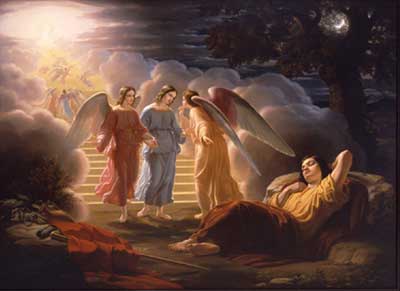
Luther Terry was a painter born in Enfield, Connecticut, July 18, 1813. He
studied art in Hartford until moving to Italy in 1838. There he studied art
at Academia delle belle Arti in Florence. Luther Terry went to Rome in 1839
and lived there permantly. There, he copied paintings by Raphael. He became
inspired to paint Christ. One painting depicts Christ disputing with doctors
in the temple. It is in The Wadsworth Museum, Hartford Conneticut. Other
paintings by Luther Terry include, "The Loves of the Angels," ;" Columbus
before Ferdinand and Isabella" ; "Jacob's Dream,";"Angel announcing the
Birth of Christ to the Shepherds" ;" Toby and the Angel"; and " Solomon's
Choice." He recieved many honors for his work from the academies of
Providence, Rhode Island and Philadelphia. He became an honorary member
of the National academy in 1846.
Luther Terry had a long time friend named Thomas Crawford who was a
sculptor in Rome. Thomas Crawford immigated to Rome from America. His
statue, "Armed Freedom", is in the Capitol Dome, Washington, DC. Thomas
Crawford was married to Lousia Ward. Thomas died at a very young age from
cancer in 1857. At this time Luther Terry was about 20 years his senior, and
well connected in Rome, looked after Lousia and her children. He married
Louisa in 1861. From this union they had 2 children a son, Arthur Noel Terry
and a daughter, Margaret "Daisy" Terry.
Louisa Crawford had a son from her previous marraige named Francis Marion
Crawford. He was born in Bagni di Lucca, Italy in 1854. He was a great linguist
and could speak twenty languages. He studyied Sanskrit at the University of
Rome and later at Harvard University and India. Francis Marion Crawford was
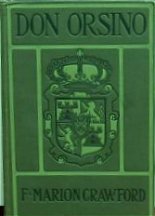
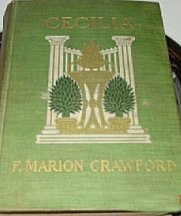
also a great writer who wrote over forty novels. One book, "The Witch Of
Praque" is a novel about the occult. The Saracinesca series, written in 1887,
is his best work. The third book in the series, Don Orsino, is about a real
estate tycoon. Another book in the series, Corleone, was the first major book
about the Mafia in literature. It used the familiar but then original plot of a
priest unable to testify to a crime because of the Seal of the Confessional.
Ironically, Francis Marion Crawford became a Catholic in 1881.
 |
 |
|---|
Francis Marion Crawford was three years-old when Luther Terry became
his stepfather. The artist must have had a tremendous impact on his life
and accomplishments-especially since Luther Terry was well connected
in Rome and old enough to be his grandfather. As there is little information
about Luther Terry's life, his famous stepson's novels may hold clues to
the way this artist lived. The Saracinesca series was a book Crawford had
been researching all his life. Luther Terry and his mother lived through the
1848 revolution in Italy as well as witnessed the turbulant times in Italy
during the 1860's.
 |
|---|
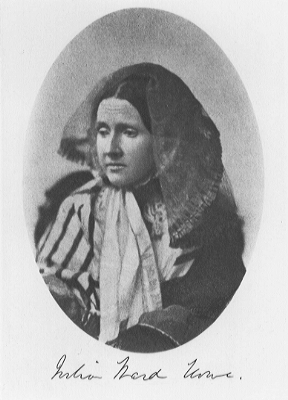
Crawford's aunt, Julia Ward Howe (1819-1910) was a famous poet that also
wrote about her sister, Louisa and little about her brother in law, Luther Terry. Julia Ward
Howe wrote The Battle Hymn of the Republic. She was also an abolitionist,
suffrage leader, lay preacher, peace worker and primary mover in the club
movement. Julia Ward Howe was the first woman elected to the American
Academy of Arts and Letters.
An excerp from "Julia Ward Howe" by Laura E. Richards and Maud Howe Elliot
describes Luther Terry's wife Louisa as a person with wealth who preferred
to travel first class in a conservative era:
"This journey across Europe was undertaken solely for the pleasure of seeing
her sister, always her first object in visiting Europe. The bond between them
was very strong, spite of the wide difference of their natures and the
dissimilarity of their interests. Mrs. Terry was now visiting her eldest
daughter, Annie Crawford, married to Baron Eric von Rabé and living at
Lesnian in German Poland. Baron Eric had served in the Franco-Prussian War
with distinction, had been seriously wounded, and obliged to retire from
active service. Here was an entirely new social atmosphere, the most
conservative in Europe. Even before the travellers arrived, the shadow of
formality had fallen upon them; for Mrs. Terry had written begging that they
would arrive by "first-class"! At that time the saying was, "Only princes,
Americans, and fools travel first-class," and our mother's rule had been to
travel second. The journey was already a great expense, and the added cost
seemed to her useless. Accordingly, she bought second-class tickets to a
neighboring station and first-class ones from there to Czerwinsk. This entailed
turning out in the middle of the night and waiting an hour for the splendid
express carrying the stiff and magnificently upholstered first-class carriages,
whose red plush seats and cushions were nothing like so comfortable as the
old grey, cloth-lined, second-class carriages!"
In the same book, "Julia Ward Howe", she describes that eventhough as
President of The Woman's congress, her sister Louisa Terry does much for
her:
" I was President of the Woman's Congress, and to be absent not only from its
meeting, but also from its preparatory work, caused me great regret. On the
other hand, I saw delightful people in England, and have seen, besides the old
remembered delights, many places which I never visited before.... I am now
with my dear sister, around whom the shadows of existence deepen. I am
glad to be with her; though I can do so little for her, she is doing very much for
me."
Clearly, it seems that Luther Terry's connections went well past Rome. He
was a very wealthy man with ties to The American Government. His stepson,
Francis Marion Crawford, was very well educated, talented and also was
well connected. Nichola Tesla was a very good friend and admirer of Francis
Marion Crawford. However, it seems strange that Luther Terry was
surrounded by great writers and people with connections in high places
yet only a little information exists about his life.
 |
|---|
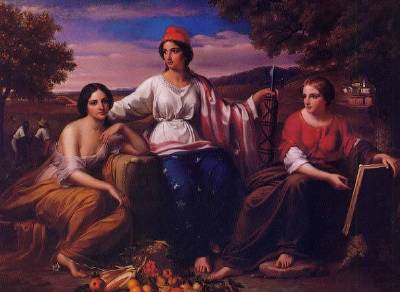
Luther Terry's art defines him best. In Allegory Of The North And South, there
are three women, seated before a distant landscape vista. The woman in the
middle wears striped fabric over a white tunic. Her skirt is made from blue
fabric with white stars. She has a red cap and holds a strange looking
peice of wood and metal. The stars and stripes represent the American flag.
And her hat represents Liberty. The symbol in her left hand are the bound
fasces of the Roman republic and represents Liberty in the United States.
There is a blonde and brunette women on either side of her. One holds a tome
called Useful Arts and Sciences with a background of a New England village.
She represents the North. The other lady is on a cotton bale. There is
plentiful harvest at her feet with slaves working fields behind her. This is
a representation of the South. And the work is truely An Allegory of the North
and the South. It was painted in Rome by Luther Terry who was also an
American expatriate. The painting shows his love for America and desire
to preserve the Union eventhough he spent most of his life in Italy.
April 18, 2006
Kyle Perry