
Indian
Flag
Tiranga
RESULTS
     The simulation of the converter was done using MATLAB 5.3 and was run on
Windows 2000. The Simulation Package simulate the Catalyst Beds, Interbed
Heat Exchanger, Lower Heat Exchanger, Pressure shell and calculates the
Expected Bed Activity Factor.
     The Simulation Package predicts the following:
      1. Bed Activity Factor for both the Beds.
      2. The Temperature and Ammonia Concentration Profile along the Two Beds.
      3. The Plot of Temperature and Bed Volume fraction.
      4. The amount of  Quench, Main-inlet and Cold Shot Gas.
      5. The Approach to Equilibrium in both the Beds.
      6. All the outlet (shell and tube side) Temperatures of the two Heat
         Exchangers.
      7. Temperature of  Main-inlet Gas at the bottom of Pressure Shell.
      8. Convertor Outlet Temperature.

      Simulation Package was tested for large set of actual Raw Plant data of
Converter installed at Ms Sriram Fertilisers and Chemicals,Kota,India and the package could simulate the Convertor Effluent stream compositions and
the Convertor outlet temperature satisfactorily with a maximum of 3 to 4%
error from the measured values. This much error is considered normal as the
Plant data is not consistent hundred percent as there is always error in
the measurement of Convertor inlet and outlet stream compositions and
Temperatures.


The analysis between the Raw Plant data and Simulated results for three
different set of data is given with error in different quantities. Along
with the analysis plots of Temperature, Ammonia Concentration along the Bed
Volume are also given for the three set of data.


It can be seen from the analysis report that maximum absolute error between
Convertor  inlet and effluent stream compositions is 4% and between
Convertor  outlet Temperature is 2.337%. Thus the Simulation Package is
able to simulate the Ammonia Converter satisfactorily.


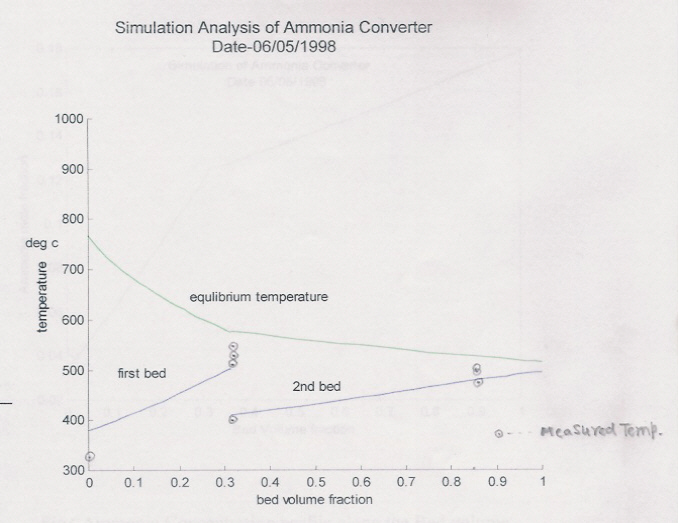
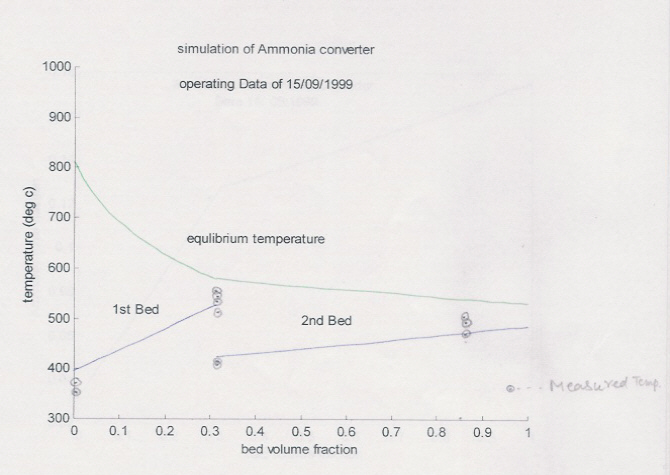
From the plots of Temperature and Bed volume fraction it can be seen that
temperature varies linearly along the two beds. On the plots measured
values are also shown which (apart from inlet temperatures) further
 confirms that simulation has been achieved satisfactorily. The Ammonia
Concentration also varies linearly in both the beds.

In the analysis report the Bed Activity Factor, amount of various Gas streams,
Heat Exchanger inlet, outlet Temperatures, Approach to Equilibrium for the
two Beds and the simulated first and second Bed inlet Temperatures are also
given.

The Bed Activity Factor is a function of time for normal operation (i.e. no
catalyst poisons and no temperature rise). The Factor was plotted against
time for both the Beds. The curve obtained is logarithmic as expected.

After the validation of the Simulation Package was over, the package was used
to study the performance of the Ammonia Convertor.

A study on the effect of changing the Pressure on the overall conversion was
done. The model was tested for different operating Pressures between 280 to
340 kg/cm2 keeping other parameters of Flow, Compositions, and Temperatures
to be constant.

A graph between Pressure and Conversion was plotted and it was observed that as
the Pressure is increased conversion also increases.

So if the pressure is kept high then the conversion will be more, so the Plant
should be run at high Pressure. But as increase in the Pressure increases
 the load on the Compressors, and hence increases the operating
cost so proper optimization between the operating cost and revenues
generated by increased conversion should be done to have maximum profit.
Convertor has design pressure of 292.36 kg/cm2 (301 kg/cm2G) and it is
operated between 285 to 300 kg/cm2 at full load.


Next the effect of  H2/N2 ratio over fractional Conversion was studied
 keeping everything else same. As expected, as the ratio was increases from 2.5
to 3.5 the Conversion increases. So if the Convertor inlet gas has
H2/N2 ratio greater then 3 it will have maximum conversion. Presently plant
is running at ratio of around 3. The ratio can be adjusted by adjusting the
flow of air to secondary reformer. Higher ratio means less amount of
nitrogen, so accordingly amount of air is to be fed to the reformer.

Thus the Simulation Package for the Radial Flow Type Ammonia Converter
satisfactorily predicts the performance of the Convertor . Package can be
used as a built in tool for the simulation of Ammonia Synthesis loop
wherein it can be integrated with other simulations tools for Separator,
Let Down Drum, Chillers, Purge Gas Separators etc. for the optimization of
the Loop for maximum production.
To have a detailed study of results click the link below to download pdf file
Download result
BACK