Spinosaurus vs. Tyrannosaurus
Now that it has been confirmed that the
logosaur is in fact Spinosaurus (I told you so!), the Jurassic
Park community seems to have shifted its attention to the foreshadowed
battle between Spinosaurus and Tyrannosaurus in the upcoming film.
Opinions about who may win this battle differ, but in keeping with the
scientifically evaluative nature of this site, this section will discuss who would
most likely win a battle between the dinosaurs at hand. I have asked Demetrios
M. Vital to write a
synopsis of the fight between Tyrannosaurus and Spinosaurus as I respect his outlook and have
next to no time to write an evaluation myself:
" A battle between these two dinosaurs would never happen in reality for
two main reasons. The first is that there is a geographical barrier
between the two called the Atlantic ocean. Tyrannosaurus rex lived
in western North America, while Spinosaurus aegyptiacus lived in northern
Africa. Also, the two species were separated by about thirty million
years. T. rex has been found in the Maastrichtian of the
Cretaceous, from seventy to sixty five million years ago, while S.
aegyptiacus is found much earlier (Cenomian?), from about ninety-seven
to ninety-five million years ago.
Barring these two problems, there are other reasons a battle to the death would
not ensue between these two creatures. First is that animals don't like
fighting, especially animals that are of the intelligence level of dinosaurs.
It wastes precious calories, and is only needed if necessary. That means
that these two animals had to be in competition with one another. Which
they wouldn't be. S. aegyptiacus is largely piscivorous, a
fish eater. While it wasn't exclusively a fish eater, it was a large part
of the diet. The most complete Baryonyx walkeri (a close relative
of S. aegyptiacus) specimen has in its gut both fish scales and parts of
a juvenile iguanodont, evidence that it either hunted or scavenged it. B.
walkeri is a little over half of S. aegyptiacus' size, so it is
presumed that S. aegyptiacus could also procure non-fish meat if needed
and available. There are also ample large fish species known from S.
aegyptiacus' time and area, further supporting its fishy diet. T.
rex, on the other hand, hunted (there is proof of hunting!) and scavenged
terrestrial animals such as hadrosaurs and ceratopsians, though, in a famine,
I'm sure it would try to catch large fish, if there were any around it.
The point is, these animals would not have been in competition. Also, they
were both large and able to harm each other, and neither wanted that, so self
preservation would be a major issue.
However, on either Isla Nublar or Sorna, the amount of food and land available
to either species was severely less than they would like, and large fish of the
type S. aegyptiacus hunted would not be around. This condition may
bring the two into competition.
As far as this fight goes, size does not matter. A forty-five foot S.
aegyptiacus versus a forty-two foot T. rex is so little a size
difference that there might as well not be a size difference. The same goes for
all the other large theropods: Charcarodontosaurus saharicus, Giganotosaurus
carolinii, Suchomimus tenerensis, Allosaurus maximus, etc. Using
the size issue is like saying, "Which would win, a lion or a
tiger?" It's almost as ridiculous a question for much the same
reasons as we have with these two dinosaurs. This might as well be a
boxing match; in other words, the individual animal's ability is what matters,
not the species. Keep that in mind when discussing which of these two
dinosaurs would win.
However, there is a huge morphological difference between T. rex and S.
aegyptiacus, which affects the outcome of the fight greatly.
Before delving into the morphology of S. aegyptiacus, it must be said
that much of what is known about this animal is inferred from its relatives.
There is very little remaining of this dinosaur after a bombing during World War
II that destroyed most of the specimens. So I will say this again: There
are very few fossils available of this animal, no complete skeletons, and most
of the material we have are teeth. We can, however, in a lack of better
data, extrapolate based on its relatives.
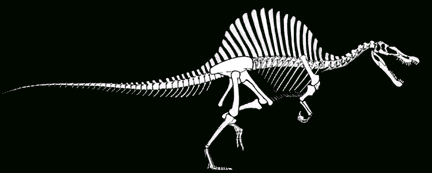 S.
aegyptiacus was very derived as a fish eater. The skull is long, low,
on a longer, slender, neck, and not reinforced for strength; it most likely
measures around six to seven feet long. The nares is posteriorly
shifted, probably to allow it to breathe while its snout was underwater, like
many modern fishing birds. The teeth are long and conical, some with
microserrations, and little to no recurvature. A rosette of teeth is on
the lower jaw, with the longest teeth almost at the tip. The upper jaw has
similar teeth radiations at the premaxilla and at the front of the maxillas.
There is an extreme kink in the snout between the maxilla and premaxilla.
There is no stereoscopic vision. The jaws were highly laterally
compressed, and almost paper thin in the more primitive Suchomimus
tenerensis. There may be a short crest atop the skull, as in B.
walkeri.
S.
aegyptiacus was very derived as a fish eater. The skull is long, low,
on a longer, slender, neck, and not reinforced for strength; it most likely
measures around six to seven feet long. The nares is posteriorly
shifted, probably to allow it to breathe while its snout was underwater, like
many modern fishing birds. The teeth are long and conical, some with
microserrations, and little to no recurvature. A rosette of teeth is on
the lower jaw, with the longest teeth almost at the tip. The upper jaw has
similar teeth radiations at the premaxilla and at the front of the maxillas.
There is an extreme kink in the snout between the maxilla and premaxilla.
There is no stereoscopic vision. The jaws were highly laterally
compressed, and almost paper thin in the more primitive Suchomimus
tenerensis. There may be a short crest atop the skull, as in B.
walkeri.
S. aegyptiacus shared a feature with other spinosaurs that will be
capitalized in JP3: a large thumb claw. This was on the first of three
digits, and is a trait first seen in B. walkeri. The forearms are
allosaur like, and slung below the animal. S. tenerensis shows a
large olecranon process and strong, stout, shorter arms. This may be the
case in S. aegyptiacus. At best, an estimate for the arms is about
five feet long.
Other unique things about this animal include thoracic and caudal vertebrae that
are about twice as long as on other theropods. This extended vertebral
column adds a huge amount to the length of the animal. It was a laterally
thin animal, and had a shallower rib cage, like compsognathids and dilophosaurs.
S. aegyptiacus has a large sail that reaches six feet at its height above
the dorsal vertebrae. This sail is made of thick, elongated neural arches.
There is speculation that they actually were covered by a layer of fat as a
hump, but not a big, round hump as in camels. There is
speculation also that the sail was a heat regulation device by those who believe
S. aegyptiacus was poikilothermic. I disagree. At that size,
gigantothermy is more efficient and a sail simply increases surface area.
I believe this dinosaur was homeothermic and the sail, while it may have been
used for heat regulation, has little bearing on the metabolic state of S.
aegyptiacus.
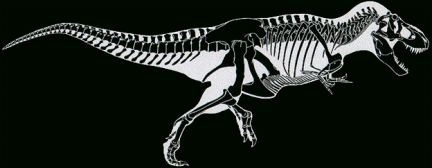 T. rex is known from twenty peer reviewed specimens, with about four more
to be studied from this past summer alone. As the star of JP and TLW, this
dinosaur achieved more infamy than ever before, and JP3 may dethrone the King,
so to speak.
T. rex is known from twenty peer reviewed specimens, with about four more
to be studied from this past summer alone. As the star of JP and TLW, this
dinosaur achieved more infamy than ever before, and JP3 may dethrone the King,
so to speak.
T. rex was designed to be a big, fast big game hunter. With
absolute proof of T. rex hunting, it made a good living as an
opportunist, hunting or scavenging whenever necessary. The skull of T.
rex can deliver more of a bite force than any living animal for sure, and is,
according to Gregory M. Erickson, "the undisputed champion of bite
force." The strong, short, stout, massive skull of T. rex
reflects this adaptation toward power. Also, the skull shows at least a a
60% overlap in vision, well in the range for stereoscopic vision. Other
features include forward pointing ears, a complex inner ear system, and
olfactory bulbs that were the size of grapefruits. In other words, there
is good reason to say that T. rex could smell almost as well as the
turkey vulture, the animal with the largest olfactory bulbs to body size. T.
rex was the owner of an amazing nose.
The legs of T. rex were designed for speed, especially compared to the
shorter legs of S. aegyptiacus. While it is disputed whether T.
rex could achieve a suspensory locomotory phase, a reasonable maximum walking
speed is between twenty and twenty-five miles per hour. But the point
is, even at twenty miles per hour, T. rex could accelerate well, and
still moved faster than any of its possible prey items.
T. rex had a massive body, with a round barrel like chest. While it was
massive, everyone of T. rex's vertebrae through its fourth sacral is
hollow and filled with air sacs most likely connected to the lungs in an avian
air sac breathing system. S. aegyptiacus most likely had had a
similar system, but the fossil support is not there. Hopefully, there will
be new finds soon.
Now, to the battle! The weapons involved for the S. aegyptiacus are
the mouth and arms, while weapons for the T. rex are mouth and possibly
legs. I don't list legs for the S. aegyptiacus, because I think
that its sail made it too unwieldy to kick well.
The arms of the S. aegyptiacus are probably its best weapon. The
problem is that they are slung below the body, and cannot flap. Because
this animal is no kangaroo, rearing up is no possibility either. This
severely restricts the use of the strong arms. (They would be good for
fishing, though!) The mouth of the S. aegyptiacus isn't as strong
as the T. rex's, so could not be used to the same effect.
The T. rex probably employed a run in and bite the thigh and run out
attack. There is no reason to say that the S. aegyptiacus was
faster or stronger than the T. rex, and I think I can say that fairly,
in other words, I'm saying that not just because T. rex is my favorite.
If the S. aegyptiacus got a few scratches off on the T. rex,
they were not likely to be debilitating injuries, unless an eye was gouged or a
major artery. T. rex has protected eyes, though. A bite
from the S. aegyptiacus would be bad, however.
If the T. rex kicked the S. aegyptiacus, there would be little
laceration because T. rex had relatively blunt toe claws, but the S.
aegyptiacus might fall over. Barring the injury of the S.
aegyptiacus from the fall itself, this could be bad for T. rex. From
the ground, the S. aegyptiacus could easily injure T. rex,
especially the legs.
If the T. rex got a bite off on the S. aegyptiacus, though,
there are bad repercussions. A bite that powerful does a lot of damage.
And that's one major reason I say that the T. rex would win. T.
rex was designed, like I said before, to take out big animals with its
mouth. And that's what it would do to the S. aegyptiacus.
Ability and weapons matter here, not size, and the T. rex has the
advantage in both areas.
So that's my verdict, T. rex with the win!"
Home