African Slave Revolts
There was always something missing when slave history was taught in school they forgot to mention that the slaves did revolt against the slavers. Here is a list of uprisings .
| 1547 | The first documented enslave African rebellion in Mexico or anywhere else in the Western Hemisphere, occurred in 1537; this was followed by the establishment of various runaway enslave African's settlements called "palenques.". | |
| 1600s | In Brazil an area known as Recife, a group of 40 enslave Africans rebelled against their master, killed all the white employees, and burned the plantation house. They headed to the mountains. Eventually they reached a place, which because of its abundance of palm trees they named Palmares. In this place an African community was born; a community which lasted nearly a century. In this community the first forms of Capoeira which is a deadly martial art, were developed. Their settlement was estimated to be about 20,000 free Africans strong. | |
| 1608 | In Mexico, Spaniards negotiated the establishment of a free black community with Yagna, a runaway rebel enslave African. Today, that community in Veracruz bears its founder's name. | |
| 1630 | In Brazil, many enslave Africans with assistance from Palmares an escape enslave African community in the mountains, left the plantations and fought the Portuguese and Dutch Armies. This fighting continued up until 1644. It is important to point out that the Dutch and Portuguese Armies were formed by very experienced and well-armed soldiers. But the Africans developed a system of fighting called "jungle war" or ambush. Capoeira which is a deadly martial art, was the key element in the unexpected attacks. With fast and tricky movements the African caused considerable damage to the white men. Capoeira became their weapon, their symbol of freedom. | |
| 1639 | In St. Kitts Nevis, many enslave Africans rose up in rebellion in what was probably the first enslave African revolt in the Eastern Caribbean. | |
| 1663 | First serious enslave African conspiracy in Colonial America, Sept. 13. Servant betrayed plot of White servants and enslave Africans in Gloucester County, Va. | |
| 1712 | Enslave Africans revolt, New York, April 7. Nine Whites killed. Twenty-one enslave Africans executed. | |
| 1700s | After a half century of guerrilla warfare against colonial and European troops, the Maroons of Surinam who were escaped enslaved Africans, signed treaties with the Dutch colonial government in the 1760s, enabling them to live a virtually independent existence. Their population was estimated to be between 25,000 and 47,000 during the eighteenth and nineteenth centuries. | |
| 1720 | First Maroon War in Jamaica. The Maroons were enslaved Africans who escaped from Spanish and British plantations and set up unique and fiercely independent communities in the Mountains far from the reach of recapture and re-enslavement. This first Maroon war ended in 1739. | |
| 1730 | Enslave African conspiracy discovered in Norfolk and Princess Anne counties, Va. | |
| 1733 | There was an island-wide revolt that killed many white families of the platations owners on the island of St. John in the United States Virgin Islands. The enslaved Africans controlled the island for six months. | |
| 1739 | Enslaved Africans revolt, Stono, S.C., Sept 9. Twenty-five Whites killed before the insurrection was put down. | |
| 1741 | Series of suspicious fires and reports of enslaved Africans conspiracy led to general hysteria in New York City, March and April. Thirty-one enslaved Africans and five Whites were executed. | |
| 1763 | The Berbice enslaved Africans Rebellion breaks out (at the time when Berbice was a separate Dutch colony). It begins on one estate, but soon spreads to others along the Berbice River. The revolt is the result of the cruelty with which the Dutch plantation owners have been treating the enslaved Africans, and it was led by a an enslaved African named Coffy. The few hundred white settlers were soon overwhelmed, and the uprising was only put down after the arrival of warships and with the help of troops from as far away as Barbados. Coffy committed suicide three months after the beginning of the affair . His followers were hunted down for another year, before the Dutch authorities were satisfied that the rebellion was crushed. | |
| 1773 | In Massachusetts enslaved Africans petitioned the legislature for freedom, Jan. 6. There is a record of 8 petitions during Revolutionary War period. | |
| 1773 | On the Belize River in Belize, enslaved Africans took over five plantations and killed six white men. There were about fifty armed Africans with sixteen Musquets, Cutlasses, etc. involved in this rebellion. | |
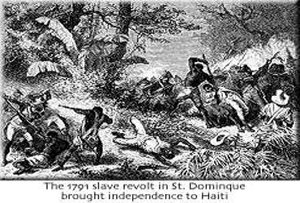
| 1791 |
|
Haitian Revolution began with the revolt of enslaved Africans in the northern province, Aug 22. An estimated 350,000 people died in this revolution before Haiti was declared a free republic on January 1, 1804. This was the most significant rebellion during the MAAFA. |
| 1800 | Gabriel Prosser plotted and was betrayed. Storms forced suspension of attack on Richmond, Va., by Prosser and some 1,000 enslaved Africans on Aug. 30. This conspiracy was betrayed by two enslave Africans. Prosser and fifteen of his followers were hanged on Oct 7. | |
| 1811 | In january of 1811, a powerfull uprising of enslaved Africans took place in the area of New orlean, Lousiana. On january 8, 1811 over 500 enslaved Africans, led by a laborer named Charles on the Deslonde plantation (some 26miles upriver form New Orleans) downed there tools and grabed a few weapons. They then proceeded to march on the city. Their goal was to capture the city and free all the enslaved Africans in the lower Mississippi valley. As they moved down the river, they pushed back the enslavers and their flunkeys, killing many and burning several plantations. There rallying cries were, "On to New Orleans!" and "freedom or death!" They got to within 10 miles of the city, where they were attacked by U.S. government troops. Casualties well taken on both sides. This was the largest enslaved Africans revolt in the United States. | |
| 1816 | 300 enslaved Africans and about 20 Indian allies held Fort Blount on Apalachicola Bay, Fla., for several days before it was attacked by U.S. Troops. | |
| 1816 | On the island of Barbados an enslaved African by the name of Bussa, led a revolt over the British rulers. His bravery and commitment against the evil of slavery is commemorated today with a statue in his honor (which is shown in the picture at the top left side of this page). | |
| 1820 | In May the enslaved Africans of the Belize and Sibun rivers a region in Belize, revolted after very harsh treatment. This revolt was led by two enslaved Africans name Will and Sharper. This revolt lasted for about one month. | |
| 1822 | Denmark Vesey plotted and was betrayed. 'House slave' betrayed Denmark Vesey conspiracy, May 30. Vesey conspiracy, one of the most elaborate enslaved African plots on record, involved thousands of Africans in Charleston, S.C., and its vicinity. Authorities arrested 131 Africans and four whites. Thirty-seven were hanged. Vesey and five of his aides were hanged at Blake's Landing, Charleston, S.C., July 2. | |
| 1823 | There was an enslaved African rebellion on the East Coast of the Demerara in the country of Guyana. | |
| 1829 | Race riot, Cincinnati, Ohio, August 10. More than 1,000 Africans left the city for Canada. | |
| 1831 | Nat Turner revolt, Southampton County, Va., August 21-22. Some 60 Whites were killed. Nat Turner was not captured until October 30. Nat Turner was hanged, in Jerusalem, Va., Nov. 11. | |
| 1835 | In Brazil, 1835 was the year of the famous Male revolt. Many enslaved Africans were returned to Africa after this revolt. There was an estimated 25 rebellions in Brazil during the nineteen century which eventually culminated with the abolition of slavery in 1888. | |
| 1838 | Frederick Douglass escaped from slavery in Baltimore, Sept. 3. | |
| 1839 | Amistad mutiny led by Joseph Cinquez, were captured. After trial in Conn., returned to Africa. | |
| 1841 | Enslave Africans revolted on the slave trader 'Creole' which was en route from Hampton, Va., to New Orleans, La., Nov 7. The enslaved Africans overpowered crew and sailed vessel to Bahamas where they were granted asylum and freedom. | |
| 1848 | Ellen Craft impersonated an enslaver holder, William Craft acted as her servant in one of the most dramatic enslaved Africans escapes--this one from slavery in Georgia, Dec 26. | |
| 1849 | Harriet Tubman escaped from slavery in Maryland, summer. She returned to South 19 times and brought out more than 300 enslaved Africans. | |
| 1851 | African abolitionist crashed into a courtroom in Boston and rescued a fugitive enslaved African, Feb 15. | |
| 1851 | Africans dispersed a group
of slave catchers Sept 11 in Christiana, Pa., conflict. One White man was
killed, another wounded.
|
|
| 1851 | African and White abolitionists smashed into courtroom in Syracuse, N.Y., and rescued a fugitive enslaved African Oct 1. | |
| 1859 | Five Africans with 13 Whites with John Brown attacked Harpers Ferry, Va., Oct 16-17. Two Africans were killed, 2 captured, one escaped. John Copeland and Shields Green hanged at Charlestown, Va., Dec 16. | |
< <back to History contents

Check out the other Logical thinker's web-site areas.
Newsletters archives | Book site | Home | History | Social & Political Issues I poetry I Hot links I Web-Rings
I My deep house music site I

This site is maintained by Markus Rice updated 03/01/2000