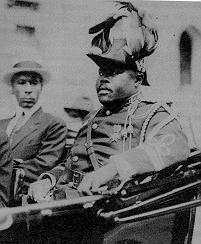
 and Sarah Garvey. They were poor, unmixed Negroes. His father was head of
the family and kept discipline with stern formality. His mother was a kind
and gentle churchgoer. Marcus was the youngest of eleven children though
only he and his sister Indiana lived to maturity.
and Sarah Garvey. They were poor, unmixed Negroes. His father was head of
the family and kept discipline with stern formality. His mother was a kind
and gentle churchgoer. Marcus was the youngest of eleven children though
only he and his sister Indiana lived to maturity.Jamaica, at that time, was an area of great prejudice. There were three groups of people - the white elites, the mulatto middle class, and the large and greatly discriminated against black underclass. Garvey was part of the latter and resented the lack of opportunity and leadership in his class.
Marcus attended a local elementary school and an Anglican Grammar school before graduating form the Church of England High School. He then took classes at Birbeck College. His education was not very thorough, and Garvey always yearned to be learned like his rival W.E.B. DuBois. Instead of elite schooling, Garvey learned from experience. At seventeen, Garvey went to Kingston to be apprenticed to his uncle, a printer. His mother joined him in 1903, his father having already passed away, but she did not like the city and died shortly after. Garvey practiced public speaking on the streets and taught himself by imitating preachers.
By the time Garvey was twenty, he was a master printer and foreman of the P.A. Benjamin Co. Troubles for Garvey were on the way, though. On January 14, 1907, there was an earthquake and fire. This caused low wages and scarcity of commodities. The Printer's Union went on strike and made Garvey their leader. The strike eventually broke, and most of the workers got their jobs back except Garvey. This caused him to distrust the role unions could play in helping the black worker. Garvey went to work for the government and edited an unsuccessful newsletter called Garvey's Watchman. This was the first in a long line of unsuccessful attempts by Garvey before the UNIA. He left his job to go to Costa Rica. There, he worked for the United Fruit Co. He recognized the awful plight of the black field workers. He went to Limon to protest but was met with indifference and another failed paper, La Nationale. He traveled to Panama, Equador, Nicaragua, Honduras, Columbia, and Venezuela. At all places he found the inferior status of the Negro.
In 1912, Garvey went to London where he met Duse Mohammed Ali. An interest in Africa was stimulation in Garvey. He returned to Jamaica and founded the Universal Negro Improvement and Conservation Association and African Communities League (UNIA). Four years later, Marcus moved to Harlem to open the American chapters of the UNIA. He went on to work for Negro independence by speaking, opening black businesses, starting the Black Star Shipping Line, spreading the UNIA around the world, and encouraging black emigration to Africa. His followers numbered in the thousands. He created extravagant titles and costumes for the leaders of his movement and "Garveyism" spread.
His movement had its problems, however. His business was fraught with problems and critics of Garvey became harsh. They claimed that he associated with the Klu Klux Klan in order to help his back to Africa movement. In 1923, he was incarcerated for six months because of mail fraud. The Black Star Line also failed.
In spite of the difficulties his movement had, Garvey became a symbol of black freedom. His powerful oratory gave pride and hope to thousands of working class blacks around the world.