Five Years of Recording
that Changed the World
By Jonathan F. Brown
Bristol, Tennessee, USA. Summer 1927. The country was still somewhat
young and most of its inhabitants dirt poor. A 35-year-old music scout
named Ralph Peer made his way through the rural South determined to
discover a goldmine of hillbilly and blues talent. He was accompanied
by a small recording crew and the newest recording device available
at that time: the electric microphone. Such higher quality recording equipment,
along with the steadily increasing mass-production and distribution of records,
gave Peer an idea. For the first time, records could be marketed to rural
working class consumers, who could afford the phonograph over a recent - but far
more expensive – invention: the radio. But Peer sensed that this new target
group wasn’t interested in buying records recorded with the urban middle
class in mind, which until that time had pretty much been the trend.
They more reasonably wanted to sit in their homes and listen to the “old traditionals”;
familiar tunes from their own local surroundings. Peer and his crew
set up camp, gathered together local talent, paid them 50 dollars
per recorded song and before they knew it, commercial country music was born.
Peer discovered Jimmie Rodgers and the Carter Family, both of whom
soon became the first stars of country music. He also discovered many musicians
who have never been heard from since.
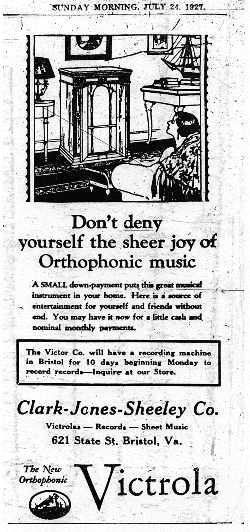
ORIGINAL AD FOR BRISTOL SESSIONS
In the ensuing five years (until the Depression stopped folk music sales by 1932),
Peer and other scouts like him would record an enormous number
of rural performances by musicians who sang their songs, got their money
and then virtually disappeared. Of course, a lot of these were hardworking
people who only played music in their spare time. Some of them must have
felt brief moments of excitement, but probably thought, “Well, nothin’ll ever
come of it,” and went on back home. Yet a part of them would be left
behind after each session. This part would continue to function independently of its creator,
and if preserved, would continue to bring pleasure to audiences well into the 21st century.
Enter Harry Smith. Harry Smith (1923-1991) was known by many as a brilliant,
if eccentric freak. He was an anthropologist, linguist, archivist, avant-garde
filmmaker, painter, magician, alchemist and occultist (even claiming
to be the illegitimate son of infamous occultist Aleister Crowley).
The Smithsonian Institution now houses his extensive paper airplane collection,
and reportedly his collection of Ukrainian painted eggs.
He considered himself to be the expert on string figures, having researched
and mastered literally hundreds of string games and figures from around the world.
Harry Smith’s crowning achievement, however, is undoubtedly his “Anthology
Of American Folk Music”. Released in 1952 on Folkways Records, it was Smith’s
well-researched and annotated compilation from his own collection of
recordings made between 1927 and 1932. Smith believed that, “during this
five year period American music still retained some of the regional qualities
evident in the days before the phonograph, radio and talking picture
had tended to integrate local types.” In addition to assembling 84 songs
on six LPs in three differently colored boxes (blue for air, red for fire and green for water),
he often gave a description of the song and performer as well as a discography
and bibliography. The legend goes that Smith came up with the order
of the songs through some magical, alchemic ritual. His overall mission with the
Anthology was to get these old “forgotten” songs out there among clever but bored
middle class teenagers in the cities who were dying for a “new” sound.

HARRY SMITH 1965
By Smith’s calculations, the youth of the country would embrace the Anthology and
become creatively inspired, eventually coming up with new versions of the
old songs, and that this would eventually bring about important change.
His plan worked and the Anthology seemed to effortlessly find its way into
mainstream popular music during the 50s, 60s and 70s. The young Bob Dylan
and his friends were big fans; the resemblance of his “Blowin’ In The Wind” to part
of the melody of the first song on the Anthology is striking. Dylan was one
Anthology disciple who rapidly achieved stardom on an international scale,
thus spreading the good news of the old-time sound around the world.
In fact, from the folk revival all the way up to hard rock, with most of the young
bands hitting the international market, one could find in their music noticeable traces
of Smith’s collection. The angry, soulful blues sounds, the psychedelic
fiddling patterns, the unusually powerful guitar leads: it was all right there from the
beginning. And quite often, to Smith’s satisfaction, this new “folk” music called for change.
The music was present throughout the civil rights movement, the anti-war demonstrations,
and other historical moments, but the great change that perhaps Harry Smith
had envisioned was at best an individual one – a personal change taking place within
the listener moved by this ancient, magical music. Perhaps he also hoped this
change would be contagious. If one looks at it in historical perspective,
considering that the Anthology was issued in 1952, at the height of McCarthyism
and Red Scare propaganda and paranoia, it isn’t hard to imagine Smith
wanting to create a sort of secret society as a response and defense mechanism
to his conformist times. In any case, for whatever reason, Harry Smith declared
his “experiment” a success. On accepting a lifetime achievement award at the 1991
Grammy ceremonies months before his death, he said, “I’m glad to say that
my dreams came true – that I saw America changed through music.”
Now it’s 2003. Homeland Security. War On Terror. There’s a whole new world order
and a whole new generation of people discovering American folk music of the 20s and 30s.
The release three years ago of the Cohen Brothers’ film “O Brother, Where Art Thou”
helped trigger another old folk music revival. Smith’s Anthology has been
re-issued on compact disc, and an extensive number of CD compilations have
recently been released by such labels as Yazoo, County and Old Hat, all specializing
in the 1927-32 recording boom.Yazoo’s spectacular six-volume set entitled “Times Ain’t Like
They Used To Be” digs even deeper than Harry Smith did, and reveals a handful
of musical geniuses Smith seems to have overlooked.
This newest incarnation of the music provides a refreshing alternative to
contemporary clean music culture, with its crystal-clear sound and calculated performances.
On the old recordings you can hear mistakes and spontaneity and, though
digitally re-mastered, there’s still plenty of hiss and scratch – you can almost hear age itself.
Record collector, researcher and producer Richard Nevins, who compiled “Times Ain’t
Like They Used To Be,” has more than taken over where Smith left off,
albeit without all the legendary alchemy and hocus-pocus. Or is it possible for one to
delve into this mysterious, seemingly timeless musical heritage without having
at least a ghost or two brushing up against you?
© 2003 Jonathan F. Brown
