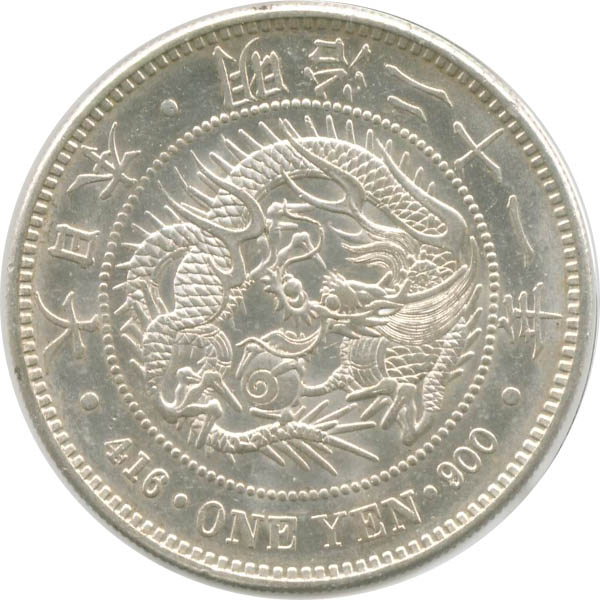
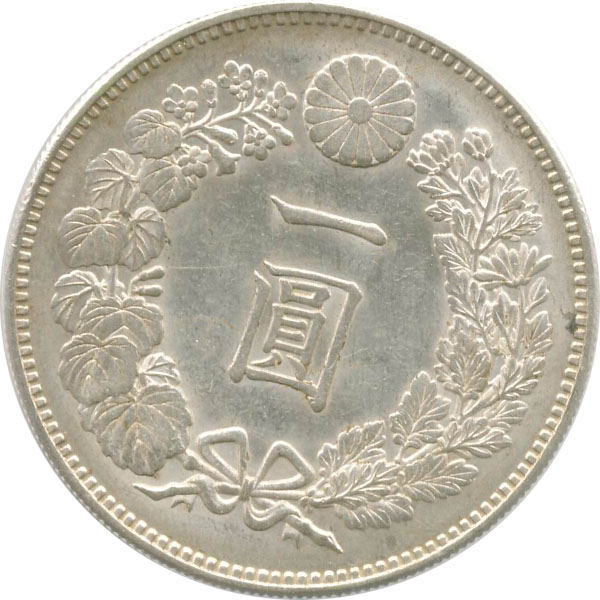
1888 Silver Meiji 1 Yen
(Type 2)
Coin Series Technical Specifications:
| Category | : | Japanese Trade Dollar |
| Year of Issue | : | 1870 - 1912 (Meiji 3 - Meiji 45) |
| Mintage | : | ? |
| Mint / Mint Mark | : | Tokyo Mint & Osaka Mint |
| Grade / Finish | : | Extremely Fine |
| Weight | : | 416 grains / 26.95 gr |
| Silver Purity | : | 90% |
| Actual Silver Weight | : | 0.780 |
| Diameter | : | 38.10 mm |
| Thickness | : | ? mm |
| Face Value | : | 1 Yen |
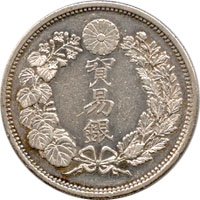
| Obverse | : | Imperial Chrysanthemum wrapping the word "One Yen" |
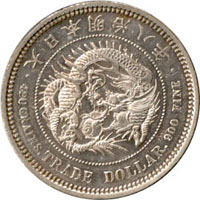
| Reverse | : | A coiled dragon holding a pearl, with the legend "Great Japan", "Meiji Year 21", "416", "One Yen" and "900" |
| Comments | : |
The Meiji era in Japan began in 1868 with Japan opened to the outside world and its various influences, one of which was trade. Seeing the wide gap between Japan and western imperial powers, the Emperor instituted many changes in the empire. As a progress to reform the complex Japanese monetary system, the government enacted a "New Currency Act" in 1871 with the following highlights:
1. Division of monetary system based on a decimal system of Yen, Sen and Rin. 2. Adoption of gold as monetary standard in Japan (followed with silver and copper) 3. Adoption of round-shaped coins for the above gold and silver (emulating western countries)
Also included as part of the package was the issuance of Silver coins resembling the western trade dollars to settle trades in the East Asia region where most countries have adopted the silver standard. The first of the silver Meiji was minted in 1871 (Meiji 3) and would continue until 1911, when the Meiji era ended and was continued by the Taisho era (only in 1915 before production was stopped). The Japanese styled the numbering of their year after the start of the Emperor's reign. In 1878 the government allowed unlimited circulation of the silver coin in Japan, making the type 2 coins.
Some of these coins were exported for overseas use, mainly Korea, Southern Manchuria and Taiwan. Coins that were sent this way was marked with a "GIN" stamp ("GIN" is a character that means silver). Where the stamp was placed signifies which mint produced the coin. A left GIN meant the coin came from the Osaka Mint while a right GIN meant the coin came from the Tokyo Mint. |
| Last Update | : | Mar 12, 2004 |
Variations of this silver coin type: (dates are still under research)
Type 1 (1870 - 1874) <- unconfirmed
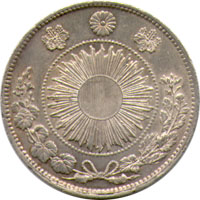
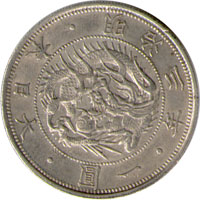
Type 2 (1874 - 1911)
Trade Dollar Type (1875 - 1878)
Last update: Nov 17, 2003