A tribute to America�s lovely poetALLEN GINSBERGAllen GinsbergBorn: June 3, 1926, in Newark, New Jersey Died: April 5, 1997, in East Village, New York City 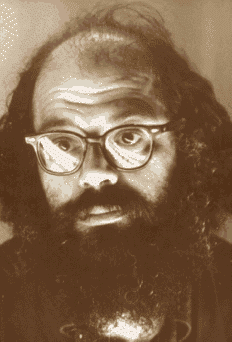 "I�ve been here before "I�ve been here beforethe odd vibration of the same old universe�" Why can�t I find no single one WASP among my favorite Americans ? Among my favorite Americans are a German Jew (Einstein), a German space technician (Wernher von Braun), a Russian Jew (Ginsberg), two grandchildren of French immigrants (Carl Sagan and the Breton, Jack Kerouac) and lots of African Americans (Malcolm X, Martin Luther King and of course all those great jazz musicians and "black" poets). In 1966 there was this memorable happening "Po�zie in het Paleis" (Dutch for Poetry at the Palace) in the Brussels Palace of Fine Arts near the Central Station. There were poets from Holland, Flanders and South Africa ("Afrikaans" differs a little bit more from European Dutch than Americanese from English), among them Berten Breytenbach, expelled from his country by the Apartheid system. One brilliant Dutch poet, Simon Vinkenoog from Amsterdam, recited his Dutch translation of "Holy". And that was the first time I heard about Allen Ginsberg and blamed myself for not knowing him yet. I immediately went to the English Bookshop "Smith and Son" in Brussels to buy two works of Ginsbergs : Howl (1956) and Since then not one year has passed without me rereading Howl and 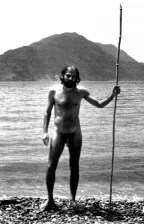 And I have only one of his sang poems on tape, the undescribably beautiful and touching Father Death Blues, that he composed on the plane, while traveling to the funeral of his father Louis Ginsberg. And I have only one of his sang poems on tape, the undescribably beautiful and touching Father Death Blues, that he composed on the plane, while traveling to the funeral of his father Louis Ginsberg.I never met Allen Ginsberg live, but saw him now and then on television. He was in the middle of the scandalous riot - American police beating up a rally by young American liberals - during the Democratic Convention in 1968, where he grabbed a microphone and started singing the Hindu mantra "Ohm" in an attempt to stop the violence. Some thought he was joking� I saw him interviewed by one of those television smart guys who obviously didn�t know what it was all about, I saw Allen singing his poems, accompanied by himself at a little portable organ they use to play in India and, in short, I kept following the work and activities of one of the greatest - if not the greatest - poets of the 20th century. In 1996 we heard that Allen Ginsberg was severely ill, he had liver cancer. He died on April 5, 1997. BIOGRAPHYAllen was the second son of Louis Ginsberg, a published poet, a high school teacher and a moderate Jewish Socialist. His wife and Allen�s mother, Naomi, was a radical Communist and a nudist. She went tragically insane in early adulthood and would spend the last years of her life in a mental hospital, where she underwent lobotomy, one of the most insane therapies doctors ever invented.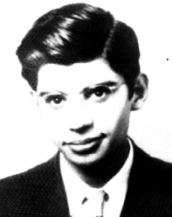 The Ginsbergs lived in Paterson, New Jersey. Allen was a shy and sensitive boy. He loved his parents and suffered seeing his mother going insane. He also tried to comprehend what was going on inside him, because he felt attracted to other boys his age. In short, Allen Ginsberg had everything to be happy in America, being the homosexual son of Jewish-Russian immigrants, who�s mother was a communist and a nudist. To make everything perfect, Allen felt also very attracted to anarchism. The Ginsbergs lived in Paterson, New Jersey. Allen was a shy and sensitive boy. He loved his parents and suffered seeing his mother going insane. He also tried to comprehend what was going on inside him, because he felt attracted to other boys his age. In short, Allen Ginsberg had everything to be happy in America, being the homosexual son of Jewish-Russian immigrants, who�s mother was a communist and a nudist. To make everything perfect, Allen felt also very attracted to anarchism.While at Columbia University, he became close friends with Jack Kerouac and William Burroughs, who were later to be numbered among the Beats. After leaving Columbia in 1948, he traveled widely and worked at a number of jobs from cafeteria floor mopper to market researcher. Howl, Ginsberg's first published book, laments what he believed to have been the destruction by insanity of the "best minds of [his] generation." Dithyrambic and prophetic, owing something to the romantic bohemianism of Walt Whitman, it also dwells on homosexuality, drug addiction, Buddhism, and Ginsberg's revulsion from what he saw as the materialism and insensitivity of post-World War II America. Empty Mirror, a collection of earlier poems, appeared along with Kaddish and Other Poems in 1961, followed by Reality Sandwiches in 1963. Kaddish, one of Ginsberg's most important works, is a long confessional poem in which the poet laments his mother's insanity and tries to come to terms with both his relationship to her and with her death. In the early 1960s Ginsberg began a life of ceaseless travel, reading his poetry at campuses 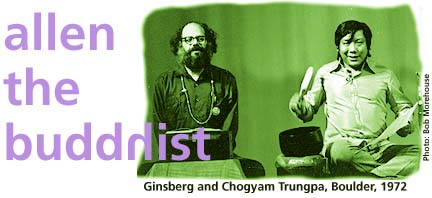 and coffee bars, traveling abroad, and engaging in left-wing political activities. He became an influential guru of the American youth counterculture in the late 1960s. and coffee bars, traveling abroad, and engaging in left-wing political activities. He became an influential guru of the American youth counterculture in the late 1960s.He acquired a deeper knowledge of Buddhism, and increasingly a religious element of love for all sentient beings entered his work. His later volumes of poetry included Planet News (1968); The Fall of America: Poems of These States, 1965-1971 (1972), which won the National Book Award; Mind Breaths: Poems 1972-1977 (1978); and White Shroud: Poems 1980-1985 (1986). His Collected Poems 1947-1980 appeared in 1984. Of course, the FBI kept a file �Allen Ginsberg�, which contains funny details. He was put on a 'Dangerous Subversive' Internal Security list in 1965 - the same year he was kicked out of Havana and Prague for talking and chanting back to the Communist police. The report describes Ginsberg further as having made "expressions of strong or violent anti U.S. sentiment," and as having "a propensity for violence and antipathy toward good order and government." A propensity for violence ? Allen was an advocate of non-violent action. A photograph of Ginsberg was placed in the Federal Narcotics files in 1967 and a copy of the photograph was sent to the FBI. Ginsberg had openly campaigned against what he regarded as harsh antimarijuana laws that were used to arrest anti Vietnam War and other protesters. "He is pictured in an indecent pose," the report said, and that "Ginsberg chanted unintelligible poems in Grant Park on August 28, 1968." Ginsberg explained that the "unintelligible poems" were William Blake's "The Grey Monk." During the first term of the Reagan administration, a list of eighty four people deemed "unsuitable" as government paid speakers abroad was prepared by the United States Information Agency. Among the names were Ralph Nader, the consumer advocate; Coretta Scott King, the black leader; Betty Friedan, the feminist; John Kenneth Galbraith, Paul Samuelson and Lester Thurow, economists; and Allen Ginsberg, poet. Discover more about Allen Ginsberg and read some of his poems on the following websites : American Poets Patti Smith�s tribute Naropa Booksmith Beat Generation And on our own website, the poems : "America" and "Father Death Blues", which he wrote on the plane to his father�s funeral |

