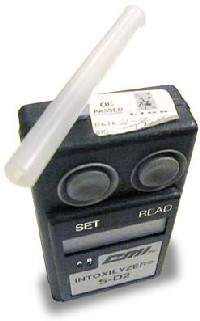
Police officers use portable breath-testing
machines like this one to find out if a driver has a
blood alcohol level above the legal
limit.
|
We
hear and read about drivers involved in an accident who are
later charged with drunken driving, and usually a news report
on the accident will say what the driver's blood
alcohol level was and what the legal limit for blood alcohol
is. A driver might be found to have a level of 0.15, for
example, and the legal limit is 0.08. But what do those
figures mean? And how do police officers find out if a driver
they suspect has been drinking is actually legally drunk? You
have probably heard about the Breathalyzer, but may
wonder exactly how a person's breath can show how much that
person has had to drink.
It is important for public safety that drunken drivers be
taken off the roads. Of the 42,000 traffic deaths in the
United States in 1999, about 38 percent were related to alcohol.
Drivers who can pass roadside sobriety tests -- they can touch
their noses or walk a straight line -- still might be breaking
the legal limit for blood alcohol and be a hazard on the road.
So police officers use some of the latest technology to detect
alcohol levels in suspected drunken drivers and remove them
from the streets.
Many officers in the field rely on breath alcohol testing
devices (Breathalyzer is one type) to determine the blood
alcohol concentration (BAC) in drunken-driving
suspects. In this edition of HowStuffWorks,
we will examine the scientific principles and technology
behind these breath alcohol testing devices.
Why Test?
Alcohol intoxication is legally
defined by the blood alcohol concentration (BAC) level.
However, taking a blood sample
in the field for later analysis in the laboratory is not
practical or efficient for detaining drivers suspected of
driving while impaired (DWI) or driving under the
influence (DUI). Urine tests for alcohol proved to be
just as impractical in the field as blood sampling. What was
needed was a way to measure something related to BAC without
invading a suspect's body.
In the 1940s, breath alcohol testing devices were first
developed for use by police. In 1954, Dr. Robert
Borkenstein of the Indiana State Police invented the
Breathalyzer, one type of breath alcohol testing device
used by law enforcement agencies today.
Let's take a look at what these tests are based on.
Principle of Testing
Alcohol
that a person drinks shows up in the breath because it gets
absorbed from the mouth, throat, stomach and intestines into
the bloodstream.
Alcohol is not digested upon absorption, nor chemically
changed in the bloodstream. As the blood goes through the lungs, some
of the alcohol moves across the membranes of the lung's air
sacs (alveoli) into the air, because alcohol will
evaporate from a solution -- that is, it is volatile.
The concentration of the alcohol in the alveolar air is
related to the concentration of the alcohol in the blood. As
the alcohol in the alveolar air is exhaled, it can be detected
by the breath alcohol testing device. Instead of having to
draw a driver's blood to test his alcohol level, an officer
can test the driver's breath on the spot and instantly know if
there is a reason to arrest the driver.
Because the alcohol concentration in the breath is related
to that in the blood, you can figure the BAC by measuring
alcohol on the breath. The ratio of breath alcohol to blood
alcohol is 2,100:1. This means that 2,100 milliliters
(ml) of alveolar air will contain the same amount of alcohol
as 1 ml of blood.
For many years, the legal standard for drunkenness across
the United States was 0.10, but many states have now adopted
the 0.08 standard. The federal government has pushed
states to lower the legal limit. The American Medical
Association says that a person can become impaired when the
blood alcohol level hits 0.05. If a person's BAC measures
0.08, it means that there are 0.08 grams of alcohol per 100 ml
of blood.
There are several different devices used for measuring BAC.
Types of Devices
There are three major types
of breath alcohol testing devices, and they're based on
different principles:
- Breathalyzer - Uses a chemical reaction involving
alcohol that produces a color change
- Intoxilyzer - Detects alcohol by infrared (IR)
spectroscopy
- Alcosensor III or IV - Detects a chemical
reaction of alcohol in a fuel
cell
Regardless of the type, each device has a
mouthpiece, a tube through which the suspect blows air,
and a sample chamber where the air goes. The rest of
the device varies with the type.
Breathalyzer
The
Breathalyzer device contains:
- A system to sample the breath of the suspect
- Two glass vials containing the chemical reaction mixture
- A system of photocells connected to a meter to measure
the color change associated with the chemical reaction
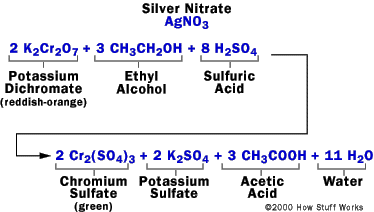
To measure alcohol, a suspect breathes into the
device. The breath sample is bubbled in one vial through a
mixture of sulfuric acid, potassium dichromate, silver nitrate
and water. The principle of the measurement is based on the
following chemical reaction:
In this reaction:
- The sulfuric acid removes the alcohol from the
air into a liquid solution.
- The alcohol reacts with potassium dichromate to
produce:
- chromium sulfate
- potassium sulfate
- acetic acid
- water
The silver nitrate is a
catalyst, a substance that makes a reaction go faster
without participating in it. The sulfuric acid, in addition to
removing the alcohol from the air, also might provide the
acidic condition needed for this reaction.
During this reaction, the reddish-orange dichromate ion
changes color to the green chromium ion when it reacts
with the alcohol; the degree of the color change is directly
related to the level of alcohol in the expelled air. To
determine the amount of alcohol in that air, the reacted
mixture is compared to a vial of unreacted mixture in the
photocell system, which produces an electric
current that causes the needle in the meter to move from
its resting place. The operator then rotates a knob to bring
the needle back to the resting place and reads the level of
alcohol from the knob -- the more the operator must turn the
knob to return it to rest, the greater the level of alcohol.
The Chemistry of
AlcoholThe alcohol found
in alcoholic beverages is ethyl alcohol
(ethanol). The molecular structure of ethanol looks like
this:
H
H3C - C
- O - H
H
where C is carbon,
H is hydrogen, O is oxygen and each hyphen
is a chemical bond between the atoms.
For clarity, the bonds of the three hydrogen atoms to
the left carbon atom are not shown.
The OH (O - H) group on the molecule is what makes it
an alcohol. There are four types of bonds in this
molecule:
- carbon-carbon (C - C)
- carbon-hydrogen (C - H)
- carbon-oxygen (C - O)
- oxygen-hydrogen (O - H)
The
chemical bonds between the atoms are shared pairs of
electrons. Chemical bonds are much like springs: They
can bend and stretch. These properties are important in
detecting ethanol in a sample by infrared (IR)
spectroscopy.
|
Intoxilyzer
This device
uses infrared (IR) spectroscopy, which identifies
molecules based on the way they absorb IR light.
Molecules are constantly vibrating, and these
vibrations change when the molecules absorb IR light. The
changes in vibration include the bending and stretching of
various bonds. Each type of bond within a molecule absorbs IR
at different wavelengths.
So, to identify ethanol in a sample, you have to look at the
wavelengths of the bonds in ethanol (C-O, O-H, C-H, C-C) and
measure the absorption of IR light. The absorbed wavelengths
help to identify the substance as ethanol, and the amount of
IR absorption tells you how much ethanol is there.
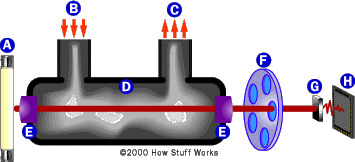
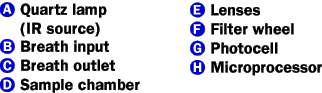
Diagram of the Intoxilyzer
|
In the Intoxilyzer:
- A lamp generates a broadband
(multiple-wavelength) IR beam.
- The broadband IR beam passes through the sample
chamber and is focused by a lens onto a spinning filter
wheel.
- The filter wheel contains narrow band filters
specific for the wavelengths of the bonds in ethanol. The
light passing through each filter is detected by the
photocell, where it is converted to an electrical pulse.
- The electrical pulse is relayed to the microprocessor,
which interprets the pulses and calculates the BAC based on
the absorption of infrared light.
Fuel-cell
Detectors
Modern fuel-cell
technology (which may power our cars and even our houses some
day) has been applied to breath alcohol detectors. Devices
like the Alcosensor III and IV use fuel cells.
The fuel cell has two platinum electrodes with a
porous acid-electrolyte material sandwiched between
them. As the exhaled air from the suspect flows past one side
of the fuel cell, the platinum oxidizes any alcohol in the air
to produce acetic acid, protons and electrons.
Oxidation of
AlcoholIf you strip
off hydrogens from the right carbon of ethanol in the
presence of oxygen, you get acetic acid, the main
component in vinegar. The molecular structure of
acetic acid looks like this:
O
||
H3C - C - O -
H
where C is carbon, H is
hydrogen, O is oxygen, the hyphen is a single
chemical bond between the atoms and the || symbol
is a double bond between the atoms. For clarity, the
bonds of the three hydrogen atoms to the left carbon
atom are not shown. When ethanol is oxidized to acetic
acid, two protons and two electrons are also produced.
|
The electrons flow through a wire from the platinum
electrode. The wire is connected to an electrical-current
meter and to the platinum electrode on the other side. The
protons move through the lower portion of the fuel cell and
combine with oxygen and the electrons on the other side to
form water. The more alcohol that becomes oxidized, the
greater the electrical current. A microprocessor
measures the electrical current and calculates the BAC.
Operators of any breath alcohol testing device must be
trained in the use and calibration of the device, especially
if the results are to be used as evidence in DWI
trials. Law enforcement officers can carry portable breath
testing devices that use the same principle as full-size
devices. Court cases can turn on the perceived accuracy of a
breath test, however, so prosecutors rely on the results
obtained from full-size devices.