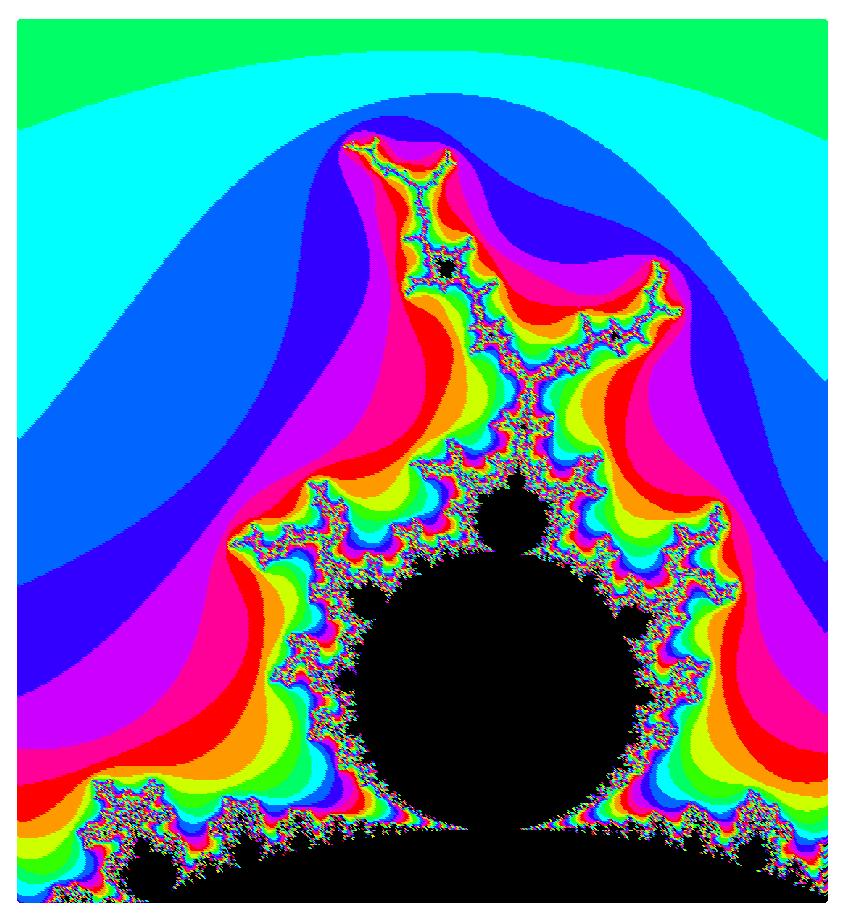
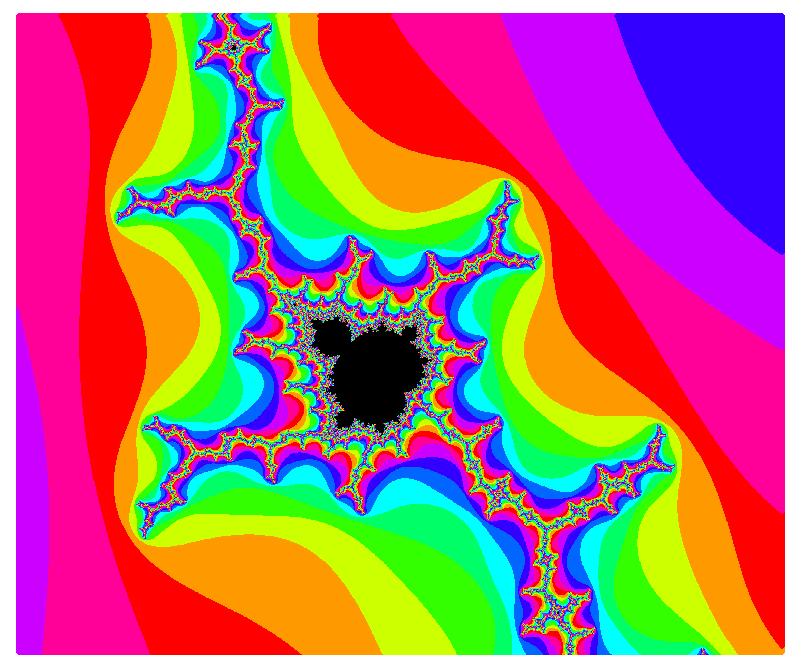
The Mandelbrot Set is a classic fractal. A fractal is a figure that can be magnified as many times as you want and will reveal infinite complexity. It is the set of all complex numbers z such that X{N} in the following expression does NOT increase to infinity no matter how large N gets:
X{1} = Z
X{N+1}= X{N}^2 + Z
You can think of this process in the following manner:
Choose a complex number. Square it, and add the original number. Now square the result, and add the original number. Now square that result, and again add the original number. Keep alternating between squaring and adding until (A) the result increases without bound (in which case the original number is not part of the set) or (B) The result settles to zero, another constant, or bounces between constants. (Then the number is part of the set).
Obviously, this picture could not be made without the help of a computer. The program does the calculations until the result a + bi has an a or b greater than 2 or less than -2 (because these numbers will always increase without bound) or has gone through a set number of iterations. The computer notes the amount of iterations and colors the point (a,b) black if it does not halt before the set limit or another color, depending on the number of iterations.
If you had a pefect diagram of the Mandelbrot set, you could zoom in forever and see that it has infinite complexity.
Fractals are linked to Chaos Theory. The concept of "Chaos" is that small changes in the inital conditions of a system can lead to huge differences in the final outcome. The Mandelbrot Set is a good example. If you choose any point on the edge of the fractal and move a TINY amount in any direction, you might get an entirely different color, representing a large change in iterations. |