idealism: a la Plato, the belief that the important things of the world
are contained in the realm of abstract ideas
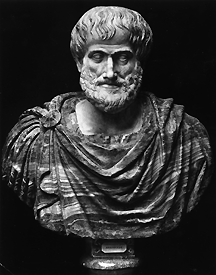
materialism: a la Aristotle, the belief that the important things of
the world exists as concrete objects in need of rational scrutiny
holistic: the conviction that one's system of belief is generalizable
to apply to everything in one's experience
problematic: the conviction that one must approach each situation with
the most appropriate system of belief.
Comments:
Aristotle is one of the first systematic literary critics. He tends
not to ask questions about good and bad, but rather questions about how
things work. Thus, his judgments are not value judgments as much as technical
evaluations.
** Homework Questions ** 252:
What does the term "poetics" refer to?
How does Aristotle define tragedy?
What is catharsis?
Identify and explain the six component parts of tragedy, according to
Aristotle.
Explain: "A tragedy is impossible without action, but there may
be one without character" (252).
253:
What is the difference between history and poetry?
254:
What is the difference between a simple and a complex plot?
255:
What are the requirements for a tragic plot?
What is denouement?
Other Discussion Questions: 249:
Who is Dionysus?
What does deus ex machina mean?
What is the role of the Chorus in Tragedy, according to Aristotle?