|
|
|
|
|
|
|
|
|
|
|
|
|
|
|
|
|
|
|
|
|
|
|
|
|
|
|
|
|
|
|
|
The new modernism |
|
|
|
New modernism defines itself in plural terms rather than the overriding singulairsm of the much-vaunted and derided less is more Miesian orthodoxy. Conversely, it is post-Miesian rather than anti-Miesian in its philosophy. It understands Miesian rhetorical gestures, but is not limited by that way of thinking. Pure modernism is severe abstraction in its fanatical devotion to the simplicity of geometric shapes. In contrast, the new modernism is liberated by its insistence on deconstructing geometries. One can think of Hadid's magnificent though unrealised design for the ill-fated Cardiff Bay Opera House as an example. Playing with notions of rigid geometries, Hadid's exemplary design consciously disrupts notion of space and light, deconstructing the difference between interiotity and exteriority in the process. Its cantilevered, anti-foundationalist framework is deconstructive rather than modernist, but the spirit of the building is indebted to Le Corbusier in its overall glass-framed aesthetic. The building uses unusal, harsh angles and glass facades to evoke transaprency and lightness as opposed to the havy-handed legacy of Miesian modernism. In this sense it shares the tenents of futurism via deconstruction. |
|
|
 |
|
 |
|
|
|
|
|
|
|
|
 |
|
|
|
|
|
 |
|
|
|
|
|
|
������������ The twentieth-century was a turbulent time for architecture and its various phases and movements. What began with revolutionary ideas quickly became non-descript and mundane, and then re-emerged once again to reclaim an authentic vision of architectural tradition. Today, the new century heralds a return of some sorts to the roots and spirit of modernism, in particular Le Corbuiser/Bauhaus/Futurism/Constructivism. Otherwise known as the International Style, the basic precepts of modernism valorised functionalism as opposed to ornament; futurism as opposed to historicism. Today modernism has returned to architectuure with a vengeance, but this time its reference points are multi-layered and cross-cultural. No longer a single, unified movement, modernism has had to realign itself with amongst others, constructivism, and deconstruction. The leading practitioners of the new modernism include Richard Rogers, Future Systems, Zaha Hadid, Norman Foster, Nichola Grimshaw,Will Alsop and a host of others. |
|
|
|
������������ The most innovative new modernist works have come from Future Systems, who are best known for the ultra-futuristic Press Pavillion at Lord's. Unsettling yet exhilirating in its bold oval design, the Press Pavillion appears like an impostor at Lord's, a poke in the eye for traditionalists and cricket lovers. With its stilts and glass facade, it looks like a spaceship that has just landed. It has already upstaged two other futuristic designs at the Lord's: Hopkins' Mound Stand . In this sense it curiously continues a forward-looking archiectural tradition at Lord's, the bastion of Englishness and tradition. |
|
|
|
 |
|
|
|
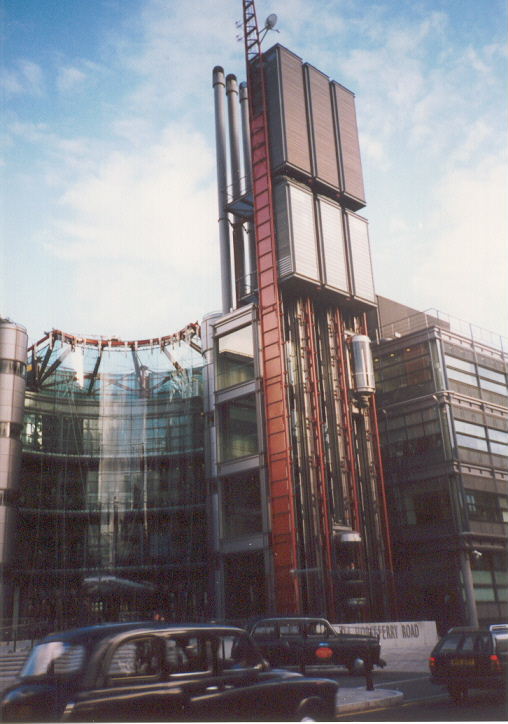
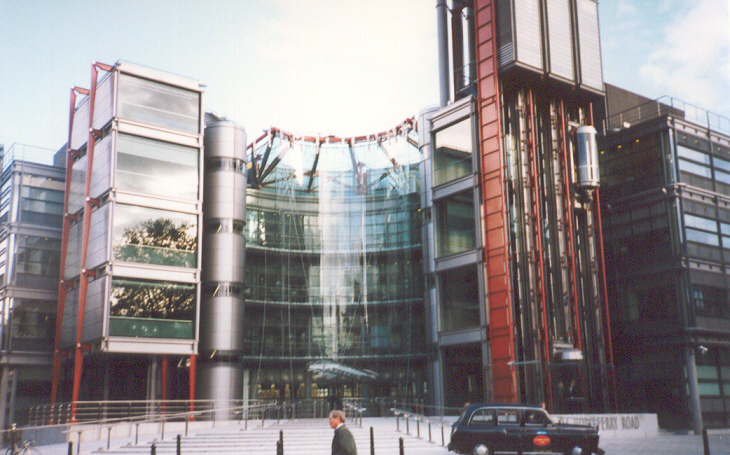
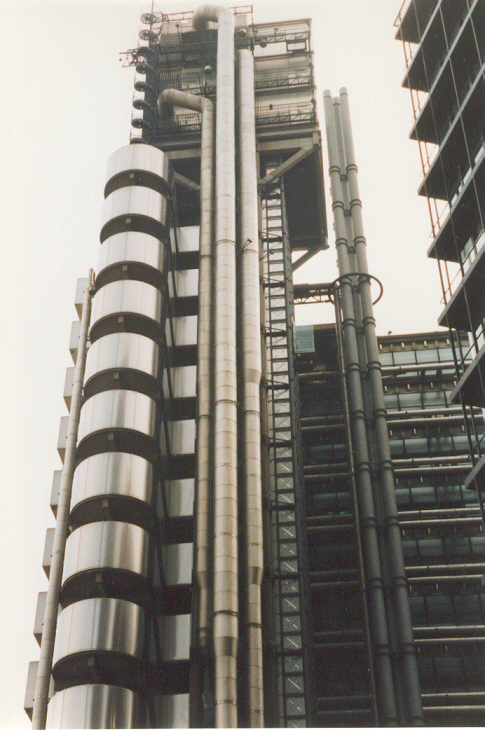
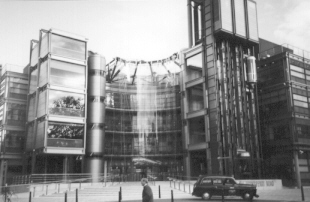
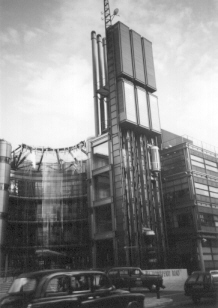
������������ However, the new modernism has not escaped frivolity and ornament. Witness Richard Rogers's overhyped Channel Four Building in Horesferry Road, Victoria. Continuing the traditon of Pompodiu and Lloyd's, the Channel 4 Building uses his familiar and overplayed anti-modernist/postmodernist stylisations so beloved by Rogers. Unlike Lloyd's bold and revolutionary reversal of the exterior/interior binarism, Channel 4's disruption of binary oppositions is less obvious. The building's central facade is dressed in an elaborate glass desgin which basically hides an oridnary office building. It lulls the spectator with its functionless yet attractive central facade. Its penchant for ornamentation is a curiously indebted to the legacy of postmodernism in architecture. However, unlike the best postmodern acrchitecture, whose dual codings were actually meaningful, the Channel 4 building exists as an elaboarte extension of Rogers's tired ideas. It is proof that postmodernism and modernism are not necesarily good bedfellows. |
|
|
|
|
|
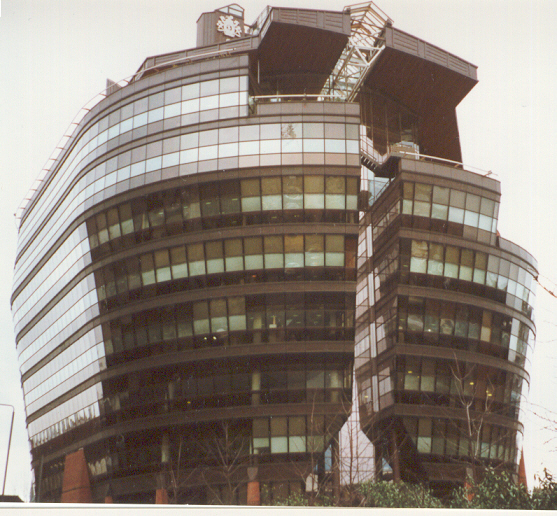
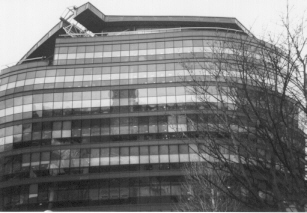
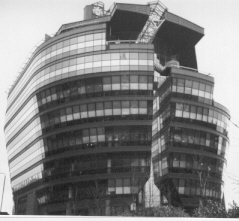
����������Grimshaw's Waterloo Eurostar Terminal and the underated RAC Building in Bristol also deserve special coonsideration.. The lesser known arc-like RAC building is paired-down Future Systems in style but radical nevertheless. Elliptical in structure, the RAC signifies a revolutionary break from a number of traditions. It's sited at a busy suburban motorway amongst many non-descript, low-rise office buildings. Standing head an shoulders above the rest, its crowning glory is its 217ft mast, which, not unlike the function of the Victorian Panopticon, is used to monitor traffic flows on the nearby motorway. It's very shape is a refreshing change from the humdrum architecture that surrounds it. In some senses it resembles Ralph Erskine's Arc in Hammersmith London, but unlike the Arc, the RAC actually serves a purpose. You feel the Arc is an excercise in the aesthetics of architecture rather than a marriage of form and function. Has anyone noticed that the RAC is an anagram of the Arc? |
|
|
|
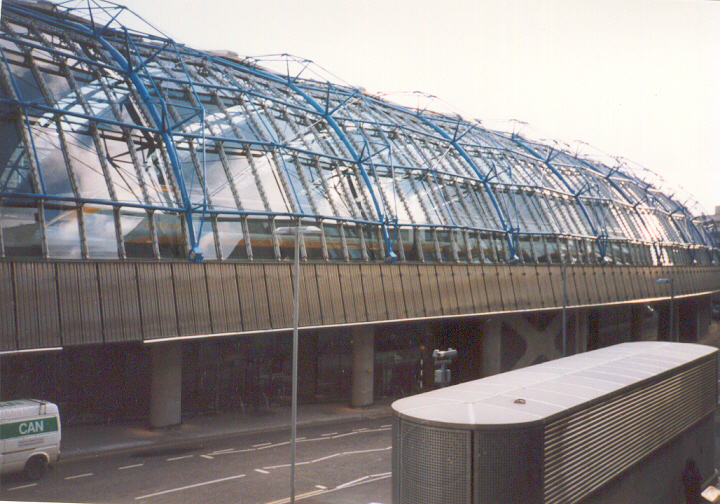
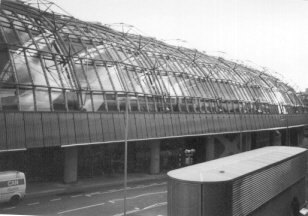
������������ Grimshaw's design for the Waterloo Terminal is, in terms of architectural theory, an engaing riposte to conlfations of modernity and postmodernity. Its snake-like structure, best observed from the London Eye of all places, places the structure before the glass-box menatlity of classical modernism, yet its glass and steel facades and interiors renders it ultra-modern rather than postmodern. Grimshaw eschews postmodern ornamentation in favour of a return to the function/form dialectic. The building is a throwback to the classic Victorian station design, but this time it is decidedly ultra-modern in its reappropriation of that aesthetic. Its coiled glass structure and steel interiors also refers to art-deco in its celebration of the machine, which as we all know, was the driving force for art-deco (witness the Chrysler building). It continues the tradition of Crystal Palace in more ways than one. |
|
|
|
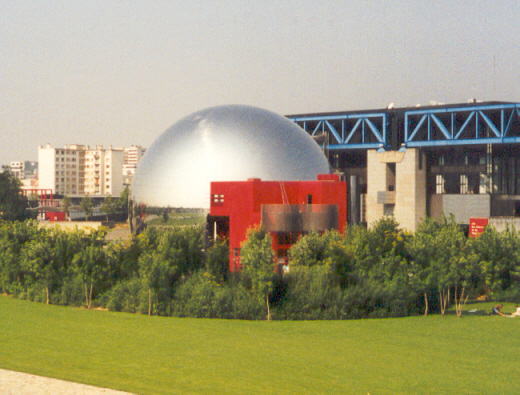
������������ However, the new modernism does not adhere completely to tradition; rather it creates new forms out of existing aesthetic paradigms, only to reinvent it as a continuation or perhaps a hybrid of the old. In this sense, Grimshaw's work is closely related to Victorian Archirecture, most notably the philosphy of late Victorian Architecture. The philosophy of the new modernism takes it cue from the anti-structuralist tendencies of deconstruction, whose chief practitioner, Jacques Derrida, has already had creative input with architects at La Parc de la Villette in Paris. In architecture, deconstruction signifies a break from the rigours of structure; playing with classical notions of foundation and support. The effect has been surprising. Bernard Tschumi's follies at Villette is a good example. Defying the traditions of architecture, these follies represent deconstruction for deconstruction's sake. They are ultimately futile exercises in deconstructive semantics, neither endorsing its philosphy nor affirming its radical impetus. |
|
|
|
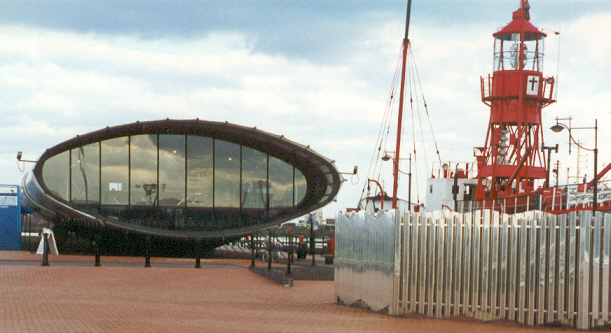
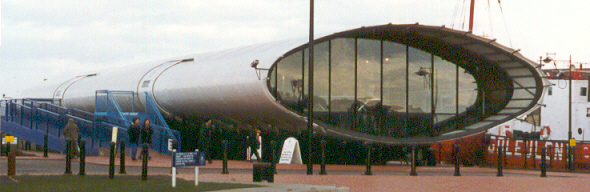
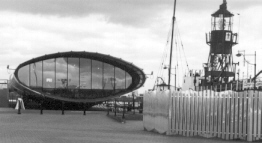
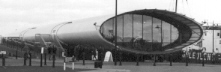
������������ In contrast Will Alsop's lesser-known works , including the visually dazzling capsule in Cardiff Bay, shares Future System's concern with new designs and forward-looking urban planning. The capsule, despite its modest size and humble architectural beginnings, is a fitting precursor to the Press Pavillion at Lord?s. Appearing like a stationery spaceship, it houses the Cardiff Bay Tourist Information center. It's a building, however, with a public duty. It is neither intimidating nor elitist in its design - the ramp at the side of the building allows access for the disabled. The front and back of the building are identical with an oval-rimmed window allowing light to sifft through this narrow tube. Predating the mobile age by some ten years, the building is not anchored in any way by firm foundations - it can be moved, change direction etc. His award-winning design for Peckham library continues Alsop's awareness of the relationship between public space and high-tech architecture. |
|
|
 |
|
|
|
|