After I broke my neck, I spent nine years trying to learn to knit again.
My family hated getting that ratty scrap of knitting down from the top shelf for me every few months. Mom had cast the stitches on and knitted the first several rows for me so I would have something to hang onto as I struggled to discover some way I could knit again. I would try for as long as my strength would last but every time I got one stitch knitted it would fall apart as I lost control of the needles and the yarn while trying to knit the second stitch. I inevitably ended up in tears and was depressed for a few days after each attempt. But every few months I would ask to try again.
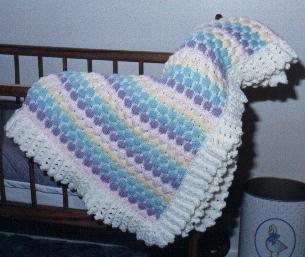
Before the accident, I had been quite a fast, accurate knitter. I loved working on big projects. I had made a long spring jacket and a skirt and sweater set which I thought would make me look dumpy but to my delight looked quite attractive and even seemed to give a slimmer look to my hips. I got a lot of compliments when I wore that little outfit. I had made a couple of baby afghans for friends and had started about three other sweaters which weren't yet finished when I broke my neck. I'm sure there were a few disasters in there but I choose to forget about them. Actually I remember a couple of green and white scarves my brothers called Boa Constrictors and a matching stocking cap which would have fit a whale and which never got presented to anyone. Though I think my brothers saw it and found it hilarious.
My students often teased me about my knitting but I found it a relaxing distraction from the hectic pace of teaching all the math classes in the 7th through the 12th grades, and helping with the sixth grade math, in a K through 12 school.
Then came the accident and it seemed my knitting days were over. You will eventually find the details of the wreck and my injury in "My Story" but for our purposes here you only need to know that I no longer had the use of my hands. For a long time not being able to knit was one of the least of my worries. After spending eight months in hospitals I was installed as a rather permanent fixture in the front upstairs bedroom of my parents' home. We spent hours and hours every weekday at therapy and eventually (after about a year) I got so I could move my shoulders and upper arms with enough control that I started to think about knitting again.
That's when the struggle began. After a while everyone wondered why I didn't give up. There were many other things I could do, fabric painting for instance. To understand my stubbornness, some would call it pigheadedness, one would have to understand how much I loved to knit. It wasn't just the finished articles, though those were nice. It was the process. For me it was a form of meditation, a way to clear my mind and free my spirit from the usual dominance of my rational, logical left brain. It was a joy.
I got nowhere for nine years.
Then one day I asked my mom to get me a knitting magazine. I wanted to see what kinds of new yarns were available after nine years. In the magazine she brought me there was an advertisement for Susan Bates needles. I hadn't heard of them. I had tried the different kinds of needles I had but hadn't thought to check and see if there were new types of needles out there. We checked out the nearest yarn shop and sure enough they carried them. My mother got me a pair. They were lighter weight and not quite as slick as my old needles. I knitted one stitch, no problem. I knew there wouldn't be. I could knit one stitch! Then I knitted another one and things didn't fall apart! The needle was light enough that when I let go of the needle to throw the yarn, (which is what I have to do because I don't really hold the needles, they just kind of rest between my fingers) the needle stayed in place inside the knitted loops. I was ecstatic. I knew I could do it.
I figured out that if I held one needle under my right arm I could use the right hand to hold and throw the yarn which greatly increased my speed. I wish I had a picture of that first grubby, white swatch of rows of garter and stockinette stitch. It's tucked away in a box somewhere. To me it is trophy.
I tried all kinds of knitting. I learned again how to do two color kntting while holding a color in each hand. I learned again to double knit. I made a sweater and long skirt to keep me warm when I went out to public buildings. I made a few rectangular shawls to use as lap robes and light blankets and even pillows when folded up.
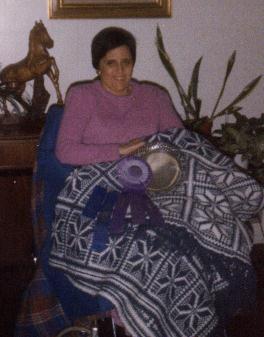
Then I decided to make a two color, double knit, reversible afghan. I found the star motif in a book and designed a border for the entire afghan and one to go around each motif. By then I could use cable needles and constructed the entire afghan in one piece. My mother cut the pieces of yarn for the fringe but I fringed the ends myself with single strand fringes. When I was finished with it I was so pleased with myself.
That fall (1986) I decided to enter it in our county fair. I won a blue ribbon. When I went to enter it into the county fair they wanted me to enter it in the handicapped division but I refused because I wanted to see if others thought is was as good as I thought it was. Not just good for someone who was a quadriplegic. I then decided to enter it in the state fair. I didn't even know I had won anything until a friend called to congratulate me on taking the sweepstakes ribbon with my afghan. I got some nice comments from the judges, one of whom commented on how even the stitches were. When you can't control the yarn tension with your fingers and have to let go of the needle. pick up the yarn, throw it, give it a good tug and then drop the yarn so you can hold the needle and guide it into the next stitch you get very even stitches.
I started to get muscle spasms in my shoulder and at the suggestion of someone on the KnitList, started knitting every other row left handed, which also meant I didn't have to turn my work on every row when working flat pieces. That solved that particular muscle spasm.
I love to play with different stitches. I still can't handle double pointed needles or the really small needle sizes. Some stitches take more brute strength than my hands have. Mostly now I like to do simple straight pieces with fun stitches and delicious yarns. I knit very slowly compared to how I fast I could knit before my accident and I don't make very many projects but I still love the process.