Mars' Surface
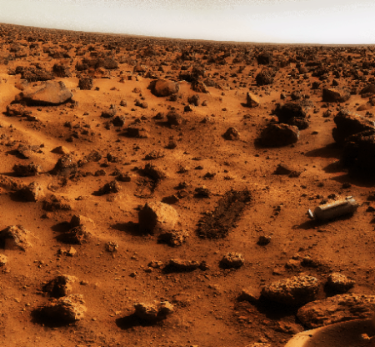
Scientists years ago noticed that Mars looked red but they needed samples of the soil to find out why. A Viking spacecraft was sent to the red planet and took a sample of Mars' soil back to Earth. Scientists studied the soil and realized that the reason Mars is red is because the soil was coated with iron oxide. Another word for iron oxide is rust.
The minimum surface temperature is -140 degrees celcius. The mean surface temperature is -63 degrees celcius. The maximum surface temperature is 20 degrees celcius.
Volcanoes on Mars are the shield type like the volcanoes on the Hawaiian islands on Earth. These type of volcanoes let the lava flow freely and the lava can cover a large area.
The southern hemisphere of Mars is cratered and is similar to the surface of our moon. The surface is quite old and has pretty much been unchanged for a while. However, the northern hemisphere has very few craters and is less eroded which shows that they are much younger than the craters of the southern hemisphere. The surface has been smoothed by many lava flows which means that there is a lot of volcanic activity.
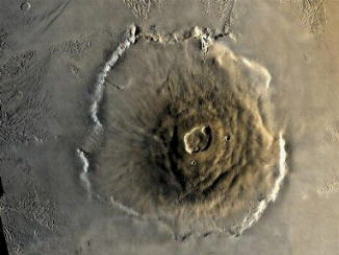
The largest volcano on Mars is Olympus Mons. A picture of it is above. The base of this volcano is 600 kilometres across and is 25 kilometres high. Mauna Loa in Hawaii is so heavy that it sunk into the Earth's crust but Olympus Mons does not show any sign of sinking which concludes that the Martian crust is definitely thicker than Earth's. The region around Olympus Mons appears to be an uplifted plain which is called the Tharsis region. An older similar region is called Elysium region. It is cratered and eroded and most likely has not been active for 1.5 billion years. The Tharsis region could have been active 0.2 billion years ago.
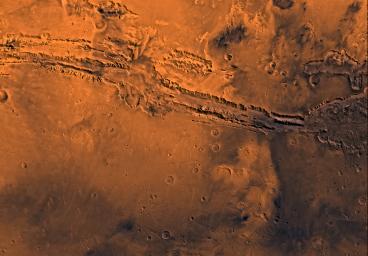
There is a humungous valley known as Valles Marineris which is named after the Mariner spacecraft which discovered it. The valley is almost 4,000 kilometres long and at its widest 220 kilometres wide. Valles Marineris stretches two-thirds the way across Mars. Valles Marineris or Olympus Mons would not be possible on a world with higher gravity and a thinner crust.