Introduction
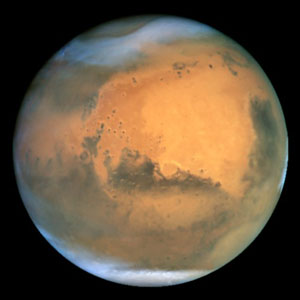
Mars is the fourth planet from the sun and is often known as the "red planet", because its rocks, soil and sky have a red or pinky hue. Mars is named after the Roman god of war. The planet orbits at a mean distance of 228 million kilometres from the sun. Mars has some similarities to Earth. A Martian day is 24 hours and 37 minutes long which is quite similar to the Earth 24 hour day. The year is about 687 days long. The axis that Mars rotates on is at a 24 degree angle while Earth's axis is at a 23.5 degree angle. Mars is about one tenth of Earth's mass so therefore it has a lower surface gravity.
Mars has had liquid water on its surface at one point in the past, probably within the last million years. This shows a possibility that life could have evolved billions of years ago and could still be there today. Before space exploration Mars was believed to be the best candidate for harboring life. The belief in Martians was also turned into a story called War of the Worlds by HG Wells. Another reason for scientists to expect life on Mars was because of the apparent seasonal colour changes on Mars' surface. This led to people thinking that the conditions on Mars might support Martian vegetation. Soon Robotic Explorers explored Mars and found no evidence of vegetations.