The Martian Atmosphere
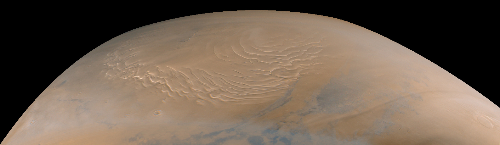
The martian atmosphere 3.8 billion years ago was thicker, warmer, wetter, and scientists believe, more likely to have life.
The current martian atmosphere is sparse, cold, dry, and mostly carbon dioxide. It is an evironment characterized by strong winds which can exeed 100 miles per hour. This causes strong dust storms which erodes surface structures. These winds are driven by seasonal heating therefore they are more common when Mars is closest to the Sun. These strong dust storms kick up extremely large clouds which then combines with carbon dioxide ice in the air which creates a hazy effect in the atmosphere. The smog-like clouds refract the incidental light from the Sun. This gives Mars its gray or yellowish sky. No clouds can be found in Mars' sky because of the temperature and pressure of the planet's atmosphere. Water goes straight to gas from solid and vise versa. Mars' ozone layer is very thin and is thickest at the poles. The ozone layer on Mars in only 1/50th as thick as Earth's. Due to the thiness of the ozone layer it cannot shield the planet from radiation bombardment or prevent volatiles escaping into space. Some current data suggests that a lot of Mars' older atmosphere has been lost because of this process.
Mars is thought to start out like what Venus is today. The weaker gravity of Mars was not capable of holding the rest of the at< edit >mosphere. Ultraviolet light can help break up molecules so that they are light enough to escape into space. Mars may have a lot more carbon dioxide but it definitely has a lot less of other gases.