 The Government Inspector The Government Inspector
 About the Play ...
Our script is based on Nikolai Gogol's best known play. Gogol (1809-52), although only completed three plays,
ranks with Chekhov as the top Russian playwrites. "The Government Inspector"
is considered by many to be Russia's greatest comedy and one of the great satires of the world repertoir.
On October 7, 1835, Gogol asked Pushkin to send him "an authentically Russian anecdote"
upon which he would knock off a comedy "funnier than hell". The original manuscript indicated the play was
completed in a few days of feverish activitity. It was initially produced in 1836,
and revised for a second edition in 1841.
April 19, 1836, the date of its premier, is a landmark in the history of the Russian theater.
Because the play depicted the corruption and incompetence of the Russian officials,
productions required the extraordinary intervention of the Emperor, Nicholas I.
The Tsar's presence at opening night brought out the dignitaries of Petersburg,
who were scandalized by what they took as an insult to good taste and a slander to Holy Russia.
Some commented what else one would expect when half of the audience was on the take and the other half
was greasing palms. For those disenchanted with the status quo, the play crystalized everything they
hated in Russia. On June 6, 1836, in the midst of the uproar, Gogol left Russia to spend the next
twelve years of his life in exile, much of it in his beloved Rome.
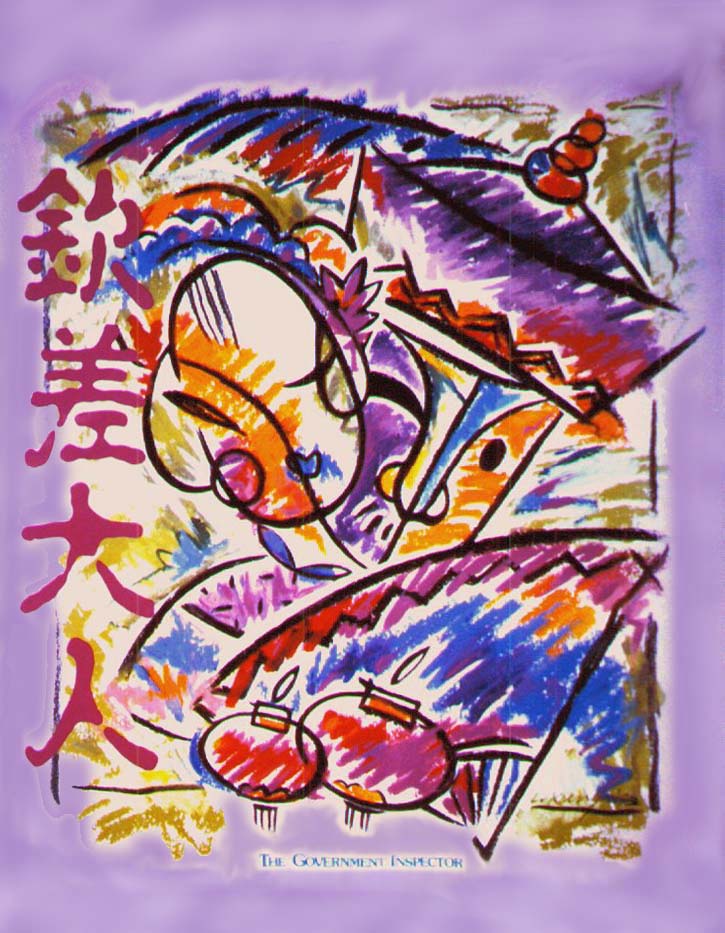
For our 1992 program, we chose this play for its universal appeal and its contrast with last year's
classic chinese tragedy "Thunderstorm". Rather than a translation, our script is an adaptation of the
basic story transported to late nineteenth century in rural China.
 July 11, 1992, San Diego State University, University Theater, San Diego, CAJune 27, 1992, U.C. Irvine, Barclay Theater, Irvine, CAJune 26, 1992, U.C. Irvine, Barclay Theater, Irvine, CAJune 20, 1992, Cal State L.A., State Playhouse, Los Angeles, CAJune 19, 1992, Cal State L.A., State Playhouse, Los Angeles, CA
 Get your own Free Home Page