
Este baile est� relacionado con una de las actividades m�s importantes de la econom�a AGROPECUARIA PERUANA DEL ALTIPLANO MILENARIO: !!LA CRIA DE LOS AUQUENIDOS o CAMELIDOS ANDINOS !! ..ESPECIALMENTE DE LA LLAMA emRemora tambi�n la domesticaci�n de los primeros cam�lidos de la zona andina como los guanacos, alpacas y vicu�as. Los bailarines llevan en la cabeza una reproducci�n de las antiguas monteras de cuatro puntas usadas por diferentes grupos �tnicos desde tiempos pre-hisp�nicos. Esta danza recuerda las largas caravanas de llamas en las que comunidades aymaras llevaban sal a otros pueblos para
 ........................................................................................
EL LLAMERO...PERSONAJE Resabio en los rodeos de llamas, asi como todos los nativos para efectuar la esquila y ofrecer a los dioses andinos las ofrendas en una ceremonia, esta danza tiene como s�mbolo la onda, en aymar�: k'orawa (arma de guerra) que en el tiempo de paz sirve para arriar el ganado; su ritmo es �gil, vigoroso y alegre, recuerda el transporte de presentes y regales al rey Incas en caravanas nativas en llamas. intercambiar productos.
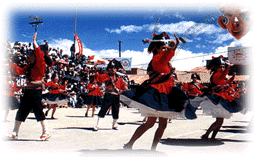
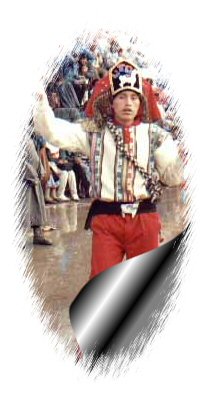
EN LAS FIESTAS....los arreadores de llamas recorr�an en caravanas, los viejos senderos del Tawantinsuyo con destino al Cuzco, para asistir a la fiesta del Inti Raymi. El baile es una representaci�n coreogr�fica del arreo y las m�scaras muestran un eterno gesto de silbido como si los bailarines estuvieran conduciendo cientos de llamas. Los danzarines, visten las tradicionales monteras y ponchillos de los llameros, una m�scara estucada donde los labios aparecen fruncidos en un silbido inextinguible. Reglamentariamente los colores de las polleras de las mujeres no deber�an repetirse. Sus bolsas se forraban con monedas y en los atados de la espalda van sujetas, por fuera, cucharas , platos y vasos de plata. Para todo movimiento est� siempre la honda y la campanilla del gu�a. ...En cierto modo La llamerada ha cambiado en su sentido m�gico y existen innovaciones en la coreograf�a, vestimenta, participantes, m�sica. Pero no ha dejado de representar la relaci�n entre el hombre andino y los auqu�nidos.
ORIGEN
La Llama, siguiendo las creencias andinas,
desciende de las estrellas que en �pocas remotas cayeron del cielo. Cuenta una
leyenda Quechua que en tiempos del inkanato hubo una revuelta
de los Chancas, y, para defender el Cusco,
baj� de las monta�as el segundo hijo de Yahuar Huaca, que
estaba desterrado, celebrando una batalla en Yahuarpampa, donde
hasta las piedras se tornaron hombres, pero dicen que fue gracias a los
Allenqapacs, quienes cayeron desde lo alto, como riscos, aplastando as�
a los Chancas.
Los Allenqapacs fueron un pueblo especializado en la cr�a de
Llamas, en los albores de las culturas andinas, y eran tan
organizados que los Inkas tomaron su modelo para administrar el
imperio.
ASI COMO CASI TODAS LAS DANZAS, TAMBIEN LA LLAMERADA FUE RECOPILADA Y REGISTRADA Y/O REINSCRITA EN LOS ANALES DEL PERU VIRREYNAL EN 1612.
SIGNIFICADO
Es una alegor�a de la domesticaci�n y cr�a de las Llamas.
COMPONENTES
Hombres y mujeres.
DESCRIPCI�N
Su expresi�n m�s pura se realiza en las pampas, tomando el nombre de Llamero, y posteriormente ha sido adaptado al medio citadino, en colorido y ejecuci�n, debido a los gustos y a lo angosto de las calles, llam�ndose entonces Llamerada. Avanzan pues en dos filas separando los sexos, alternando dos pasos hacia el frente con uno hacia atr�s y realizando numerosas figuras en diferentes filas y con las hondas entrelaz�ndose en estrellas y otras formas.
FIESTAS
En las principales seguidas por el pueblo Aymara y a destacar la de la fiesta de la Candelaria en Puno.
INSTRUMENTOS
Pitos en el Llamero, y Banda de metales en la m�s reciente Llamerada.
NOTAS
Los Allenqapacs tuvieron importantes criaderos
de Llamas, encontr�ndose probablemente uno en Carabaya,
el cual proviene de Qarhua-uyo, siendo en Aymara Qarua,
Llama y Uyo, Canch�n .
La Llamerada actual desciende de la m�s aut�ntica
Llamero, siendo la primera enfocada hacia los mestizos y la segunda,
original, hacia los indios. La melod�a imita el trote leve de las Llamas,
por ende los danzantes parecieran ir tras hipot�ticos reba�os.
LLAMERADA
LLAMERADA.... is one of the oldest dances of the PERUVIAN FOLKLORE;
it belongs to the Aymara nation in its origins. Its original
name is "karuwani".
Its link with the llama and the auchenics in general dates back to the
pre-agriculture epoch, over forty centuries ago. Since those times, the llama
gives food, transport and cover. That is why it appears painted in caves and
ceramics and sculpted in stone.
For many pre-colombian cultures, dance was art and magic, for the dancing to be
produced in reality; is why the llama herder dancers would imitate the scenes of
herding in order to keep around the herd.
The llama herder dancing has changed in its magic sense and innovations were
imposed in the choreography, costumes, participants and music. However, it has
not stopped representing the relationship between the Andean man and the
auchenids.
According to tradition, this dance goes back to a human fence
around the auchenid herds people would push the animals to press together into a
ring until they would reach them with their hands. The llamas, alpacas, vicu�as
caught were sheared; the old or injured animals would become food stuff. The
round up finished, the "huilancha"or the sacrifice of the propitiatory llama was
made, whose blood was offered to gods.
According to another tradition, it recalls the Inkan
postilions in charge of herding the auchenids. It also rememorates the herders
of colonial ALTO-PERU.
Under the current interpretation, it is a mimicking dance, because it tries to
imitate the daily life of the herders and those of the shepherds; but it also
represents the virtual linking with the llama, that is why the costume of the
dancers is elegant and it recovers old signs of power.
In most of our dances, women partaking just since three
decades ago, but in the llama herder dance a woman are in since ancient times,
because the position tasks or that of the herders to native was family
activities.
The attire is a mixture of ancient elements, worn by the Aymara since pre-colombian
and colonial times until the XVII century, with parts of the current Aymara
clothes.
The hat is the most typical; it is square and embroidered with teaseling made of
woolen cloth; it recalls the hat that the Aymara authorities would wear.
The man wears a woolen shirt, woolen cloth or silken cloth; the short woolen
cloth pants a bit down under the knees; woolen string socks; typical sandals; a
colorful bundling square piece tied up on his chest; a chumpi or a multicolor
sash that surrounds his waist; a rope hopped in a counter sense of that of the
bundling piece. In the most traditional llameradas, men also wear a plaster mask
with the lips gathered in a whistling attitude.
Men and women hold a sling or korawa in their right hand, a symbol of the
shepherds and llama drivers, the main part of the choreography and of the
clothing. Most of the "steps" include the movement of the sling pretending the
driving or the throwing of stones.
The women wear one or more wide long polleras (typical kinds of skirts); under
the polleras are one or more underskirts or mancanchas made of white fabric; a
blouse, and on it a crossed bundling piece.
Colors have changed. The traditional black color is worn by the tatalas (head
drivers); the group, and this is one of the innovations wears differing colors
according to the fraternity and according to the festivity.