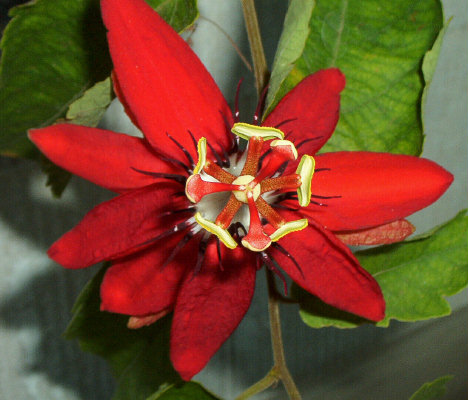
passiflora coccinea red granadilla |
| Types of Passion Flowers |
| � P. Coccinea (The red granadilla above) - Native to Brazil, this Passiflora has very showy red 3-5" flowers with a white center. Exotic, tropical, and loves warm weather. Keep above 50� F.. A very vigorous vine for those who need to cover an arbor. Free flowering from mid-summer to autumn, and seeds from this variety germinate very easily. � P. Edulis (The edible passion flower) Known as passion fruit the world over, it is commercially grown in many countries for juice. This is a very adaptable species that will tolerate mild frosts of no less than 28� F. There are many different sub-species of Edulis, although some of these will require hand-pollination if you want more fruit. The sub-species include: o "Black Beauty" Large Black/Purple fruit with beautiful flowers o "Purple Giant" Huge purple fruited variety resistant to many viruses. o "Golden Giant" As the name implies, humungous sweet yellow fruit. o "Gold Nugget" Yellow fruited variety resistant to viruses, good tasting fruit. o "Panama Gold" Yellow fruited with good disease resistance. Tasty. o "Panama Red" Red fruited delicious taste, good resistance to disease. � P. Foetida (The goat scented passion flower) A fuzzy vined and leafed plant, with over 50 named varieties. A very vigorous plant that is hardy to 40� F. Easy to grow it bears beautiful white, pinkish or blue flowers followed by fruit that has a sweet-acid taste. � P. Gilbertii A vigorous climber that is tolerant of a wide variety of conditions. Great for a cooler but frost protected environment, will take 30� F. for short periods. Fragrant 3" mauve and white flowers are produced profusely followed by a lot of fruit which is inedible. � P. Gracilis (The annual Passion flower) The only annual passiflora, climbs on a slender vine to 6 feet during summer. This variety needs very little attention and will re-seed itself in spring. Small white flowers about 1" produce scarlet 1" long fruits. � P. Incarnata (Maypop or May Apple) This passiflora is the only species indigenous to the U.S., one of the easiest to grow and has the best cold hardiness (to 15� on a mature plant!). Has large fragrant mauve and white flowers from June to November and sweet edible fruit. Also commonly used as a calming herbal tea. Very well drained soil that is fairly dry in winter is needed to prevent root rot. This is a very herbaceous vine and dies back every winter, only to pop back in May, hence the name Maypop! � P. Kalbreyeri This species is from the Decaloba section, and is also a mountain species from the Andes of Venezuela. Flowers are about 1.5-2" and are purple to white. High temptures and humidity must be avoided and this vine is subject to over watering. Good air movement is vital as well as a sunny location. This variety is rare and hard-to-find. � P. Ligularis This variety has beautiful fragrant flowers with speckled petals. This vine dislikes hot weather, does best in cooler climates (45-80�f), and is not a good potted plant. It also requires two different seed plants to set fruit. � P. Maliformis (Sweet Calabash) This beautiful vine is native to South America. Although it is very similar to P. Ligularis, this vine produces grape flavored fruit on a twenty foot vine. The flowers are fragrant with purple and white speckled petals. The shell of the fruit can be so hard you need a hammer to crack them open! This plant can take several years to produce fruit. � P. Mollisima (The Banana passion flower) Native to higher mountain regions, his Passiflora prefers cooler less humid climates than most passiflora. This vine is a Tacsonia and germinates at cooler temps. Often grown just for the large banana shaped delicious fruit which tastes like an orange. The flowers are similar to Antioquiensis and are large and showy, pink to coral pink. � P. Morifolia, A main source of food for the Heliconiinae butterflies. Grown all over the world, this vine is vigorous with a woody bulbous root. This plant does require a dormant period taken in the winter, and best to keep them dry at this time when in spring new shoots will appear from the root. Slight frost will not harm it if kept fairly dry. Flowers are greenish yellow or white and mauve about 1". � P. Rubra (The red fruited passion flower) A vigorous slim vined plant to 15 feet. Very similar to Capsularis. This variety will not survive a frost down to the roots, but can be easily grown in a container. Free flowering summer to autumn with white or pale yellow petals to 2" . Produces abundant bright pink to red fruit. � P. Seemannii A rather large vine and found usually only in private collections, this is a beautiful species with blue and white flowers 3-4" in size. This plant is not cold hardy at all with minimum temperature tolerance of 45 degrees F.. � P. Quadrangularis (Giant Granadilla) This passion vine is truly the giant with huge flowers and the largest fruit of any passiflora. It is a large vine, and is very vigorous. The flowers can get up to 5" wide and the fruit can get up to 8 lb.. Best kept at 50 degrees F., but will tolerate lower temperatures if the soil is kept fairly dry. � P. Zamoriana (Lilac Passion Flower) An extremely rare species from Ecuador, it is a mountain vine that prefers cooler conditions. From the Tacsonia section, best grown outdoors with partial shade in summer and then taken into a greenhouse or conservatory in winter where temptures should be kept at 40-55 degrees F.. Easy to germinate, but not easy to grow, and well worth the trouble. It is large flowered and may produce sweet fruit. The flowers are 5 1/4" wide and are deep salmon rose or lavender rose. So, as you see, there are many different colors and varieties of this beautiful exotic vine. This is one plant that would be highly suggest that you grow, even if its only during the summer months. |
 |
 |
| MORE |
|