
Unfortunately, there are very few times when you can tell the age of your lovebird, unless it is banded, and both are when it is very young. (This is another very good reason to band your baby birds!!)
�
The first indicator of age is a dark bar on the beak. This shows up within days of hatching, and fades away by the age of about three months or so.
�
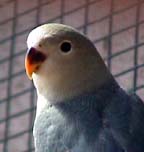

The first bird is a baby whiteface violet about 8 weeks old.
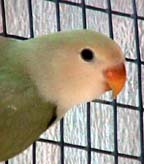
Picture #2 is a blue American cinnamon about a week older. Notice that in this mutation, the bar is not black, but brown.
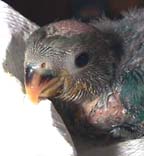
The third picture shows the cinnamon again as well as a medium green baby also about 9 or 10 weeks. You can see that the black is already starting to recede and fade.
The fourth picture shows the streaked beak of a pied chick about 3 weeks old. His two younger siblings both have solid black beaks.
A lutino or creamino may not have any dark bar on its beak. A pied bird may have either the normal dark bar as the birds above, or streaks of dark if it is a more heavily pied bird.
The second clue as to age is the first molt. This happens at about 4 - 6 months.
The young bird loses its immature color as it molts into its "grown up" feathers. The first sign of this is what we sometimes affectionately call "measels."
If you take a look at the pictures below you will see why.
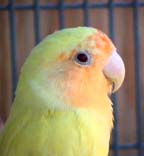
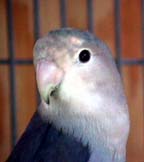
They begin by getting little speckles of color on their foreheads.
By the time they are done molting, they will have their mature coloring. From here on out, you are pretty much out of luck in determining the age of a lovebird if it has not been banded at birth.
�
�
|
|
|
|
|
|
|
|
|
|