
When a pair is ready to mate, they will select a nestbox and the hen starts cutting strips of whatever nesting material is available (newspaper, willow branches, palm fronds) with her beak, and will begin tucking them in her rump feathers, just above her tail, to carry back to the nest.
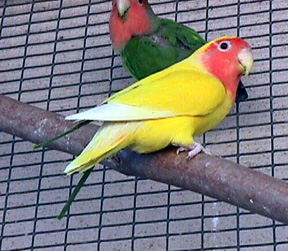
Peaches is obviously ready to start laying eggs. You can see the bulge between her foot and her tail in the picture. Her mate, in the background, has playfully pulled out several of the palm frond strips she put in her rump to carry back to the nest, but she managed to hang on to these two.

She will take these into her box and arrange them just the way she wants (making a "bowl" in the back half of the box and a wall of sorts to seperate the front and back of the box, with a little passage way on the right for going in and out.)
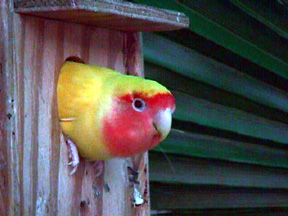
She will keep going back and forth until she either is satisfied with the results or runs out of material.
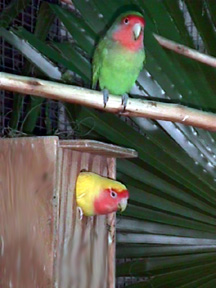
Once the nest is set up and she begins to lay (usually 5 eggs), she spends most of her time in the box. Incubation will take about 23 days. During this time, her mate will spend most of his time guarding the box, usually sitting on the perch just outside the nestbox "door" - but in this case, they have removed their perch, so he usually sits on top, or on the perch in the picture. He will feed her in the box, so that she does not have to leave the eggs.
The eggs will hatch in the order that they were laid - usually 2 days apart. Once they are hatched, it is the father who does most of the feeding.
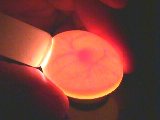
After about 10 days, you can use a small penlight flashlight to "candle" the egg to see if it is fertile. If the egg is fertile, you will see spidery red veins.
|
|
|
|
|
|
|
|
|
|