
If the bird has a single dark factor, it will darken the green slightly, but is most noticeable in the rump, turning it from the light turquoise blue of a "normal" to a medium blue. We call this bird a Jade or Medium Green.
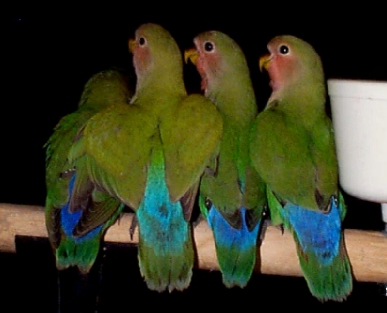
So we have a jade violet, a "normal," and two jades.
Here is a picture showing three green babies.
The first has no dark factor -- a "normal" green.
The second has a single dark factor (as well as a single violet factor) -- a "medium" green violet or a "jade" violet.
And the third has two dark factors -- a "dark" green or an "olive."
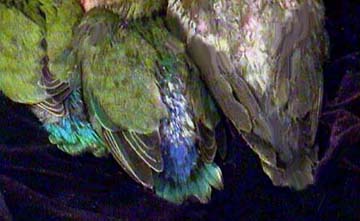
Below is a picture of a baby olive.
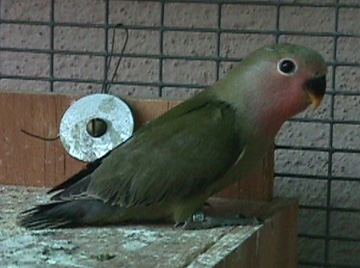
Full grown, he will have a dark red face and bib, dark olive green body, and dark grey rump. (Below is a picture of him at 6 months - just finishing his first molt.)
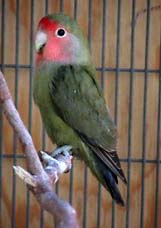
In the "blue" series, a single added dark factor gives you a "medium blue" bird, otherwise called a "cobalt" in the U.S. This is evident mostly in the color of the rump, much like the green birds in the photo at the top of this page.
If you add a second dark factors, you will get a grey-green bird with a charcoal grey rump similar to the olive's (or dark green's). But his forehead band witll be canteloupe color of the "blue" series rather than red like the green birds. We call this color a "slate."
Below is a photo of two young slates. But they are whiteface slates. And the added whiteface mutation tends to give you a bird that is closer to true grey, rather than the grey-green of the regular slate, by reducing some of the pigment that gives the green color.
You will also notice that the bird on the bottom is a pied whiteface slate. This is evident in the two white flight feathers she has in each wing.
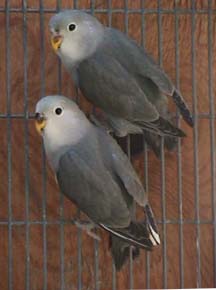
As pieds go, this is nice, as you want your pieds to be as symmetrical as possible, though generally a pied bird with more pied markings would probably be more desirable in a show. This bird is what we call very lightly pied. Click here to see more pied birds.
In adult plumage, the birds above will have paper white bibs and white foreheads, which creates a stunning effect against the charcoal grey of the body.
|
|
|
|
|
|
|
|
|
|
|
|
|
|
|
|
|
|
||
|


