What is Jiu-jitsu?
 t is a martial art that emphasizes throwing, and submitting your opponent. This differs from karate and kickboxing, which utilize kicking, punching, and strikes by elbow or knees
to subdue the opponent. Jiu-jitsu is translated as �gentle art� because you use your position, leverage, and weight to overpower your opponent instead of brute force.
t is a martial art that emphasizes throwing, and submitting your opponent. This differs from karate and kickboxing, which utilize kicking, punching, and strikes by elbow or knees
to subdue the opponent. Jiu-jitsu is translated as �gentle art� because you use your position, leverage, and weight to overpower your opponent instead of brute force.
Although Jiu-jitsu is practiced hundreds of years ago by the Japanese Samurais, it was only 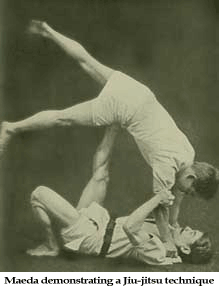 until the early 20th century that it
developed as a sport. Jigoro Kano consolidated various techniques from various Jiu-jitsu instructors. He labeled his art as �Judo�, which has
special set of rules to ensure the safety of practitioners, yet preserve the traditions embedded in the art. Judo utilizes locks, some ground fight, chokes, with preference to throws. But the guiding principle behind the art was
to �give way�. Instead of confronting the opponent by full force, Judo emphasizes on positioning to efficiently use the opponent�s weight and strength against him.
until the early 20th century that it
developed as a sport. Jigoro Kano consolidated various techniques from various Jiu-jitsu instructors. He labeled his art as �Judo�, which has
special set of rules to ensure the safety of practitioners, yet preserve the traditions embedded in the art. Judo utilizes locks, some ground fight, chokes, with preference to throws. But the guiding principle behind the art was
to �give way�. Instead of confronting the opponent by full force, Judo emphasizes on positioning to efficiently use the opponent�s weight and strength against him.
About 1910, a Judo master named Esai Maeda traveled to Brazil where a government official named Gastao Gracie assisted him in establishing a Japanese colony there. In deep gratitude, Maeda taught him and his family Judo, and this is passed around throughout their generation.
In the late twenties, Helio Gracie improvised the family art by developing ground fighting techniques and incorporated it with street fighting. He later used these to compete against brawlers much heavier and stronger than him and won. His art was later known as Gracie Jiu-jitsu (GJJ), or Brazilian Jiu-jitsu (BJJ).
In 1992, his son Royce Gracie competed in the Ultimate Fighting Championship (UFC), a tournament that pits martial artists of various disciplines against each other in an �Octagon�, an eight-sided cage surrounded by steel fences. Except for bites, groin kicks, and eye gouging, there were no rules. It was designed for the audience to see which martial art discipline works best in a street fight environment.
Gracie defeated wrestlers, boxers, and karate experts often heavier and stronger than him. He tackled them to the ground and finished them off with a choke or joint locks--often within seconds. When he bagged the UFC championship twice, he proved the efficacy of groundfighting in combat regardless of the opponent�s size, strength, or discipline.
For martial arts enthusiasts, BJJ today appears very much different from the Japanese Judo. The latter emphasizes standing throws, while the former has preference on groundwork. But they are one in principle: To subdue an opponent by �giving way�.
Source: