Bunga
Jeruk's management by
EDWIN'S GALLERY

Jalan
Kemang Raya No. 21, Kemang, Jakarta 12730, Indonesia
Phone: (62-21) 7194721
Fax: (62-21) 71790278
Email address: [email protected]
Homepages: www.info.batavianet.com/edwingallery
Contact person: Ms. Titien (9.00 AM - 4.00
PM, Monday-Friday)
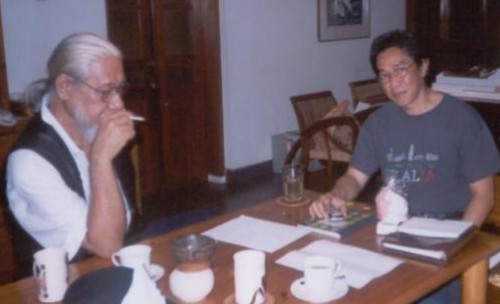
Curator Jim
Supangkat (left) and manager
Edwin Rahardjo (right)
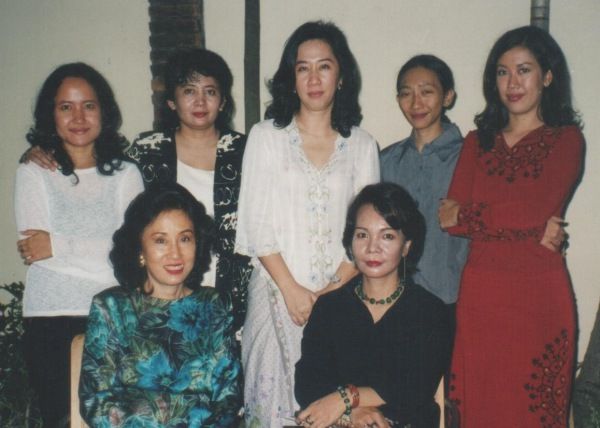
Edwin's Gallery's
joint exhibition
Outer World Inner World,
2001.
Standing
at the back are Bunga Jeruk (artist),
Hening Purnamawati (artist),
Mrs. Edwin Rahardjo, Sekar Jatiningrum (artist),
and
Gilang Cempaka (artist). Sitting at the
front are
Melani Setiawan (art collector) and
Aaltje Ully (artist/Mrs. Jim Supangkat)
Indonesian
artists under Edwin's Gallery management:
Ms. Bunga Jeruk
Ms. Sekar Jatiningrum
Ms. Ay Tjoe Christine
From Jakarta
With Art:
Edwin's Gallery: Unofficial History
Written by
Nin
Titled
by Bunga
Jeruk
2003
Edwin Rahardjo got a formal ed in Architecture and Interior Design -- we could trek this back in a few glances just by strolling along the gallery's cool corridors and staring at the building itself from across the busy street of Jakarta's sort of elité compound Kemang, unless it rains. Mr. Rahardjo, naturally, designed it himself. Not just the new building, which is still in infancy, but the business as well; underneath this impressive brick-and-mortar job lies more than two decades of relentless hard work and undying determination to drag a major dream to life.
Communication Science students in the stale decade of 1980's must have heard of Edwin Rahardjo somewhere in the long years of tuition, especially if they took Photography classes. The price tags attached to photography those days automatically kicked me out of such classes, yet Mr. Rahardjo was still within my earshot because he was, so people said, quite a master of the commercial photography game. He had been, since 1980. Through the prematurely decaying magazines we commonly fought over in the campus' library, we'd bumped into his works, involving larger-than-life clients such as DeBeers, Nestle, Nivea, Wella, Toyota, Suzuki, Mitsubishi, and Mercedez-Benz, which means the entire ingredients of my clueless little sister in her first years of dabbling in fine art.
In 1984, Mr. Rahardjo decided that the time was ripe to find Edwin's Gallery. I suspect that declaring the opening of a fine art gallery has been a rather dangerous inclination every art lover in Indonesia keeps daydreaming of, but history shows convincingly that this time it was writing a different scenario. People said Mr. Rahardjo started the gallery from scratch (or sort of) -- in two times ten years it has grown up with nothing to get mad at when looking over its shoulders.
Besides the usual fine art items like paintings and sculptures, Edwin's Gallery also takes up picture framing, greeting cards, old prints and reproduction. A few people said this makes Edwin's Gallery not so 'purely artsy'; but that would be nonsensical in the Indonesian climate, even if Jakarta isn't transformed into a waterworld in (every) monsoon. We got to give concessions when necessary. And this is such a case.
Indonesia is full of artists and collectors and art dealers and God knows what else of the kind, and once every blue moon someone suddenly announces the finding of his or her very own art gallery, hosts an exhibition, and before we have a chance to blink both the gallery and the owner have been slumbering back to oblivion. Since 1980's, this has been a routine on our calendars. Most galleries, including the ones which are still more or less alive today, consist of just one single person, his or her own garage, and nothing whatsoever else. The gallery's owner, secretary, printer of catalogs, art dealer, lawyer, office-boy, front-desk officer, debt-collector and accountant is condensed within that one person. Healthy business management, as the increasingly frontierless world has known it, never exists beyond imagination.
And this, in Indonesia, is normal. Just an example, a rather well-known gallery in Jakarta, of which certain art dealers in Singapore might have heard, is located in one room, around 3 meters square, with one phone line (joint with approximately six other users), and another room crowded by 10 computers hooked to the internet, about 200 meters away from the gallery -- a public cybercafé owned by the gallery owner's distant cousin or so; whenever the gallery's owner checks business emails, he does it among a dozen of students who are busy downloading nude starlets' pics. When it is time to hold an exhibition, the gallery's owner hires two or three involuntarily-leisured men to clean some rented rooms up and put the artworks there. One of them also makes coffee for everyone in the opening night of the exhibition, if he happens to be in a good mood.
Mr. Rahardjo would surely say I shouldn't tell such a story, although it's 100% true -- he's always very cautious about saying anything to and about anybody. That's one of his good characteristics. But I'm not in his list of employees and I'm not blessed with any good characteristic except when it comes to cats, so I have to say what I must: Indonesian art galleries still have lightyears to go before they attain the minimum standard to pass the fit-and-proper test in, for instance, Singapore; and so far to pass as a lucrative partner for, say, a gallery in the United States, they still have countless homeworks to get over with.
My point is, art gallery management isn't a child's play and is certainly never a lonely housewife's hobby; it isn't intended by God to be something you do merely because you love paintings and you are not qualified to be a member of the Parliament and you got dropped-out of the Geology Dept. in college and your Dad left you some hard cash to waste. A professional art gallery has to fulfill a long list of necessities before it dares to thrust its nose into the world in broad daylight.
Those are what Edwin's Gallery is not.
An outsider could instantly say the gallery Mr. Rahardjo built is like any other, its counterparts in all five continents of this planet; namely it meets the requirements without fanfare and simply function the way it should. In Indonesia, I'd say that is 'abnormal' (see the previous lines about what is 'normal'). Even if it is identifiable by and is commonly interchanged with its sole owner, the way it works is more of an organisation than an impromptu execution of an idea suddenly gotten in a reverie or a frantic temporary job handled by people whose only impressive characteristic is that they somehow manage to drink all the coffee without any notable progress in work.
The word 'management' if coupled with 'artist' most often elicits a spotlighted picture of a pop diva. This thing is not a daily menu in Indonesia. Edwin's Gallery has been handling this rare item. It talent-scouted artists in the making, got them signing contracts, and lo and behold a management materialised behind their backs (artists, especially indoor painters, are most often found facing the wall). The gallery takes care of their art material supplies and does the (some say) dirty work on their behalf -- such as finding them places to exhibit outside the gallery or the city or the country, negotiating with domestic and foreign art dealers and collectors, tidying up their typically messy schedules, and so on. It might or might not work; that depends on a rich variety of headaches. But the point is, it professionalizes the commonly unprofessional professional artists. This line is rather hazy, but you'd catch the drift if you know even if just a tiny weeny bit about Indonesian artists in particular and anybody with artistic inclinations in general.
Now the following are cutouts lifted from Edwin's Gallery's official CV:
Since 1984, more than a hundred Indonesian and foreign artists have already had their shares in the gallery's history. Among them we could easily recognize one of the Indonesian leading artists, Djoko Pekik, early on in 1990 with his solo exhibition titled Alam dan Kehidupan (Nature and Life). This exhibition was of some historical significance since it was the artist's first after a long absence from the Indonesian fine art scene. Again, in 1994, he displayed his artworks in a joint exhibition hosted by the gallery under the banner Nostalgia Dua Generasi (The Nostalgy of Two Generations). In 1997, the gallery has come up with a retrospective exposition of paintings by Ahmad Sadali (1924-1987), much admired for his skill in bringing the principles of aesthetic and religious worldview together. The Hidden Works and Thoughts of Ahmad Sadali, held ten years after his death, has opened up another dimension to the artist's personal thoughts that had never been seen by the public before. It has also been hosting expatriates such as Arie Smit, Donald Friend, Rudolf Bonnet, Le Mayeur and Han Snel; Heri Dono is among the contemporary Indonesian artists well-known abroad that has enjoyed the similar event at Edwin Galeri. Bringing forth less known, younger names on the Indonesian artists' list has also been the gallery's characteristic feature.
The history of Edwin Galeri is a testimony of its basic concept that embraces all branches within the art world without losing the standard it has imposed upon the range of choices. As a business it is mostly a result of love of art, guts to take chances, endurance in facing risks, sensitivity in reading the art-loving public and consistency in moving forward. Edwin Rahardjo himself has summed up the gallery's foundations as based on passion, strategic planning and targeting, effective marketing, and bold steps that perhaps seem to deviate from the mainstream at the time.
In the early 1990's, for instance, the gallery brought forth a joint exposition of batik art by Nia Fliam, Noel Davenport and others using the term 'lost wax art'. This was a strategy that has proven to reach its goal; the batik art had been suffering a lot of abuse and misuse thus a new term must be coined in its place. The exhibition was sponsored by the Coutts Bank, itself a revered name in its field. The similar step has been taken in 1991 when the gallery hosted a number of surrealists. Up to this day, there have been artists from Holland, the Czech Republic, England, Japan, and many others hosted by the gallery.
After the two decades of growth, a few setbacks and the usual stuff, Edwin's Gallery looks like maturing into an entity that could cast its gaze over a wider horizon. It has started to leave the boundaries. In the long run, it might hope, some Indonesian artists might get the breakthrough towards the at least regional fine art world they have been dying to reach. On the other hand, the Indonesian fine art might get the door opened for comparative studies and the like.
In 2003 the gallery scored a major exhibition of Chinese contemporary art (or, as Mr. Rahardjo prefers to call it, the Avant-Garde), such as Fang Lijun, Yue Minjun, Liu Xiaodong, Feng Mengbo, Zhao Shaoruo, Mao Xuhui, Tang Zhigang, Zhang Xiaogang, Shen Xiaotong, Zeng Hao, Guo Wei, Song Yonghong, Zeng Fangzhi, Yang Shaobin, Qiu Shihua, Wu Xiaohang, curatored by Chang Tsong-zung (Johnson Chang), who favors the term 'experimental art'.
That Edwin Rahardjo has managed to bring the world-class Chinese artists to Indonesia itself has been the talk of the town, something a little beyond possibility for the initiated. Honestly I know nothing of this, yet if people say this is the greatest feat Mr. Rahardjo has made, then it might be so. And mind you, I am not paid to write this -- so you better believe me.
The gallery has had its long years behind and more in front of it -- for fine art's sake you better hope it would bring even greater dreams to life.
Footnotes:
-
The name 'Edwin's Gallery' is sometimes written as 'Edwin Galeri' because last decade's policy of the state and provinces has sort of outlawed the use of foreign words and expressions. Public services such as hotels, restaurants, shops and so forth, including art galleries, were asked to change their names into something purely Indonesian (assuming that there is such a thing). The grammatically correct name should have been 'Galeri Edwin', but it might have been considered confusing enough to substitute the already familiar English name.
-
The official CV © 2001 Edwin's Gallery, based on the Company Profile written by DR. M. Dwi Marianto, 2000.
Bunga
Jeruk's Note:
Right now Edwin's Gallery manages my business.
This means nobody else (person or institution) is authorized to sell my
art works (paintings and sculptures). It's good to have a manager, because
an artist shouldn't get busy with selling and so on! An artist's job is
to create art, period!
| Click
here for INFO OF INDONESIAN ART GALLERIES, HOW TO SUBMIT PROPOSALS, CONTACT PERSONS & ADDRESSES (NIN'S INFO PAGE) |

These
are the pictures of Edwin's Gallery, in 2002 and 2003.
Scenes are taken from my solo exhibition "Every Dog Is #1" opening
night, 2002
Curator: Jim Supangkat
Manager: Edwin Rahardjo
Exhibition was opened by Fikri Jufri
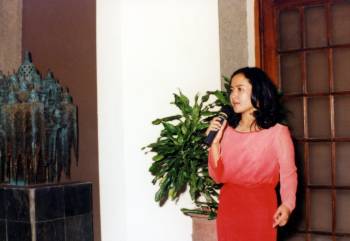
I gave a speech explaining my artistic concepts for the exhibition.
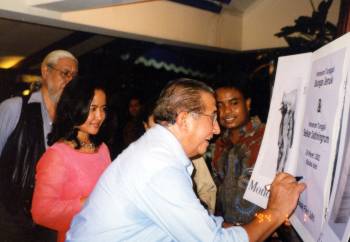
Fikri Jufri (journalist) opening the exhibition. Jim Supangkat (curator) at the background.
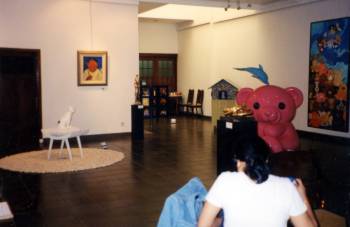
Preparing the opening night. At the background are all my artworks. There's my favorite, Pinky the pink bear! (Dolphin's Kiss)
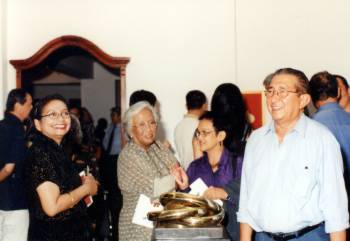
Pia Alisjahbana (magazine editor, second from left), Carla Bianpoen (reporter of Jakarta Post), and Fikri Jufri
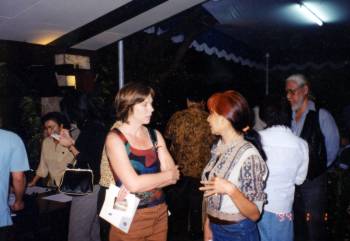
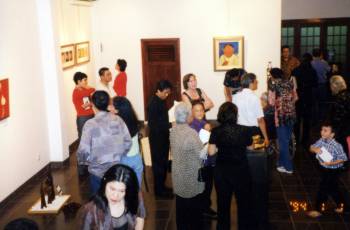
and Bunga Jeruk's personal collection