
#LIVERPOOLFC ON AUSTNET
SPION KOP
Words cannot describe the famous terrace at Anfield, the Old Spion Kop (which was a standing area) until 1994 where it had to be seated and dropped to a stand with poor atmosphere.
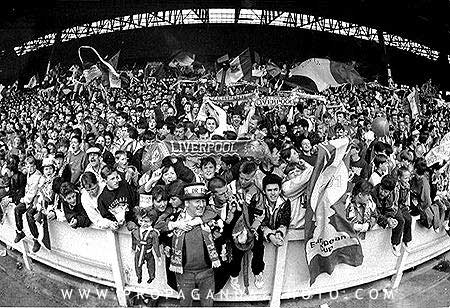
During the sixties in the cellars and clubs of Liverpool the world of pop music was born. The age of the Beatles had come and the Merseyside suddenly became the center of a popular culture. The young Liverpool fans on the stands of Liverpool proudly took their new songs along with them to matches and sang them before the matches.
Download this video of the Kop in Real Audio Format: Right Click Here saves as and change file extension to *.ram
It came down to it that they were trying to say:" We are in the focus of
modern music."
By this musical development the time had become ready for the melting together
of the three different influences: The Victorian singing of hymns, the shouting
from Italy c.q. the rhythmical clapping from Brazil and finally Beatlemania. On
the steep - infamous in it's days - Spion Kop stand of Liverpool ( in short
"The Kop" ) it could all be found and the songs for the stands were
born.
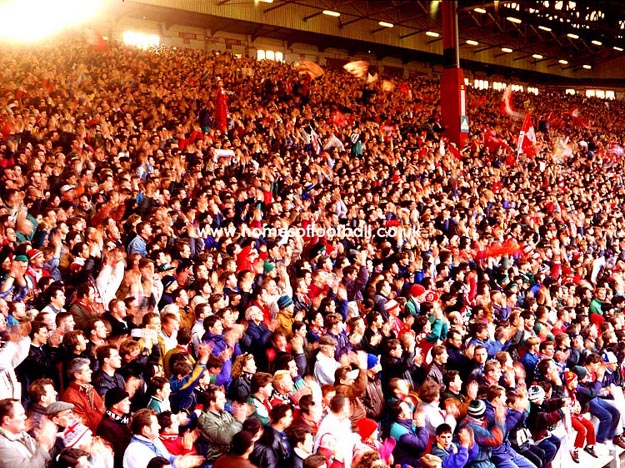
Before
we go deeper into the spreading of the fan songs, we will tell a little more on
"The Kop" itself.
This stand behind one of the goals originally was a huge open slope. To all
football fans in the eighties it had become famous, not to say notorious. It had
the aura of being the Mecca amongst stands, only to be visited by true
intimates. Only a lunatic or a potential suicidal idiot would risk coming there
with e.g. a blue (Everton) scarf.
"The Kop" got it's name in an unusual way. On the night of Jan. 22nd,
1900 troops from Liverpool who were fighting the "Boer War" in South Africa,
got into a bloody fight that took many lives. In their attempts to liberate
their comrades at Ladysmith, they encountered an impressive obstacle, namely a
heavily defended hill called Spion Kop.
The battle for this hill went on throughout the night and at dawn, when finally
the summit was conquered, the surface was colored red with the blood of 2000
men. Victory didn't last long however, because the British commander was forced
to make his men withdraw - in order to prevent further bloodshed. The next day
the Spion Kop again was taken by the Boers. Nothing had been gained, but great
courage had been shown and the memory of that courage was taken home to England
by the survivors of the battle. Some of them came from Liverpool and as they
returned to their city as heroes, they brought along the shocking story with
them about the bloody night on Spion Kop. It didn't last long or suddenly they
were on a slope of a hill again - the big slope on one end of Anfield Road -
watching their local favorites 'battling' courageously on the pitch below them
and they called the slope to their other battlefield in South Africa. Years
later, in the season 1928-1929, on Spion Kop a stand with a roof was built, with
standing places only.
In the beginning of the sixties the proud "Kopites' did not only sing the latest Beatles' songs, but they started to adjust them, if that was convenient in any way. They thought of new words to sing with the melodies giving their opinion on their own team's players, their rivals and remarkable incidents during the matches.
When the fans of visiting parties on the other end of the stadium heard this, they soon started to imitate the songs by "the Kop'. They again changed the lyrics to make them apply to their own sides and players. In that way the habit of creating and altering songs spread like a chain-letter from club to club until all of the country had taken over, after which the rest of (particularly Western) Europe (and after this other parts of the world) followed. Many of the fans singing these days don't have a clue where and how their favorite songs originated. But that is not a bad thing. An important ritual had been established and very soon it didn't limit itself to the warming-up period before the match, but spread over the whole ninety minutes of playing time.
Maybe the most famous of all songs is You'll never walk alone , which Liverpool fans usually sing at moments of triumph and before a match at Anfield, with all the scarfs of those who sing stretched out horizontally in order to create one big sea of club colors. This was, like most of the ritual songs, first to be heard in the beginning of the sixties at 'the Kop' and thanks it's origin to the fact that a local pop music star by the name of Gerry Marsden, had a top 10 hit with it in the charts. His group, Gerry and the Pacemakers, has long since disappeared off the stages, but will remain immortal, be it anonymous, because of the football fans taking over that one song.
Another song, When the saints go marching in, based upon an old jazz melody, was being introduced by 'the Kop" to honour one of their key player, Ian St John. It is now being sung with different lyrics ( all over the (football)world, but again the source of the song is hardly known with anybody singing it..