
Poverty Alleviation Throughout the Past and Present Administrations
The Philippines continuously changes its leaders, from one president and administration to another, with different programs for the country to become a better nation. The country�s economy also changes--sometimes it is up but more often than not, it is down. The prices of oil, transportation fares, basic commodities like rice, sugar and food, services like gas, power and water supply have already increases. The only thing that never changes in the country for more than decades until now is poverty.
As President Gloria Macapagal Arroyo presented her "10 point legacy" in her inauguration speech last June 30, 2004 in Cebu City, there was a mixture of happiness and disappointment among the public especially the poor sector because they were expecting a "pro-poor program" which President Gloria Macapagal-Arroyo pledged during the last election campaign. Although the 10-point legacy seems to alleviate poverty and improve the welfare of the Filipinos by creating more than 6 million jobs, helping entrepreneurs, developing millions hectares of agri-business land, improvising the tax collection and providing efficient services to the public, it could be just like another dream being promised by another president to the people especially to the poor sector of the populace.
There have been several attempts made by the past administrations to reduce poverty in the Philippines. But because of the many years of the country�s struggle in debt crisis and its after effects, the goal of uplifting the standard of living of the poor has been held back.
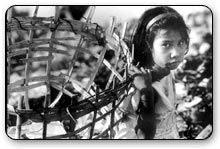 According to "A Strategy to Fight Poverty", a report made by the World Bank, "more than one third of the Philippine households still have income below the poverty line". Since 1971, the population of the rural areas had almost two times larger depth of poverty than in urban areas ( 68 percent versus 34 percent). Urban poverty presents totally different problems and needs compared to rural poverty. The poor families in urban areas have easier access to health centers and receives better education and other services provided by the government. Unlike those of the poor families in the rural areas, they have less chances of availing the services and programs of the government because of their remote location and lack of facilities like schools and health centers.
In fact, poverty in the Philippines is enormous in rural areas such as Ifugao, Misamis Occidental, Masbate, and Romblon. Negros Occidental, Iloilo, Leyte, and Cebu have the greatest numbers of the poorest rural families in the country.
The Philippines then came up with the new structural reforms of the financial sector, agricultural pricing and marketing, the tax system, the foreign trade and investment regimes and government corporation in the late 1980s with a more liberalized economy provided by the Corazon Aquino�s Government. Between 1985 and 1988 poverty declines by 1.3 percentage points per annum when GDP growth averaged 4.8 percent.
The Ramos Administration put poverty-alleviation in its highest priority during the 1990s. Even though the country experienced economic growth since 1985 up to the late 1990s, it was not enough to maintain the growth for a long time to be able to reduce the poverty level of the Philippines compared to the attainments of other East Asian countries. But still, the Ramos Administration believed that through macroeconomic stabilization and structural reform, poverty will be reduced. One of the ways is by giving the responsibility to the local government in responding in the needs and desires of the general public. The poverty-alleviation efforts of the central government, nongovernmental organizations, private enterprise, and communities involved will be mobilized and coordinated in the Social Reform Agenda of the government.
Then, Estrada Administration carried the slogan "Erap Para sa Mahirap" that made the people of the masses believe and hope for their elected President Joseph "Erap" Estrada to pull them out of poverty. Unfortunately, Erap was charged of culpable violation of the Constitution and betrayal of public trust which brought him to impeachment trial. But not long enough, with the power of EDSA 2, the elected President Erap Estrada was overthrown and replaced by the elected Vice President Gloria Macapagal -Arroyo.
From the past Administrations of the Philippines until the present Arroyo Administration, the struggle to reduce poverty in the country has shown no progress yet. It has become the cancer of our society. What could have been wrong on the programs proposed by the government for the poor population?
The World Bank,in its report on "A Strategy to Fight Poverty" suggested the following elements that should be included in the poverty alleviation strategy for the Philippines:
- Continuing the strong focus on economic growth, driven by openness and competitiveness and accompanied by macroeconomic stability.
- Improving access to the means of production by the rural land reform on the doable, promoting tenancy reforms and market assisted land reform, and ensuring the essential investments in rural infrastructure and improvements of agricultural extension services necessary to raise productivity, and thus, incomes.
- Addressing the scarcity of affordable urban housing and threats to environmental health in urban areas by considering a program of urban land reform and extending water and sanitation services to poor urban areas, while slashing public spending on housing (which does not reach the truly poor).
- Increasing investment in human capital by improving the quantity and quality of primary education in rural areas, and strengthening primary health services, especially immunization and prevention of water-borne and respiratory diseases.
- Rationalizing and better targeting social safety net programs, by transferring resources in government livelihood creation programs to capacity building of institutions with successful track records in reaching the poor and by ceasing general food price subsidies in favor of targeted income subsidies or food stamps and supplementary feeding programs.
Taking to account closely the following elements mentioned, these are in some way related and present to the "10-point legacy" proposed by President Gloria Macapagal-Arroyo for her six-year term. As what this article has mentioned before, this pro-poor program by the Arroyo Administration could have been just like the other "nailed" promises of the past administrations and could possibly be a deceiving act for a hidden agenda of the new government.
On the other hand, this could be a true act towards a goal of making this country in better condition. The "10-point legacy" of President Gloria Macapagal-Arroyo presents the masses with a clear objectives but the Filipinos still have to wait and let the President and her Administration prove to the masses, given her six-year term, on how this pro-poor program can be brought into reality by effectively reducing poverty in the Philippines especially in the rural areas, together with the government�s honesty and full dedication to public service, of course with the cooperation and participation not only of the poor population but also of the entire Filipino population as a concerned citizen of this country.