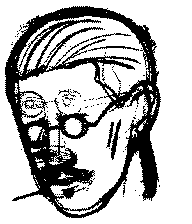
 writing, who dedicated himself to exuberant
exp
e total resources of language.
writing, who dedicated himself to exuberant
exp
e total resources of language.
....
one of the most radical innovators of t
writing, who dedicated himself to exuberant
exp
e total resources of language.
Joyce was sent at first to the expensive Jesuit boarding school described in A Portrait of the Artist as a Young Man. But by the time he entered the Faculty of Arts in University College, Dublin, he was already involved in that struggle with dire poverty which was to continue into his middle years. He seems to have inherited something of his father's improvidence; and when benefactions from admirers began to reach him, a good deal of the money was spent in the best restaurants of Paris. But with the son, as not with the father, these indulgences went along with a life of unremitting labor. Joyce was a dedicated artist of the first order.
He grew up a rebel among rebels. Those movements, whether political or literary, which had as their objective the freeing of Ireland from English dominance, held very little attraction for him. His instinct was for a broader European culture, and to this an exceptional faculty for linguistic study gave him precocious access. Among companions who were picking up a little Gaelic and were enthusiastic for the theater of Yeats, Synge, and Lady Gregory, Joyce stdied Dano-Norwegian and opposed to the Celtic twilight the hard, clear illumination of Ibsen in his realistic phase.
In a city much given to artistic coteries he remained aloof and even arrogant. For a time he led, or claimed to lead, a life of more than common adolescent irregularity; his early fugitive productions were often improper or scandalous. A powerful and original intellect made him quickly intolerant of the narrow curriculum of his college and of the strict Roman Catholic orthodoxy by which it was controlled.
In 1902 he broke away from his family and his studies and went to Paris on a tenous proposal to read medicine. After a year of near starvation he was recalled to Dublin to the deathbed of his mother. His refusal to kneel in prayer beside the dying woman, whether it be matter of fact or the artistic transmutation of fact, certainly marks that turning point in his life at which he formally renounced the Christian faith and thereby thought to free himself from influences by which (as we can now see) his mind had been irrevocably coloured.
In 1904 Joyce again departed for the Continent, this time taking with him a girl called Nora Barnacle, who became the mother of his son and daughter, and whom he married in 1931. Miss Barnacle, who is said to have worked in a Dublin hotel [as a chambermaid], had little education and no understanding of Joyce's work; to the end she seems to have felt merely that he made things very difficult for himself by writing in so strange a fashion. But she shared the fondness for music and was vivacious and humourous. Joyce's domestic life was a happy one - although indeed checkered by a morbid jealousy correlative with his sense of persecution as a writer and in its last years darkened by his daughter's decline into insanity.
He worked for many years as a teacher of English in Trieste and Zurich, in an exile which was to grow legendary with his tardily achieved fame. The course of his career, like that of so many artists of his time, was much influenced by the American poet Ezra Pound, whome he was on one occasion to describe as having taken him "out of the gutter". Pound indeed was to disapprove of Work in Progress, but before this he had been largely instrumental in sponsoring Joyce and in introducing him into circles which made easier his eventual setting in paris. There the writer who had in youth stood out against coteries became himself the center of a coterie.
His eyesight deteriorated progressively. This, plus the great difficulties of printing and proofreading his often strange and fantastic writings, made him peculiarly dependent on the assistance of devoted friends. This he abundantly received, and although his circle tended to surround his labours with pretentious and absurd exegesis, it was composed in the main of persons of generous and amiable disposition. Joyce lived largely on the gifts of patrons - notably of Harriet Weaver, and no Medici could have been more munificent.
For long the judgments and prejudices of society had impeded his efforts to support himself and his family as a man of letters. He rightly considered his reliance upon patronage as entirely honorable. Joyce had weathered World War I in Zurich; and he and his wife, with their son and grandson, managed to make their way to Zurich in the second year of World War II. His last published letter, dated Dec 20, 1940, thanks the mayor for the asylum granted him and exhibits the simplicity and dignity of one who knows his place in the literary history of his time. He died in Zurich on Jan 13, 1941.
The piece of retroactive wit - for it can hardly be more - has had the curious consequence of prompting an American scholar to comment on the poems as a tissue of indelicacies. In point of sober fact they are almost excessively refined: ghosts of Elizabethan lyrics haunting a mind that has known Pater, the pre-Raphaelites, and Verlaine; airy nothings, from which are entirely lacking the name and local habitation which were to count for som much in the vitality of Joyce's mature art. Yet technically they are consummate; and within their narrow range there is at play a sensibility delicate to the point of femininity.
But although deprecating Chamber Music as a "capful of light odes," Joyce was to bring out a second and even more slender gathering, Pomes Penyeach, in 1927. The volume cost a shilling, so one would expect 12 "pomes" (which are apples or pommes, one supposes, as well as poems). Actually there are 13, and one of them is called "Tilly" - mysteriously, if one does not happenn to know that this is a Dublin word for the extra splash of milk that comes free as the milkman fills your jug. This may stand as an early example of the arcane way in which Joyce's mind worked.
The keeper of a boardinghouse, having connived at her daughter's seduction by a lodger, bullies the man into a promise of marriage. Another mother quarrels with the promoters of a series of unsuccessful concerts who are paying her daughter inadequately as an accompanist. A drunken commercial traveler falls down the steps of a lavatory in a public house and is injured; during his convalescence he is visited by his friends, who make boring conversation and later try to reform him by taking him to a religious service for businessmen.
Of this last story we are told that Joyce designed lavatory, bedside, and church in a ludicrous correspondence to Dante's Inferno, Purgatory and Paradise. Joyce was indeed fond of contriving such correspondences, and even fonder of setting literary detectives somlemnly to work discovering them. Others of these stories are richer and more complex, with irony and symbolism at play beneath the realistic texture. The longest, "The Dead" is the deepest and the most compassionate. It is in fact Joyce's first assured masterpiece and must rank among the great short stories of the world.
But in fact the Portrait is also a work of the greatest emotional and stylistic subtlety. Reading it is certainly one of the most powerful imaginative experiences open to the English-speaking adolescent; and there are some who, in middle age, would scarcely trust themselves to read aloud the page descriptive of Stephen Dedalus' apocalypse - when, alone on the seashore and in reply to "a proud cadence from Newman" that has been echoing in his mind, "He drew forth a phrase from his treasure and spoke it softly to himself; A day of dappled seaborne clouds".
Stephen has created something beautiful and is henceforth an artist. But this high, pristine emotion is not all. Written for the most part while Joyec was still a very young man, the Portrait shows a depth of modelling and a power of dispassionate scrutiny which make it as hard-wearing as anything of its kind - whether in literature or in painting. In this regard it is strikingly superior to Exiles, a play, again of largely autobiographical reference, written by Joyce in 1914.
Ulysses was of very long gestation and resembles Henry James "The Golden Bowl" in having attained dimensions entirely unapprehended when it was first conceived. While writing Dubliners, Joyce had projected a sketch in which a certain Mr Hunter should spend a day wandering about Dublin is some loose ironic or bathetic correspondence with the hero of Homer's Odyssey. But that hero, according to a theory favoured by Joyce, was of Semitic Origin, and his myth in some way related to that of the Wandering Jew. In this way Mr Hunter became Leopold Bloom, the Jewish space salesman whose day's occasions in a city at once native and alien to him provide the skeleton for Joyce's immensely elaborated evocation of the life of Dublin throughout "Bloom's Day": 16 June 1904.
And this unlikely Ulysses is given his Telemachus in Stephen Dedalus, who steps straight out of the Portrait for the purpose of sustaining, symbolically, the role of the son in search of his father. This theme is perhaps the most important of the innumerable echoes of The Odyssey, which it pleased Joyce to work into his novel.
Yet Ulysses, although it can be represented as elaborately schemed and patterned at half a dozen levels, is essentially an immense and exuberant exploration of the resources of language. Nothing in it need be taken very seriously except this. When it is boring - and it is often boring - it is because the artist in JOyce has succumbed to the philologist. When it is exhilirating -and it is mostly that - it is because the English language is being used with a vigourous creativeness unexamped since Shakespeare. The result is oftn highly fantastic and even phantasmagoric. But we feel chiefly Joyce's power of rendering, with the utmost fidelity and immediacy, both the flux of consciousness in his principal characters and the tangible and visible surfaces of the life around them.
Joyce's excursions into the complex workings of the mind often take him outside the common bounds and conventions of polite literature. As a result of his uninhibited use of language, many attempts were made to suppress the book. Ulysses was banned in the United States until 1933.
In 1984 a three-volume edition of Ulysses was published, which corrected approximately 5,000 errors that appeared in all previous editions of the work. The result of seven years of work by an international team of scholars, the corrected edition of Ulysses sheds new light on many passages and makes it possible to reinterpret entire episodes and characters.
Finnegans Wake is a long book written in a language painfully invented by Joyce - a language designed to bear to ordinary language the same relationship that unconscious mental processes bear to conscious mental processes. A sentence in Finnegans Wake exhibits language subjected to all those processes of displacement, distortion, over-determination, condensation, secondary elaboration, and the like, which the depth psychologists of Joyce's age - Freud and, more notably for Joyce, Jung - were digging out of dreams.
Joyce, who had found himself continually harassed by censorship throughout his career, maded it the supreme task of his life to evolve as elaborately "censored" work as ever achieved by man. Where he was himself aware of the large irony of this is obscure. It is certain that the Wake, closely inquired into, is tortuously of obsessively confessional. The book cannot in any common sense be read. But it is of absorbing interest - particularly no doubt, to writers - as commemorating the most pertinacious effort ever made to transmute language into new forms and apply it to new purposes.

