

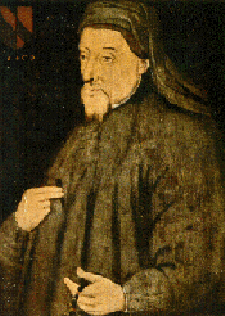
(1340-1400)
HIS LIFE:
With Chaucer we first encounter in English a poet whose language is intelligible and genius perceptible to everyone. With him English becomes a literary instrument sufficiently like the language we speak and write to-day to be understood without having to be learnt. And his genius can be seen by everyone because, like Shakespeare's, it had breadth and depth, that abundance which may be called-if the word does not intimidate- length, and that fourth literary dimension which eludes measurement but is immediately recognized and which for all its many names is perhaps still best named as poetry.
Chaucer surveyed with wide, impartial, and inquiring eyes not only the past, as revealed by books, but also the life of his own day; he was familiar with foreign lands and, in his own country, at home with every class of people. The works of his contemporaries show the life of the fragments only; in Chaucer's pages the reflection is whole and complete. Moreover, beneath the changing customs of the time he makes manifest the springs which move humanity in every age; his vivid pictures of his own time and country are no less true of every century and every land.
Geoffrey Chaucer led a busy official life, as an esquire of the royal court, as the comptroller of the customs for the port of London, as a participant in important diplomatic missions, and in a variety of other official duties. All this is richly recorded in literally hundreds of documents (see Martin Crow and Clair C. Olson, Chaucer Life Records, Austin, Texas (1966) [Widener 12422.598]). But such documents tell us little about Chaucer the man and poet.
Nor does Chaucer himself tell us all that much. He is a lively presence in his works, and every reader comes to feel that he knows Chaucer very well. Perhaps we do. There is a certain consistency in the character of Chaucer as he appears in his works, and occasional biographical passages, such as this from "The House of Fame", seem to ring true:
(House of Fame, 641-60)"Wherfore, as I seyde, ywys,
Jupiter considereth this,
And also, beau sir, other thynges:
That is, that thou hast no tydynges
Of Loves folk yf they be glade,
Ne of noght elles that God made;
And noght oonly fro fer contree
That ther no tydynge cometh to thee,
But of thy verray neyghebores,
That duellen almost at thy dores,
Thou herist neyther that ne this;
For when thy labour doon al ys,
And hast mad alle thy rekenynges,
In stede of reste and newe thynges
Thou goost hom to thy hous anoon,
And, also domb as any stoon,
Thou sittest at another book
Tyl fully daswed ys thy look;
And lyvest thus as an heremyte,
Although thyn abstynence ys lyte."
This has the ring of truth, and yet we can never be sure how much is true and how much a role that Chaucer adopts for his poetic self. The
Scrope-Grosvener Trial. It reveals Chaucer as a curious and sociable character, rather like the man who scurried about meeting and talking to all the nine and twenty pilgrims that gathered at the Tabard.By the 1380's Chaucer had earned wide admiration for his work, and a number of contemporaries mention Chaucer and his poetry. Naturally enough, they describe Chaucer's works rather than Chaucer the man.

