The Nitrogen Cycle
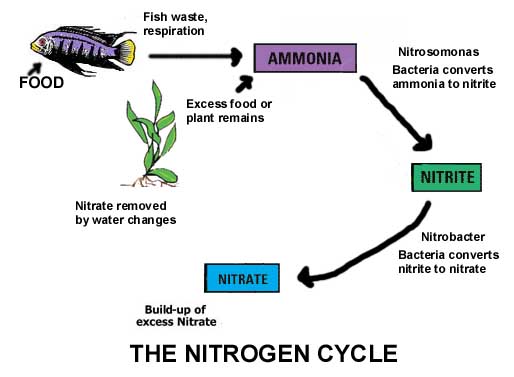
The Nitrogen Cycle refers to the conversion of toxic nitrogenous compounds,
ammonia (NH3) and nitrite (NO2-) to nitrate (NO3-). This phenomena is commonly
encountered when first starting an aquarium, or if certain events take place
which eliminate or reduce beneficial nitrifying bacteria, such as disease
treatments or prolonged power failures. In nature, the volume of water per
fish is extremely high, and waste products become diluted to low concentrations.
In aquariums, however, it can take as little as a few hours for ammonia concentrations
to reach toxic levels.
The initial nitrifying bacteria to populate the aquarium are likely to be
Nitrosomonas, which convert ammonia to nitrite. This takes approximately ten
days. Many factors contribute to this and your time frame may vary. The levels
of ammonia during this stage are often toxic and you should use hardy species
to help cycle your tank at this point. You should be willing to do additional
water changes, to make sure that ammonia levels do not get too toxic for
your fish.
The next group of nitrifying bacteria to colonize are those of Nitrobacter,
which convert nitrite to nitrate. Again, you should be prepared to do extra
water changes in case levels of nitrite get too high. Nitrite, if present
in high enough concentrations, is lethal and can affect the red blood cells
of fish.
You can start cycling your tank with some hardy fish. Some species include: common goldfish
(for cold water tanks), zebra danios or white clouds for tropical tanks,
and damselfishes in marine systems. Note: Do not use feeder fishes.
They may introduce unwanted diseases to your aquarium.
Generally speaking, if your test kit can measure it, you have too much ammonia
in your tank. A water change will help reduce the ammonia and the stress on
your fish.
During the cycling process, ammonia levels will go up and then suddenly
drop as the nitrite-forming bacteria take hold. Once they have appeared,
the nitrite level will go up until the nitrate-building bacteria appear.
They don't even begin to show up until nitrite is present in significant
quantities. Once the nitrate-forming bacteria have appeared, nitrite levels
fall, nitrate levels rise, and the tank is fully cycled. Your tank
is fully cycled once nitrates are being produced (and ammonia and nitrite
levels are zero). To determine when the cycle has been completed, obtain
some test kits and measure the levels yourself, or you can bring water samples
to your fish store and let them test it for you. The cycling process normally
takes anywhere from 2-6 weeks. At cooler temperatures it takes even longer
to cycle a tank.
Do not get more fish until your tank is fully cycled!!!
More fish means that more ammonia is being produced, increasing the stress
on all fish. Once ammonia levels reach highly stressful or toxic levels, your
tank has succumbed to ``New Tank Syndrome''; the tank has not yet fully cycled,
and the accumulating ammonia has concentrations lethal to your fish. This
is generally the cause of most beginner fish deaths in the aquarium.
Speeding Up Cycling Time
The nitrogen cycle can be sped up. They do, however, require access to an
established tank. The basic idea is to find an established tank, take some
of the bacteria and use them as a starter culture. You can do this by
using the filter media of the established tank and placing it in the filter
of the new tank. Or you could use some of the gravel from the established
tank and place that into the new tank.
Back to the Basic Guide
Temperature
Back to the Main Page