|
|
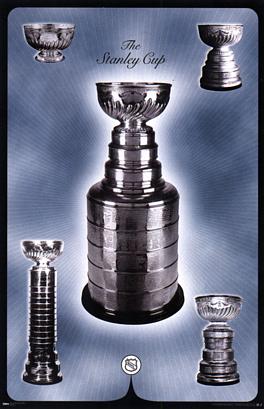
The History Of The Stanley
|
|
||||||||
|
March 18, 1892: The beginning of what
is generally known as the most prestigious sporting trophy in
the history of professional sports, the Stanley Cup. The Cup,
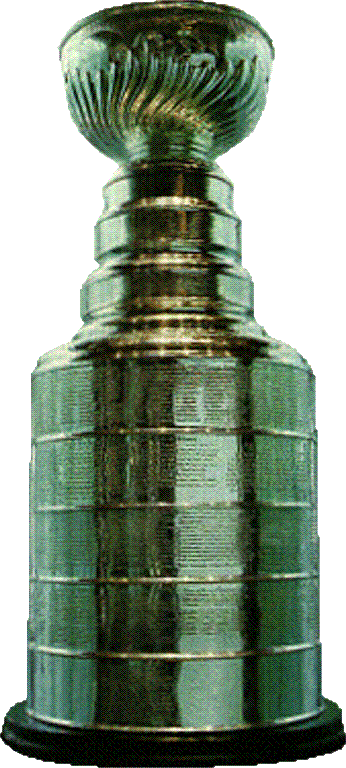
measuring 7 � inches high by 11 � inches across, is the only trophy in sports
that is passed down from team to team. Each winning team has the
club name and year engraved on a silver ring fitted on the Cup. On
that night, at a dinner of the Ottawa Amateur Athletic Association Lord
Kilcoursie, a player on the Ottawa Rebels hockey club from Government
House, delivered a message on behalf of Lord Stanley, the Earl of Preston
and Governor General of Canada:
Lord Stanley appointed
Sheriff John Sweetland and Philip D. Ross as trustees of the cup,
setting forth some simple preliminary conditions for the annual
competition. The winners wer
The
first real game for the Stanley Cup was played on March 22, 1894 between
the Montreal AAA and Ottawa. Montreal beat Ottawa 3-1 in a very well
played game. An article in the paper the next day read:
The write-up is amusing by today's standards, many papers today give the Stanley Cup playoffs it's own special section, while this write-up was probably stuck in the corner of a page. By the next season hockey had grown so much that nearly every village in Canada thrived on it. The sport had spread from Quebec and Ontario to the west coast. That season, a prairie team
from Winnipeg called the Victorias were challenging for the Stanley Cup. In the upset of the year the Victorias from Winnipeg beat the Victorias of Montreal 2-0. The rematch came less than a year later, in what was reported as "the greatest sporting event in Winnipeg history," and seats were "scalped" for an astonishing $12 a piece. The Montreal Victorias were reported to be 'admired by the ladies' and a 'much younger team'. The Montreal team overcame a 2-0 deficit to bring the Cup back to the east with a 6-5 victory. In the early days, hockey was played with 14 men on the ice, seven on each team. The extra man was known as the "rover", one of the most famous rovers was Lester Patrick, who later became the first manager of the New York Rangers. The game back then was much less sophisticated than it is today, games were played mostly on outdoor rinks with two portable poles, often without nets between them, were used as the goal. Goal judges, if used, were virtually unprotected. They stood behind the poles, relatively close to the play, without any padding. There were no sideboards in those days, so when a player was hit with a body check, they often landed in the fans. Fans would shove players back into the action, but often not before being roughed up by the fans themselves. In those days, it was considered an honour to attend a Stanley Cup deciding game, Referee's for example, would donate their services to be able to attend, and were usually presented with a memento of the occasion by the competing teams. The game has changed enormously since the early days, one of the most important changes was the creation of the National Hockey League. After the First World War a new professional hockey organization was formed, called the National Hockey League, or NHL for short. Franchises went to the Montreal Canadians, Montreal Wanderers, Ottawa Senators, Quebec Bulldogs and Toronto Arenas. In 1926, the other professional leagues folded and the NHL took control of the Stanley Cup. This was the beginning of hockey's modern age, in 1967 the league doubled in size from six teams to twelve. The league expanded more and by 1975 there
The success of
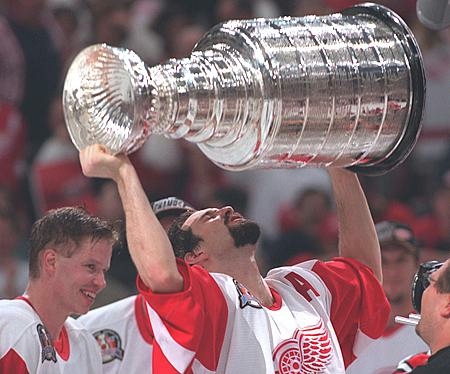
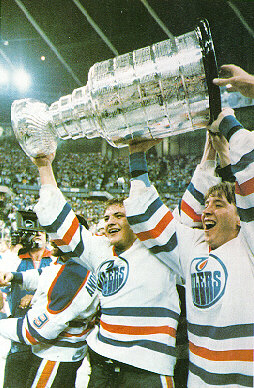
the Stanley Cup has been greater than Lord Stanley could have ever
imagined. He never attended a championship game or the presentation
of his trophy, having returned to England during the 1893
season. Regardless, the quest for the Stanley cup has become one of
the world's most prestigious sporting competitions. It is the dream of
many aspiring hockey players across Canada, the United States, and in
countries across Europe.
By Lisa
Crompton | ||||||||||