|
NAS at NYI
N.J. at NYR
MON at FLA
ATL at DAL
CHI at EDM
|
Do you find that a lot of calls that you wouldn’t make are called by the other ref? I wouldn’t say a lot, there are times and there are times that they don’t make calls that I would make but I find it very difficult to call something three feet from my colleague that I know he is looking at. It’s pretty tough to publicly embarrass a colleague in front of 20 000 people. Now on the other hand, if something happens three feet in front of him and I know his head’s turned or he’s out of position or whatever, that’s easy to call. The tough ones are the ones that he’s looking at and his judgement says it wasn’t and my judgement says, ‘Well I think experience will tell you that will be’ (laughing) but you have to learn from those too I’ve had experience where that has happened and things kinda went south for a few minutes, and you just at the end of the game say ‘You know, that was kind of a hot spot why didn’t you react?’ And you discuss it, whereas when you’re out there by yourself, you don’t get to discuss it with anybody you just learn the hard way.
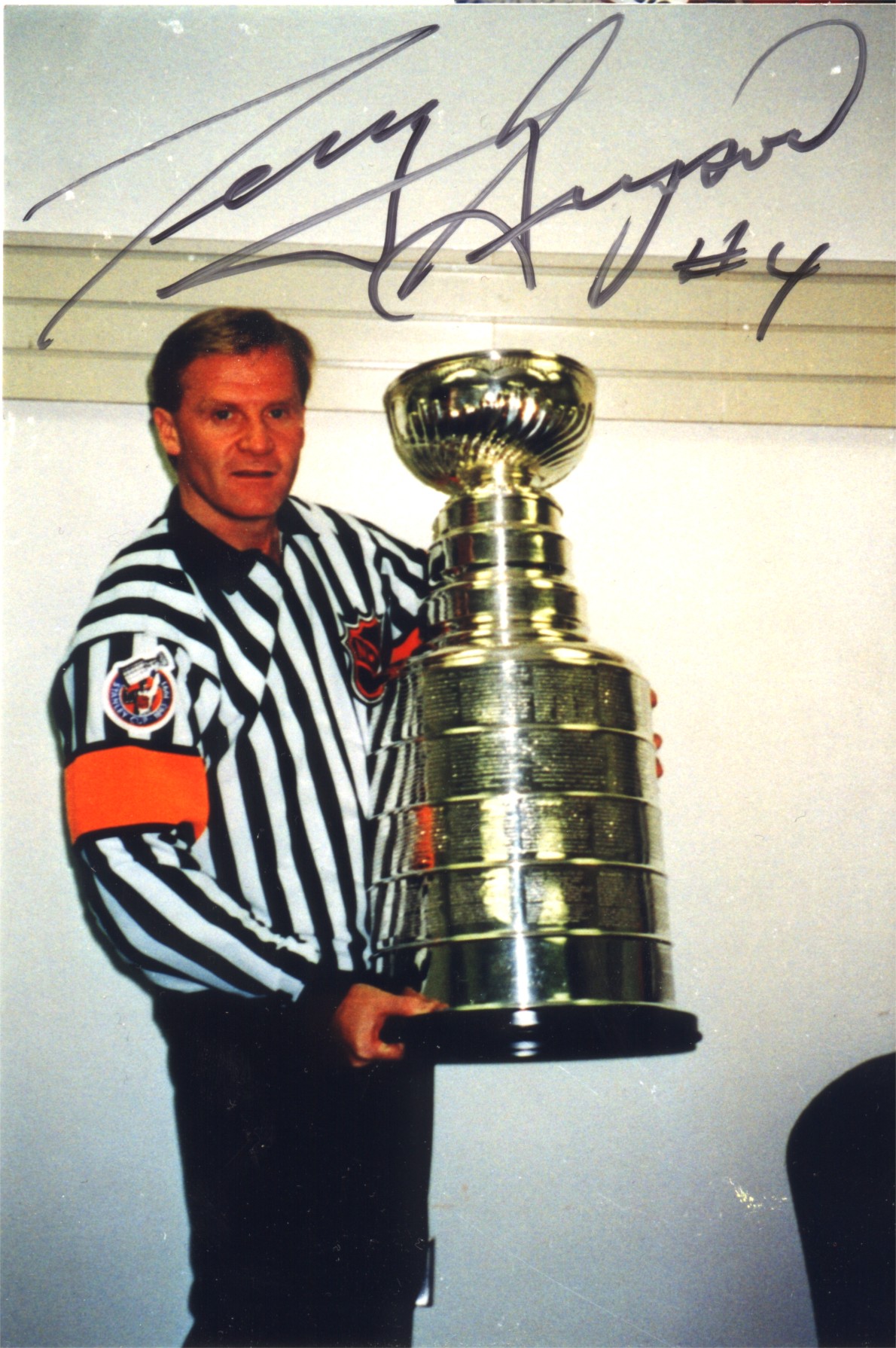
What does being President of the Referee’s Association involve? The key things as president of the association, I’ve been president basically since 1988, is I guess the main focus is you’re the head person in the negotiations of the collective bargaining agreement, and I’ve been on the executive since ‘82 so I’ve been involved in negotiating contracts ‘82, ‘85, ‘88, ‘93 and ‘97, and the next one comes up in 2001. So you’re the point person for that, you have to butt heads with the league, you have to basically if there’s any grievances, if we feel a player has abused an official, we have a procedure that we go to the league with that about. You handle the business side of that I try to set up deals with different companies, maybe we want new sweat-suits, so we try to find a source that will maybe put their logo on a sweatshirt. I work on the pension committee, I worked on the obstruction committee for the rules. You handle all the little stuff too where maybe guys have messed up and done something wrong travel wise and their boss gets mad at them and they call me and ask how to handle it, and I’ll tell them what I think they should do. You give the league input about how training camp is going, I usually have a meeting part way through the season to tell them what’s happening out there in the field, and what the complaints are. You conduct the annual meeting and look out for the wellbeing of the people in your association. When you’re negotiating contracts have you ever considered using the tactics the baseball umpires did in handing in their resignations? Absolutely not. (Laughing) Because they’d accept too many of them. It’s, I’ve told this to Keith Allen from USA Today and a couple other people, I just did not understand that tactic whatsoever because I am president of an association, but I am not a union type person what I believe is, I’ve told the National Hockey League, if you think there’s someone on our staff that is not worthy of being on our staff then you should let them go, I don’t believe in protecting the weak link because when I negotiate I want to negotiate with a strong group of people, so that the league needs them. And when you do something like the Baseball umpires did, first of all you’re an association, but we have 76 people on our association and it’s very very difficult to have 76 people thinking the same way. If I came home and told my wife Laurie that, ‘Guess what I handed in my resignation’ she’d kick me in the butt! She’d say, ‘What are you doing?!?’ Because it doesn’t make any sense, one guy might have a disabled child and really need those medical benefits, so he says ‘You know, it’s not exactly the way I want it to be but it’s pretty close, am I going to give it all up?’ And that’s what happened with the baseball umpires, they have couple of very political problems to start with, and those sets of umpires never come together till the playoffs, and one group says they’re better than the other, one group supports it one doesn’t, so when they went to do this the American League guys were really not in favour of it and that’s what happened. Some of them did, some of them didn’t, so Baseball saw a great opening and said hey we’ll give you two more days to thing about it what happened was 22 of them stuck to their guns and 22 of them lost their job. I’ll tell you what I think happened, they got together at a meeting during all star break, a little bit of gang mentality set in, they thought they were bigger than the game, and I don’t want to say I’m a soft negotiator because I don’t think I am, but you have to realize that they sign the paychecks, they hold the money. It’s all about you justifying your position and developing a position that makes good common sense. And to think you’re bigger than the game, you know put it all in perspective , Wayne Gretzky just retired last year and I haven’t seen the NHL cancel one game, and whose been more important to the game than Wayne Gretzky in the last 20 years? As a group we’re very strong, that’s why in ‘93 we were able to leverage, we had negotiations, we ended up going on strike for 17 days, it was a difficult time for everybody but we made sure we had good solidarity before we did it because if you do it and you don’t have the solidarity, everything can go south very quickly. But we were on the phones constantly reassuring people, we had finances if guys needed things. I mean we did a lot of preparation, we didn’t want to do that, but that’s what happened. So as far as what the baseball umpires did, if you talk to anyone in the legal field they were shocked by it too, our lawyer had no idea couldn’t figure out the strategy at all. When you’re on strike who do they replace you with? What they did was they went to the OHL, the US Amateur Hockey League, the Quebec Jr. they went to amateur officials Because the AHL officials… Well I have to say nobody from the AHL came, because what happens there, a lot of our young guys on contract, that’s where they go to work, so the linesmen there get to know our guys pretty well and they were very supportive of us. What they did basically is they went out and got as many amateur officials as they could and they struggled big time to get enough guys, because it’s kind of a fraternity and what we were doing in ‘93 was trying to bring recognition to our aspect of the business so that if a young guy does come in, it becomes a pretty good career if you hang in for 20 to 25 years. How long have you been a referee? I’ve been under contract with the National Hockey League for 21 years, but just to tell you how that works, usually when you sign as a referee you’re going to spend a bit of time in the minor leagues sort of learning your trait in professional hockey. So my first year I worked in the American Hockey League and Central Hockey League, and a little bit in the IHL. My second year was pretty much strictly American Hockey League, my third year I did 11 NHL games and the rest were in the minor leagues, my fourth year I did 22 NHL games and the rest were in the minor leagues, my fifth year I did 56 games, which is one shy of what they consider a full season, and then in my sixth year I became full time NHL. So this is really my 16th season in the NHL full time, but I’ve been under contract for 21 years. That’s kind of the normal progression for a referee, a linesmen, they tend to either take one year and do some in the minors and then come up, or they go straight into the NHL, its’ a little different rules. How many games do you usually do in a season? Well a referee is contracted to do 70 game sin a season and a linesman is contracted to do 82, and part of the reason that is, number one, in the one referee system of course we had to skate a lot further, and also we travel a lot more. Referees are not regionalized or zoned whatsoever, the linesmen are, lets say a fellow lives in Oshawa, he works a lot of Ottawa, Toronto, Montreal, Buffalo, Detroit, Boston. Whereas myself, this week I’m in Toronto, Detroit, Philadelphia, next week I’m in San Jose, LA, Phoenix, and Anaheim. So you see the referee travels a great deal more, so the travel time we spend on the road also dictates we can’t do as many games. And then if I do any more games than 70 then they pay me 1/70 of my salary over that and if a linesman does more than 82 they pay him 1/82 of his salary over that. Last year for example I did 76 games, so they have to pay me six games fees. I did four exhibition games and 18 playoff games. So when it’s all said and done I do close to 90 games. One season when I was doing NHL and minor leagues and playoffs I did 110 that was the most I’ve ever done. Wow That was a busy year (laughing) Are new rules hard to implement? They’re not hard to implement as long as the ground rules and everything is on the same page. Of course when you develop a rule each team thinks it’s for the other 27 teams and its’ not for them, so they try to circumvent the rules they try to push the limits they do everything they can , so the bottom line for us is we’re given a mandate from the league and we always try to say give us as clear a mandate as possible, don’t tell us go out and use your good judgment, because we're always trying to use our good judgement, but I think the best success we’ve had with any rule to date was the obstruction situation. We had a committee which I was on, we had coaches, GMs, players, officials, we sat down and some of the coaches and GMs come up with ideas that we had to tell them as referees there’s no way, we don’t have enough eyes in our heads to call it that way. And so we had a lot of good dialogue, and I helped produce a video on the obstruction rules, we fed it out to the people, they had teleconference calls about the obstruction rule so we had a good foundation to move forward. Now obstruction is interference, interference is, in most cases, judgment based. We have people that believe that if I touch you with my glove I’m interfering with you, we have other people who figure you’re allowed to grab somebody once but not twice, so the problem is when you have something that’s judgement based you’re never gonna satisfy everybody. And one of the biggest complaints I have is that, I read different papers and watch different TV broadcasts as I travel around, and usually when someone doesn’t know a hell of a lot about the game, they’ll say there’s too much ‘clutching and grabbing’ because you know what that became sort of a catch phrase of the early 90’s. I don’t feel it’s that way anymore, it could be better, but the league tells us right now they’re very satisfied, so if they’re very satisfied with the way obstruction is being handled then I guess I’m not going to go out there and take it upon myself to change the mandate. So the implementation of rules is not difficult if we could just get everybody understanding that it’s for the betterment of the game not to screw up their team, but that’s difficult to do. I think constant monitoring of the officials and a clear mandate make it not difficult. Now one thing that sometime I’ll hear coaches and GMs say ‘there should be zero tolerance on something’ well you know zero tolerance doesn’t work anywhere in life because circumstances are so different. So as soon as they come up with a zero tolerance phrase we try and squash that because you know it just doesn’t work. A police officer can stop you for speeding, but he might not give you a ticket, he might give you a warning. And it’s because under his good judgement he’s decided ‘I can work with this one’. And it’s no different for us, so there are things that we’ve raised with the league that we think maybe they should look at the rules, I think there’s too much stick-work in the game in terms of slashing, I think that what’s happened is when we tightened up with obstruction, so that means now when you skate by me I don’t reach out and grab you anymore or reach out and hook you, I reach out and give you a whack. So we as referees are saying we watch this a hundred times a game and think. ‘Oh god I hope he didn’t get hurt’, or, ‘I hope this doesn’t escalate’, now if it escalates to a higher level ok we call it, but the league says, ‘No we’re not having any complaints about that’, so we’re saying ‘Well I guess OK we’ll hang on till there is’. See we’re constantly monitoring things too but we’re basically the people that are put in charge of the mandates the league gives us so if they think things are fine in a certain area you don’t take upon yourself to change it. With the monitoring of the games, what does happen if a ref has a bad game? Well basically we have supervisors that are at the games live in some cases, all games are videotaped we have an office in Toronto where they have a big bank of TVs and some of our supervisors and bosses sit there every night and watch the games. If there’s a call that’s controversial, you can be sure the team’s gonna be calling them that night on their cell phones or first thing in the morning anyway, but if they feel that an official is not working up to a standard or they see that his obstruction standard isn’t good, or he isn’t controlling the front of the net properly, if the supervisor is present at the game he’ll come down and say , ‘Look I want to talk to you about a couple of things.’ They probably would call you the next day because right after the game you’re still a little heated up, a little emotional, it’s not the best time sometimes to get criticized because you’ve been criticized for three periods already, so what they do is they’ll contact you the next day or if they’re on the road with you you’ll have a discussion about it. If they watch it on the video tape what they’ll do is they’ll call you the next morning and say look here’s a couple of things we noted we’re going to send you a tape we’d like you to look at it and then we will discuss it with you. And then of course we’re rated all season long as well, and according to your rating is weather you work the playoff or not. So that’s how they pick the refs for the playoffs? Yeah that’s how they picked, in baseball it’s seniority in a rotation, but for us it’s all ratings. And for the finals? Is it the same way? You’re rated to get into the playoffs, and then once you get into the playoffs you’re rated in the playoffs as well. So in each round they drop numbers, like the first round there’s 20 refs, the second round they drop to 14, the third they drop to 10 and the last round they drop to five. In the past they used to have 11, 8, 4, and 3, but now with the 2 ref system it’s changed. Have you refereed many Stanley Cup winning games? Actually I have done, let me see, I’ve done the finals eight times, I New York and Vancouver, I did game five Montreal won over Los Angeles, and last year, I did Buffalo vs. Dallas, game six. I’ve done three out of my eight times I’ve been there I’ve done the game where the cup’s been presented. The game seven I did in 1994 that’s probably my most memorable game because there’s only been three game sevens since I think 1960, there was one in 72 one in 87 and one in 94. So it doesn’t get to game seven very often.
In the game six with Dallas and Buffalo, was there a lot of complaint from Buffalo about the controversial goal? Well the truth of that is there was absolutely nothing said to us until about fifteen minutes after the game. Oh really? Yep, the goal was scored, we went over to the penalty box because we discussed, we said Brett Hull’s foot was real close to the crease we have to wait for the OK from the Video Goal Judge. We stood there for 2 min and 29 seconds and nobody came near us. And then we get the call down that they’re deeming the goal good because he had possession and control and we left the ice. We’re in the dressing room getting undressed when the Assistant Coach from Buffalo comes to the door and said ‘Did you know Brett Hull’s foot was in the crease?’ I said ‘Well it very well could have been, but if it was deemed possession and control, it’s a good goal.’ I said, ‘Did he have posession and control?’, ‘well I don’t know, his foot was in the crease’, I said ‘Well you better go check the video tape.’ So you see, you know what the sad thing about that whole think is Lisa? It was a good hockey goal. No one at ice level said one word until somebody from some TV truck scared it up and then away they went. And that’s a problem I have with the game of hockey right now is it’s not being played for the moment, it bugs me when something happens and I look over at the benches and they’re all sitting there looking up at the TV screen to see what happened so they can complain. We don’t look at TV screens, if somebody gets high-sticked I don’t look up to see who high-sticked him, I’ve got to call it. And then they sit there and they look up there and say ‘oh he missed him, how could…’ and you know, that’s not fair. And it hurts the game, it makes lazy spectators, lazy players, lazy coaches because all of their opinions now come from slow motion, and from an angle that the person whose making the judgement, like myself, would never see. I get people saying ‘well you should see the overhead camera’ well I’m sorry I’m not hanging from the rafters. And to me that hurts the game. I understand why TV does it, because it brings the fans closer to the game. But I love sitting in a room with people watching a hockey game and something will happen, I’m trained to watch so when I’m sitting watching with my wife I can say, "Watch this, this might happen here’, and she knows the game well but it’s a little different. I sit in a room with people and something will happen and they’ll say ‘Oh, lets watch the replay to see what happened’ and I’m thinking no, that’s not right. Because you know people say the refs today aren’t as good as they were 25 years ago, well I’ll tell you something the refs 25 years ago were great referees but you know what when they made a decision everybody had to live with it because nobody could second guess them with the replay. Now the young officials get second guessed to death! When we did the Stanley Cup finals last year, I think there was 42 cameras covering the game, well I’m sorry I only got one set of eyes, I’m not that good. For one of my goals I’d love to have all the reporters that are doing the game have to sit down right next to the boards at ice level and report on a game without any replays, because if you’ve ever been to an NHL game and sat in the press box, its’ so funny, as soon as anything happens they get up out of their chairs and run and watch the TV monitors. And I’m thinking ‘Hey that’s not fair! Report on how you saw it’ But anyway, I’m getting off track here. Do you have any input in the new rules? Yes we do, about February we’ll get a document in the mail saying ‘Do you have any new rules submissions?’ We can submit any new rules we want, any changes any wording new rules whatever we want to do, that goes into a committee, we sort through them, and the committee sort of looks at the merits of them pairs down the list and then submits it to the board of governors. The board of governors will discuss the ones that they think have merit, the governors then will pass it on to the GMs, the GMs will then discuss it and vote on it then they’re implemented on a trial basis during the exhibition season. And we have input during the exhibition season to say, ‘Hey this is impossible’, or, ‘Hey this is no good’, or, ‘Hey this doesn’t work’, and then the week before the season starts the GMs will meet again and with the blessing of the governors will pass the rules that they think are going to work. If it were up to you what rules would you have around the goal? I’d have to say I very much like the rules we have in practice this year. Basically leaving it up to my judgement, I think you’ll have to admit that there’s a lot less controversy this year. I think the whole problem was with that other rule was that the term ‘zero tolerance’ was in there. And the only way you can exercise zero tolerance is with video cameras, so we as referees at ice level no longer determined if a goal was a good goal, we had no say in it whatsoever. I think that’s very dangerous. I do support video replay for ‘did the puck cross the line?’ because sometimes that’s very difficult but that’s a black and white thing, ‘did the puck go through the net or in the net?’ that type of thing is no problem but when we had zero tolerance with a foot in the crease considering, all the things that happen in a game of hockey because it’s fast action and its in a confined area a big toe in the crease just didn’t bother me. And here we were disallowing goals, and goals are probably the most important thing in the game for next to nothing. So the way we have it now basically I like it. There’s a couple little things we have to fine tune, but it’s very good and I think the players accept it. It bothered me the last couple years and we went to the league and said ‘This isn’t the way it’s meant to be’, ‘no no we’re going to stay with it ‘OK, OK, stay with it, it’ll bite you eventually’, but you know you were disallowing what I would consider beautiful hockey goals because some guys toe was in the crease. And you just feel awful because you know the game enough how hard it is to score and then here you are saying, ‘sorry no goal you’re toe is in the crease’. So I like the way it is now because we can even have a guy in the crease, lets say I’m standing in the crease and the goaltender is looking to his right, he goes to move to his left bumps into the guy whose in the crease and the puck goes into the net, I can disallow that goal but I don’t have to give a penalty. Because the guy in the crease was there, but what we call that is incidental contact. It wasn’t like he was pushing the goalie or banging the goalie but he didn’t allow the Goaltender to take up the position he desired, and the goaltender is entitled to take up any position he wants in his crease. So I think where we’re at is very good now give it back to us, hey there’s still going to be goals that people are upset about, but I’d sooner have them arguing over my judgement than over somebody’s toe in the crease.
What about the goals, I’ve seen a few of them this year, where the player goes in to the crease, claims to see a loose puck and bowls over the goaltender and the goal counts, what do you think of those goals? Well I think that’s where some of the fine-tuning has to come. I’ve seen a couple of those goals but I’ve also seen where the defending player drives the guy into the net so you have to consider all the circumstances, but if a guy is totally by himself and goes straight forward into the crease and knocks the goalie in, I couldn’t allow that goal. Yeah Toronto scored a goal like that this year I’m sorry but if I was doing the game they wouldn’t have got it. And so you see that’s where we have to fine tune and bring it all together. Because what’s happened there is that the guy’s going by the letter of the law, saying well the puck was in the crease and this and that, but the rule is one thing common sense is another. I always have to say to myself ‘Was that fair?’ if the goalie has stopped it and the goalie is not moving backwards and then suddenly he’s moving backwards, I’ve got to go back to my physics days who provided that kinetic energy to get them moving backwards. (laughing) So that’s how I look at it, but you know what? I’m going to be wrong some night too, but you have to minimize that. What are your views on fighting? Well first of all, fighting is kind of a strange animal in our game. People that don’t watch the game very much now say, I don’t watch the game there’s too much fighting. I mean, literally I can go ten or fifteen games and never have a fighting penalty, really there isn’t very much, there’s a lot less than there used to be. But people who don’t watch… They see things like the Edmonton player from the other night with blood all over his face… Exactly! And you know Lisa so many times I’ll
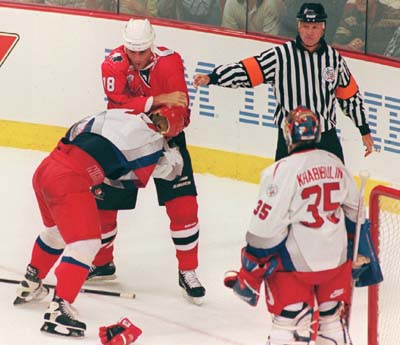
do a game and lets say I’m in St. Louis, and I coulda played in the
game nobody was hitting anybody, but there’s this weird moment where
maybe somebody gives somebody a push in the chest, that picture will
be in the paper the next morning. And they’ll say ‘Physical game
played last night at the
Gregson
keeping an eye on a fight, fighting is a 'strange animal' in
hockey he says. I was watching that game with my friend, and it was the first hockey game she’d watched all the way though, and she was laughing her head off, she found it hilarious, just seeing them talking. Exactly and I’m trying to keep them in the game and then finally they yapped too much and I had to give them misconducts, but people criticize it and yet they want it. I have trouble with people that way too. I like… well I shouldn’t say like, I understand and agree with spontaneous fights, if I go into the corner and I give you an elbow in the mouth and we come out of the corner and we get at it, that’s because I’ve made you angry and we fight. I cannot stand, lets say the game’s going along nothings happening and then player X and player Y come out on the ice we drop the puck and they fight. What is that all about? In the old days maybe that change the game, it doesn’t do that anymore I don’t mind spontaneous fights because someone is angry, I cannot stand what I refer to as premeditated type of things where ‘OK, you ready to go, I’m ready to go.’ I got in trouble, well not in trouble, but I got a call from the bosses, because I had this game and nothing, nothing, nothing was happening, two guys came out drop the puck they start fighting, so I give them five and a game I said, ‘Get outta here.’ My boss said ‘No, you cant give them games’ I said, ‘Well that was horseshit, they come off the bench, they had nothing to do with that game, I said, I don’t need them in my hockey game’, ‘well no you just give them five.’ ‘OK fine, that’s what I’ll do.’ I think that hurts the game, but the spontaneous ones, I’m not saying a player should take the law into his own hands, but I don’t mind it for emotional reasons, but I cant stand it for anything else. With the Domi and Ray thing, do they get misconducts because they wont stop talking or because of what they’re saying…? Yeah because what happens there, we had the initial fight along the boards and everybody was yipping and yapping but I thought well you know those two guys they threw a couple of punches, so I try to keep the players in the game as much as possible, so I told them both ‘go to your benches and be quiet’ so Quinn pulls Domi off onto the bench but Ray stays on for the shift. Well the face off is right in front of the bench, so now Tie’s leaning over the boards yapping at him, and Rob Ray turns right around, Rob Ray’s not even paying attention to the puck, so basically they’re trying to incite each other into a fight. So you give them ten minutes for that. It’s not so much what they were doing, it just looks brutal. And if I let that go, then somebody’s going to say ‘Well how much control does this guy have?’ What are your views on hitting from behind? Absolutely shouldn’t be tolerated. Unsafe dangerous, shouldn’t be tolerated. The problem we have with it though is that the players themselves I find, more and more, I don’t know if it’s because they’ve got such good equipment or they’re brain-dead or what, but so many of them leave themselves, they turn and face the boards to get the puck, well when I played hockey you were always playing angles making sure you could see anybody coming at you, players now they turn face the boards to get the puck, and a guy’s coming in, now you have to take a little bit of ownership on both ways, the guy coming in, he’s told finish your check, and he looks up, there’s the guys back to him he finishes the check and now the guys hurt. I think that first of all you cant hit from behind so the guys got to be penalized, but dammit if a guy is stupid enough to set himself up to be absolutely totally vulnerable, I mean, he’s got to take some ownership there. I don’t want to see anybody get hurt, I don’t think hitting from behind should be tolerated at all, but I think there’s got to be some coaching done that you just don’t stand facing the boards Sometimes even when the player coming in to do the check lets up they get called for a penalty Exactly! Because the guy that he’s hitting has put himself in such a vulnerable position that you think, ‘Oh man that must have hurt.’ And also we have some players that are very cute about at the last second turning and getting hit from behind, when the guy coming in when he was coming in to throw the check wasn’t hitting anyone from behind. When you let that go as an official, you have to get in there real quick and say why you didn’t call it. You’ll say ‘Because you put yourself in that position at the last second’, but it still doesn’t help it, tempers usually get going pretty good. Hitting from behind I think there has to be some coaching done and I think the players have to take a little bit of ownership on that one too. What was your most memorable game? I would have to say game 7 of the 1994 Stanley Cup Finals New York Rangers against Vancouver in New York, it ended up 3-2 it was a tough but good hockey game no controversy, it’s like a player, as an official everyone wants to get to the Stanley Cup finals, and I think to get to a game seven, that’s it, you’ve played a thousand some games plus all the playoff games to get there, and it’s one game elimination. So that would have to be my most memorable game. Has the inclusion of European players changed the style of play in the National Hockey League? I would say yes it has, I think that some good some bad. As you know European hockey is a very defensive style of hockey. And so I think that’s, you know we’ve gotten into the trap and all that kinda stuff, and they can complain all they want about there’s too much obstruction but I think it comes down to coaching techniques, so many teams now with 28 teams, there’s going to be 30 next year, we’ve got some teams that are playing not to loose, they’re not playing to win. But I cant blame that totally on Europeans we wouldn’t be at 28 teams if we didn’t tap into the European pool of players. And then we’ve got some pretty exiting players like Selanne and Jagr. I would have to say some of the best players in our league now are European who have tremendous, tremendous skill. It’s nice to see whenever you have a Jagr and a Martin Straka or a Selanne playing with Kariya there’s some pretty great skill going on out there. I think that maybe a defensive style of play has come in with European influence, but also there’s some pretty exiting offensive hockey with Europeans. We just wouldn’t be at 28 teams and there wouldn’t be as many jobs, and there wouldn’t be as many people out there going to local hockey games if we didn’t have the Europeans. How often do you travel? We start training camp Labour Day weekend, and the last couple of years I’ve finished up around the 20th, 21st of June so it’s 10 months pretty much, and I would probably be on the road at least three weeks a month. This week I’m home a couple of days because I worked in Detroit and Toronto so that worked out good. But basically I leave tomorrow morning, which is the 8th of January and I get home on the 18th, then I’m home for a couple of days and then I head out again. So I’m on the road probably about three weeks a month, and you get two days off here and there, you don’t come home and sit for a week or anything like that. You do a lot of traveling, and usually when I go on a road trip it will be to a geographical area, so like the west coast and then I come back and I go to Philly, and Ottawa and Washington, and Tampa and that type of thing. So that’s probably the part that after a while gets as tiring as anything because the teams travel in their charter jets now so as soon as the games over they’re on the jet and off to the next city where we have to stay over, get up the next morning and catch the commercial flight and they can get delayed and cancelled you just have to get to the next city one way or another. So you have to watch the weather all the time. That’s about how much I’m away ten months a year. Was there any really bad traveling experience to get from one city to another? Oh I’ve had times where I’ve taken trains and planes and cars just to get to a game and get there about seven o’clock for a 7:30 game just due to the weather. Last year one game I was to fly to Washington on a Tuesday morning, well I watched the weather channel and it said there was a bad storm so Monday night I went down to the airport and everything was cancelled except one flight to Nashville so I flew to Nashville got in there at midnight stayed there got up the next morning at 5:30 went over to Nashville airport pleaded with them to let me on a flight so they flew me to Baltimore. I got into Baltimore then I picked up a car and drove to Washington to get to the game. Our guys do lots of strange things, and have done lots of strange things but we’re pretty good about getting there we’re pretty resourceful What if a referee just cant make it to a game? Well first of all that just isn’t allowed to happen. If it does, if you see that you’re really in a jam, you’re just not getting out of there, you notify the office first thing in the morning, and they’ll look on the list and see if somebody’s more accessible and have him on a standby. There’s been time where the one guy called and said ‘This isn’t looking very good’ so they’ll call somebody else and the two guys will end up at the rink at the same time, but it’s better to have two than nobody at all At one time referee’s had their names on their backs, why were they removed? I’ll tell you the truth, a lot of people don’t know this, but in 1993 when we had our negotiations Gary Bettman was in his second year as president, and I think he was absolutely blown away by the recognition that we as referee’s had particularly in Canada. People knew my name and Andy Van Hellmond’s name. We were household names in many ways like players were, and I think because of that we got a lot of support in Canada particularly during our dispute negotiations. Bettman came from the NBA and they don’t have names on their sweaters they’re basically nameless and faceless and their just people who run around the court out there. So when we came to our agreement and we worked the rest of that season, that summer he said, ‘OK, you guys don’t have your names on your backs anymore, you’re going to have to pick a number’, and we said ‘why?’ He said, ‘Well it’s for your protection so people don’t know who you are and can’t harass you.’ What it was about, basically now Lisa we’ve got a lot of new guys on our staff and people don’t have a clue who they are because they’re just a number. I mean I don’t even know, I watch a game on TV now I gotta go look at the list to see who number 22 is. So if I don’t know, the public certainly isn’t going to know. But it’s a very hard argument, if we say in the next agreement ‘We’re not going to come back to work unless you put our names back on our sweaters’, the general public, you’ve lived without it long enough, you’d think what a bunch of ego maniacs they are. I have to say I don’t really care because I’ve had 15 years with my name on my back, but it’s not an easy one to try to get back and Gary Bettman knows that, he’s not a stupid man. It sounds like an ego based argument and that’s not what you want. So that’s why it’s taken off and that’s why it’s not back on. Have you ever been injured by a puck or a fight? I’ve never been injured by a fight. I’ve had lots of bruises from a puck, a broken bone in my foot, a couple things. I’ve been fortunate though, over the course of 21 years I’ve just had one broken collar bone and two concussions and some stretched ligaments. Touch wood I haven’t missed a game in eleven years, but you never know. Lots of bruises, you’re constantly getting hit with the puck, and sore hands all the time because you’re along the boards and your hands get squashed, that kinda stuff. We have had several guys with knees and ankles, lower back, lots of lower back problems because of the skating position and the stress you put on it. But you just work on staying in shape, our guys are a lot of the time on the other end of the spectrum a lot of our guys work hurt, it’s not the brightest thing to do but its’ just kinda the way our guys have been raised. How do you prepare for a game? We have to be in the building about an hour and a half before the game and then we have to be in our room and no one is allowed in our room one hour before the game, and do lots of stretching some guys skip rope, we have life cycles in our room and things like that, basically just get the heart rate up a little bit get the muscles working and then we head out on the ice about five minutes before the game just to do a little bit of skating. That’s how you physically prepare for it now mentally it’s a whole different thing, I’m pretty much of a routine person the day of a game I’m not real talkative to anybody, if you’re on the road you get up in the morning, some guys go to the gym some guys go for a walk, then you usually have lunch around 12:30, 1:00. Some guys like to work on their lap tops whatever. I like to go back to my room by 2:00 close the curtains read a bit have a snooze and then we head for the game usually 5, 5:30. So that’s how that works. Everybody kinda has their own routine the day of a game sort of from the mental and the physical side. What do you think of the new four on four in overtime? I think it has merit, what it does to me is something the National Hockey League has been very neglectful in doing it. I look at the ice surface the 200 by 85, it’s the same ice surface we’ve been playing on since about 1952 when the players were 5’9" 180 pounds, now they’re 6’2" 210 and we’re playing on the same ice surface. All four on four does for me is it provides in relative terms the same amount of ice they had 20 years ago. I think we should have made the ice surface slightly bigger, I’m not saying Olympic sized, but slightly bigger, and we would have more free flowing action because you get three big guys in the corner where can they go now? But the four on four in overtime it shows that give them more ice and there is more flow. Now people say oh lets play four on four all the time I’ll tell you what, it wouldn’t be the same because they would then start to develop tactics to check each other. It’s like shinny ok we’ve got five minutes each team you’ve already got a point lets go and see if we can get another one. Now if you say from the start of the game we’re playing four on four it would be a very different game it wouldn’t be free flowing, they couldn’t keep up the pace. so I like it I think it’s good for the fans but I think it has it’s limitations to that five minute overtime. What is your favourite arena? Well most of them have been torn down by now, guess I’ve been around too long. I like Madison Square Gardens in New York because it’s an arena where a lot of historical sporting events have happened and it’s right on seventh avenue in New York and things are humming, it’s kinda neat. I really like the old Montreal Forum, it was a classic arena. It was just Saturday night in the Montreal Forum the women all had fur coats on and the men had shirts and ties, it was almost like going to the theater it was neat I really enjoyed that. The Montreal Forum was a good arena. As new arena’s go, I don’t want to sound like a dinosaur, but the atmosphere’s just aren’t the same they’re very much for the corporate person which I understand, that’s where the money is but I would have to say of the arena’s we currently visit I like Madison Square Gardens and of the old arenas I like the Montreal Forum. Who were your hockey heroes and why? Coming from an older school, one of the reasons I wear number four is because my three favourite hockey players wore number four, Red Kelly, Jean Beliveau and Bobby Orr all wore number four. And I always wore it as a kid because as I was growing up those were sort of the guys I always liked to watch and I would have to say that they’re probably my favourite hockey players over time and I would have to say that I was always amazed by Wayne Gretzky not only on the ice but how he conducted himself off the ice. I just was amazed, over 20 years you get that many microphones shoved in your face sooner or later you would think you’d make a slip but he was a classic that way, now that’s he’s retired I can tell you I think he was a hero too. What is your advice to young hockey players? First of all I think there aren’t enough young kids having fun playing the game, I think too many of them get into structured environments too early and what happens is I hear about these eleven year old kids playing 70 and 80 games a year and I think that’s disgusting. Kids don’t go public skating anymore, kids don’t play hockey on the road or on the pond anymore because they’re so structured. What was wrong with when I was growing up we’d maybe play 25, 30 games over the course of the winter, but we went public skating twice a week, we played hockey on the road every two nights. I just thing young hockey players should have fun, I think too that if you’re a good athlete and you’re going to be a good hockey player whether you play 20 games or 55 games or 60 games at the age of thirteen or fourteen if you’re a good athlete you’d come to the forefront anyway. I don’t agree with hockey players playing from September to march and then gong to tryout camps in May and then going to hockey camp all summer. I can see going to camp for a week or so, but I just don’t see this summer hockey. I think you should be playing baseball and lacrosse in the summer. I think though, there just isn’t enough fun and too many parents start to live vicariously through their kids and think that they’re all going to be pro hockey players. But I’ll tell you there aren’t many guys that make it. To make it takes a lot of commitment, a lot of discipline, and its’ work. It’s a job, I know there’s good money, but it’s a job. And the thing it, they’re 16 17 18 years old, it’s a job for them. They’re generally not living like a 16 or 17 year old kid. If you make it to pro hockey your career starts when you’re about 15 or 16, you might not get paid till your 21 or 22 but you start now. It’s a hull I’ll tell you, part of the problem too is I see 11 and 12 year old kids playing 60 70 games, then when they get to be 15 or 16 they suddenly discover girls and other interests and they get their license, then they say to their parents ‘I don’t want to play hockey anymore’ then it’s like a big rift between them and their parents because what do the parents say ‘I spent all this money…’ and that’s not what it’s all about I don’t think, but then when you do get to be 15 or 16 and you think you do have a shot or you want to maybe get a hockey scholarship or something out of it then it takes a lot of discipline and commitment, you have to discipline yourself and you have to commit yourself to it. I think you have to instill in young kids some discipline and commitment, but I think fun is a bigger factor early on. What was your most embarrassing moment in hockey? Funny enough I think it happened last year, it was the two referee system, it was about the third time I ever did it and it was a tie hockey game, we went into overtime and not used to the positioning of the two referee system, I’m standing in front of the goal line in an endzone, San Jose player comes behind the net and I figure, ok he’s going to go up the boards to his winger whose on the hashmark but he doesn’t, this is in the third min of overtime. He fires it right at me hits me in the shoulder goes in front of the net LA scores the winning goal. I was just standing there but it’s embarrassing to think that you got an assist on the winning goal in overtime. Nobody said anything to me, I think I felt worse than anyone, the San Jose player, nobody said anything to me but I was embarrassed by ti because you sure don’t want to settle scores that way. But I’ve been fairly fortunate, I haven’t scored any directly. The lower leagues have a very high turnover of Referees, do you think there is anything that could be done to improve that? Well that’s another thing that needs to drastically be worked on Lisa because what do we do? We make sure we have players, we make sure we have coaches, we make sure we have an arena to play in, we make sure we have a team to play against, and then, oh yeah, we should get some Refs. Well Lisa there’s never been a game with any meaning where you keep statistics played without referees. I always say we’re the last people thought of and the first people complained about. The Canadian Amateur Hockey Association has to, like we had to, the NHL officials, they have to establish that these guys are an integral part of the game and they should get respect. I go and watch some minor hockey games and those young people out there than get abused worse than I do in the NHL. There are parents that are lunatics. I’m gonna get booed some nights at the Air Canada Center but generally when I go on the ice nobody says a word. I just think the CHA has to say, ‘We need these people, lets work with them not against them.’ Now there’s going to be disputes, no question I understand that, but it’s just going to be over specific things not a general impression that they’re evil. I always tell this to associations, you set up programs for everybody but the referees. You don’t think about them but you need them. And there’s no pride in a lot of the referee associations because it’s like, ‘oh it’s those guys’ that just drives me bezerk, when somebody says ‘oh you’re one of them’ yeah well what’s that? I’m a human being too. I take the offensive usually when someone gets like that, I’ve heard guys start complaining and they’ll say, ‘This guys an idiot and that guys an idiot’, so I’ll say ‘Well what do you do for a living?’, ‘oh I work for Bell Canada’ I’ll say, ‘I want to tell you something I think Bell Canada is one of the worst phone systems in the world’, they’ll say, ‘Well what do you know about phone systems?’ I say, ‘As much as you know about refereeing’ so in other words, shut up. Associations, here’s what happens I think, you take a 16 year old kid, put him on defense on a midget hockey team and he makes a mistake, parents or the fans say, ‘Oh well he’s young, he’s learning’ take a 16 year old kid, put him on the lines and he misses an offside they yell at him., throw crap at him and scream at him. That’s not right. What’s wrong with him learning how to be an official? They really have to address it, kids get into it thinking it’s not that bad, it’s not an easy job, particular in the culture we’re in now. People don’t respect authority, they don’t respect policemen the way they used to, they don’t respect ministers… the high rate of turnover has to really be addressed by instilling a pride, making these people appear as an integral part of the game, not they game, but an integral part of the game, And making so that it’s something they’d like to try. The Whitby Amateur Hockey Association, do you ever see the referees holding a raffle or anything? No, they’re not raising money, these kids have to buy referee jerseys, but there’s not pride in it because you’re supposed to sneak in to the rink and sneak out of the rink. Well that’s crap as far as I’m concerned. When ref’s are criticized by team management do they get fined automatically? No not automatically. At our level there’s criticism probably every night after every game, but when they get fined is when they go to the public. They might say ‘Geeze I didn’t like that call’ well that’s ok, but when they say, like last year when I did the Philly vs. Toronto game and Ed Snider the owner of the team when ballistic, he got fined $50 000. First of all, it was his opinion, and second of all, he said a lot of things that weren’t true. The league takes a stand when it becomes a public forum and basically if he’s criticizing an official on a personal level or this or that he’s basically criticizing the league. But if I do a game and Scotty Bowman says ‘I didn’t think the obstruction standard was very good last night’ he’s not going to get fined for that, but if he says ‘I think that Terry Gregson favored Nashville all night, I thought it was disgusting’, he’d get fined for that.
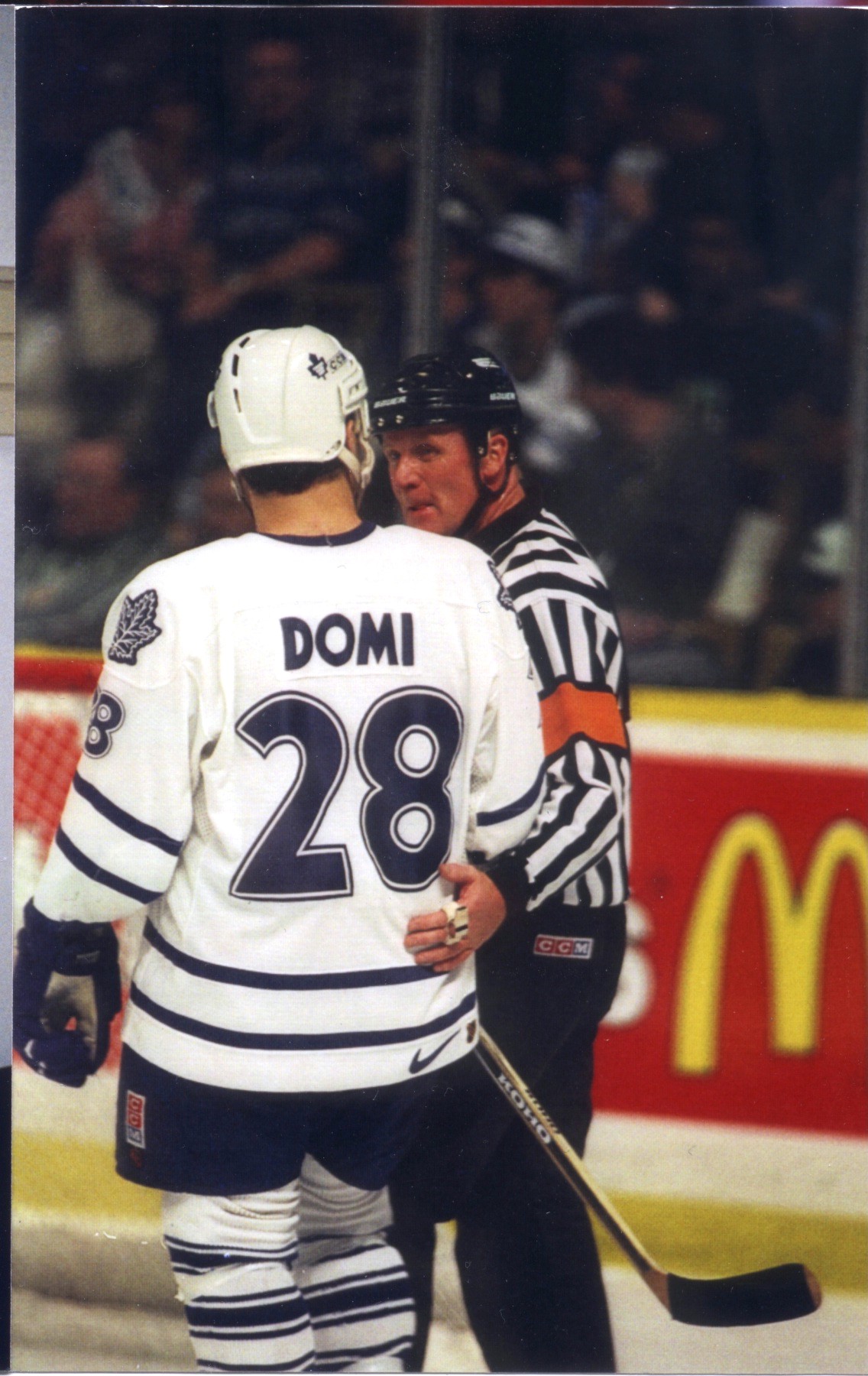
Both Tie
Domi and Rob Ray got 10 minute misconducts for trying to
incite each other into a
fight I find that with middle of the road and lower teams yes, I find the teams at the top they’re going to win enough games that they go for it. So it’s back to strategy, the teams that aren’t as deep play not to loose. The teams like a Detroit, Philly and even Toronto, they tend to go for it in the overtime which makes it fun. How do you feel about having a shootout after overtime if the game is still undecided? No thanks. I’m a purist or an old fashioned guy, I think hockey is meant to be played and you capitalize on a team’s mistakes I don’t think it’s meant to be a skills competition. What happens there is the team that wins in a game of hockey they win because of an opportunity they capitalized on, a team that wins in a shootout, it’s a lot of pressure, it’s not an individual sport it’s a team sport, but when you do it on a shoot out, it becomes a one on one situation, if a one on one situation arises in a game that’s because the team has broken down. But in a shootout it’s choreographed. In any given week how many games do you usually referee? Three to four, three and a half would be the average, so three to four games a week. Are the games usually relatively close together? The most we can do generally is three in three nights, it happens on a rare occasion you do a fourth one in four nights but generally three in three, or four in six that type of thing. And geographically they try to keep it in the same area, like I said next week I’m San Jose, Los Angeles, Phoenix and Anaheim, so I do four games in six nights next week. Can you hear the crowds when you’re on the ice? In our buildings no. Generally the glass is so high, you hear the noise, and the odd time you’ll hear one individual, but usually, like in the playoffs it’s so loud you don’t hear anything, it’s just a constant roar. When I go to watch minor hockey I think I hear more in those buildings than I do in ours. The buildings are fairly loud, particularly the American buildings, but with high Plexiglas and everything you don’t hear much really no. I saw you speak years ago at Palmerston and everyone enjoyed it… Oh were you there then? Yep I was. Everyone I know still remembers it actually. Is that something you do often? I do it any time I’m asked. I guess I’ve done three this year, one at the level 6 for the CHA, one for a Lions Club group and one for an Optimist group, but I don’t get asked that often. Any time I’m asked sure I’m glad to do it, if I can work it into the schedule. In those talks if you could get one thing across to kids what would that be? I think that if you come up with a goal that you want to achieve you work towards it with discipline and commitment and, I mean setting realistic goals, work hard for it and things happen. When people say to someone that has reached a certain level of success ‘you’re lucky’ luck has nothing to do with it. The old saying ‘don’t wait for your ship to come in you’ve got to swim out after it’ is so true. And that’s what I would tell young people. I don’t expect someone in grade six or grade seven to know what they want to do. But you’re always looking, and talk to older people, and talk to people that are doing different things, you might think, ‘I’d really like to do that’ then you talk to somebody and start to find out what it’s all about. There’s some things that I would like to do as a hobby, but I’d never want to do as a job because I control how I want to do it, when I want to do it. But I think the thing is if you have a goal and you start to establish a goal then you have to work at that goal, it doesn’t come to you. Don Cherry is always talking about eliminating the third man in penalty do you see that as a viable way to protect star players? No. I thin that the third man in penalty is fine the way it is because it stops that gang warfare, and how many times do you see the star player in an original altercation anyway? How many times have you seen some strong guy like Stu Grimson go after Mats Sundin? It doesn’t happen. So I would say that that’s not really necessary When a new player first comes into the NHL do they look like they’re in awe of where they are or do they seem experienced enough to fit in? No you can tell. You can tell and if you know a guys from Whitby or Port Perry or something you might say ‘Oh I guess everybody in Port Perry is watching you tonight’ he’s kind of happy to hear that there’s a sense of recognition. I try to know a little, not much, but maybe a hometown of a player or what country they’re from or something, just so sometimes you can use that for a psychological purpose. Particularly young goaltenders because we get to talk to some of them maybe because of a face off, they’re nervous, they might come across cool in the interview but there’s no question they’re nervous. Does the NHL have to hire a lot more refs for the two ref system? Yeah well last year we had 16 full time NHL refs, this year we’re up to 24, next year we’ll be at 30 and the year after that 36. When I came in the business in 1979 we had eleven, so it took us twenty years to go from eleven to 16 and it’s going to take two years to go from 16 to 36. SO it’s a big change. I noticed in the game with Buffalo and Toronto, you blew the whistle a little early, which made the players a little mad, and you went up and said something to them… I went up and said it was my mistake. Do you do that often? That’s not really something you can do often is it? No you hope not. You never lie to anybody. What happened was Roloson caught the puck and he went to hang on to it and it flopped out of his glove. But I’m right behind him and I see he’s got it in his glove and I know he doesn’t want to get rid of it, so I blow the whistle the next thing I know it’s lying on the ice. I just pointed at myself, a couple of guys started yelling ‘Come on!’ I said, you know what, I made a mistake. Does that usually silence the complaints pretty quickly? For a person with experience yes, a younger guy they’ll just keep hammering him. As I say, I never lie to players, if I make a mistake I’ll tell them, but in our business you cant be going around saying sorry I made a mistake, but if it happens once in a while you just admit it. And I said ‘guys I made a mistake I blew the whistle far too soon’. And Roloson, he said ‘I’m glad you did because I wasn’t supposed to drop it anyway’ and a couple of Toronto players said ‘Yeah OK forget it’ that’s just the way it is. Do you get any autographs from the players? Personally no, I have three things downstairs. I have a picture, I did the game when Wayne Gretzky scored his 802 goal to break Gordie Howe’s record, and there was a picture taken at that game that I saw and so I got a copy of it and gave it to the trainer to get Gretzky to sign it for me. I have a picture of Mark Messier scoring the winning goal in game 7 of the Vancouver Rangers series that I gave to the trainer and I got Messier to sign that, that’s about it. I don’t do that because, well, I know I got Greg a stick signed by Mats Sundin once, but I don’t want to put myself in a compromising situation, unfortunately a couple of our guys have asked, now don’t get me wrong, players are really good about it, I’m sure if I asked there’d be no problem, but we’ve had a couple of situations where guys have said ‘can I get a signed stick for a charity auction’ ‘yeah no problem’ then during the course of the game the ref has to disallow a goal or something then the guy tells the news guy, ‘I gave him an autographed stick and he still disallows my goal’ there’s a perception out there. So I don’t do that. I get people all the time dropping off hockey cards ‘can you get this guy to sign this for me’ I say ‘I’m sorry I cant, I don’t do that’ because you have to be careful, perception in many peoples minds becomes reality, so if you ask for a favour people expect, not ht hockey teams, but people perceive that you’ll give a favour in return. We’re in the business of fairness so it’s best not to. Maybe when I’m ion my last year and I’m in my last few games I’ll get a whole whack of stuff who knows.
Lisa Crompton |