|
|
|
British Currency
Explained, More or Less
Scroll down for
the Equipment List
|
| British
currency in 1882 had not yet been decimalized. Over the years, several different
denominations and coins accreted on the pounds/shillings/pence (£.s.d)
system. For starters, 12 pence = 1 shilling, and 20 shillings = 1 pound
sterling. The mathematically apt among you have already figured out that
there are 240 pence to the pound. |
| But wait--there's
more. Coins come in a fascinating variety of denominations, and if the system
was simple, it wouldn't be English. |
| The smallest
is a mite, which is 1/8 pence. Next comes the farthing, at 1/4 pence, followed
by the ha'penny (halfpenny) at 1/2 pence. From there, we go on to the penny
itself, tuppence (twopence), thruppence, (threepence), groats (four pence),
and sixpence. |
| Moving
into the realm of shillings, there are florins (two shillings), crowns (five
shillings), half crowns (two and a half shillings, or two shillings, sixpence)
and half-sovereigns (ten shillings). Once again, the mathematically astute
have already realized that a sovereign equals twenty shillings, or one pound
sterling. |
| Going
on to seriously coinage, we have the abovementioned sovereign, the double
sovereign (two pounds), and the never-circulated lion (5 pounds). If it
was never circulated, why do I mention it? Because I did the research, and
if you're still reading this, you obviously care. |
| Lastly,
we arrive at the guinea, which is 21 shillings, or one pound, one shilling.
Guineas are snobbish--excuse me, prestige--units of currency traditionally
used to understate in quintessentially British fashion the quantities of
professional fees and subscription amounts, and values of pictures, horses,
estates, and flamboyant gambling debts (Hard Day's Night reference.
Ask your parents, Ilana). |
| British
currency outside the British Isles gets even more complicated. I'll go into
British Indian Currency if and when it gets really relevant. As for other
countries' currencies, be grateful that the Russians stuck to rubles and
kopeks. Once again, if and when it becomes relevant, I'll post the information.
Bear in mind that you can expect to pay a 10% fee for changing currency
locally. That means that at best, you'll get 90% of your pounds in rubles,
yen, rupees, chickens, etc. |
| As far
as the exchange rates go, it varies according to who's changing your money.
In 1882, one pound sterling was approximately equal to US$3.00. Conveniently
enough, the inflation rate from 1882 to present is approximately 15. In-game
costs in pounds sterling will be 1/5 of what you'd pay in dollars today.
For example, the £500 prize would be worth about $25,000 today. It
may sound low, but in 1882 London, a quid gets you six bottles of whisky,
or thirty gallons of fresh milk, or fifteen pairs of basic ladies' shoes,
or a month's rent on a house or shop. |
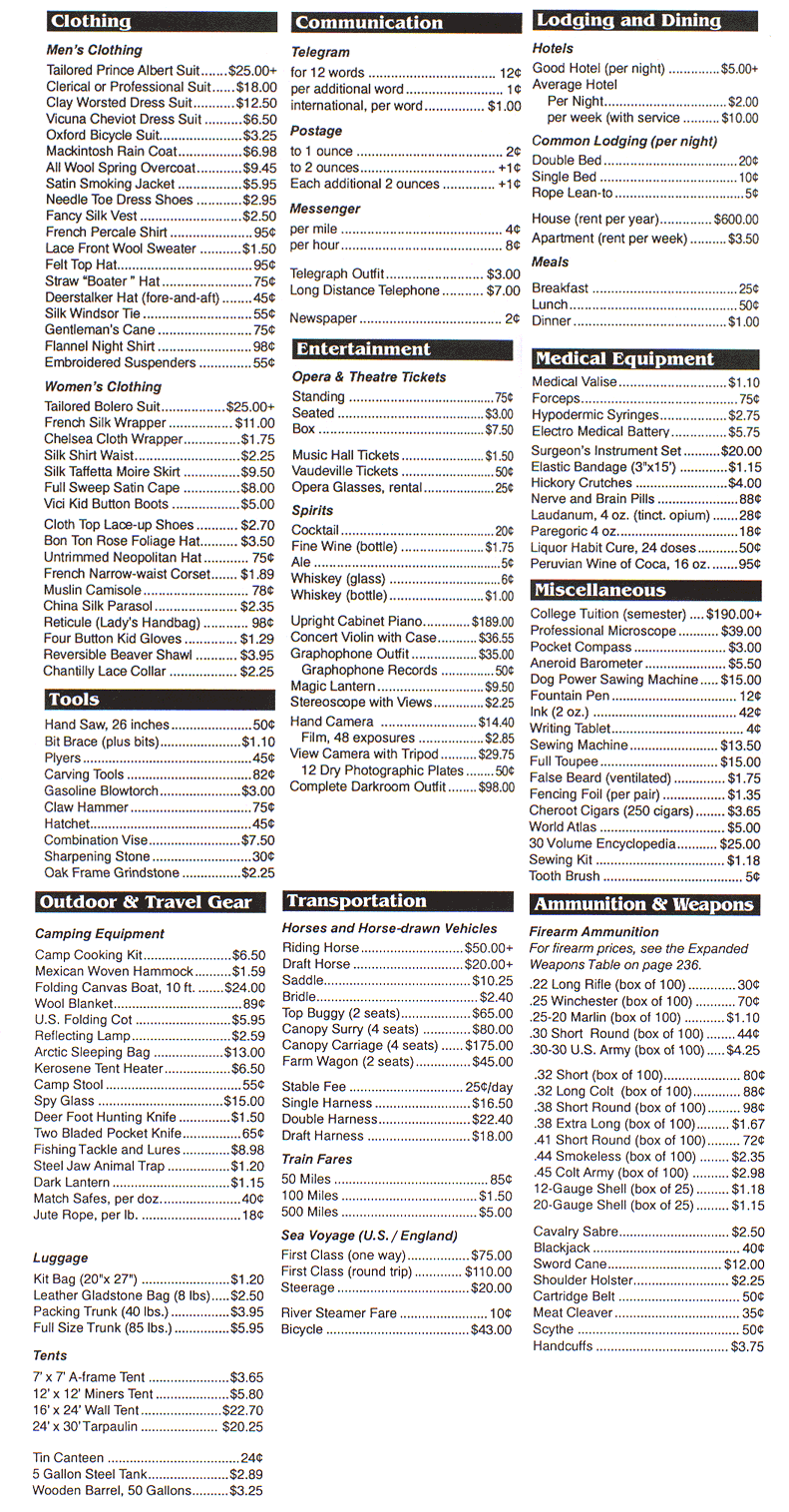
| That said,
the following table gives prices for goods and services in 1882 dollars.
It's blatantly ripped off from pages 216-7 of Chaosium's Call of Cthulhu,
5th edition. For 1882 £.s.d. prices, divide cents by three and convert
assuming $3.00=£1. |
|
|