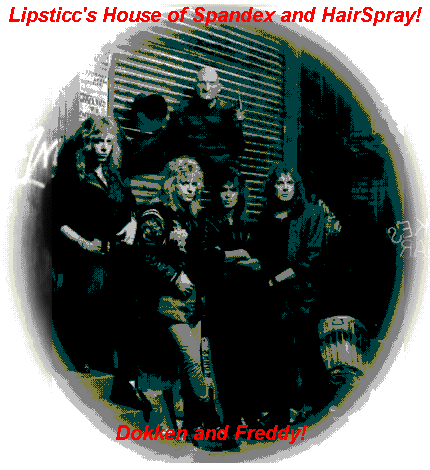
The following text is taken from the "Dysfunctional" Multimedia Sampler.
Picture the City of Angels -- thirteen lucky years ago.... Clubs along the Sunset Strip are packed fuller than Freddie Mercury's trousers. Denizens of the night garbed in fishnet stockings and mile-high hair teeter on stiletto heels. And you should have seen what the girls wore! But things were hopping. Over the next five years, Los Angeles turned out a tide-pool of talent that sold hundreds of millions of records worldwide. Back when Grunge was a mere gleam in the sleepy eye of Seattle, El Lay was the Liverpool of the Eighties. Then things started to get silly. Bands thought that Maybelline was something you put on your face, rather than a really good song by Chuck Berry. By the end of the decade, the hair architects folded up their blueprints and started dressing like lumberjacks on a camping trip. The clubs closed, the scene died, and these days a lot of people react to those bands the way that vampires do to garlic and crucifixes.
Even back then, Dokken was an anomaly. The group's look and sound flew in the face of the flash 'n' trash of the Strip while their musicianship soared above the willful amateurism of late 70's punk-rock.
"I have no qualms about our past," reflects Don Dokken, the band's lead vocalist. "I mean, have you looked at your high school portrait lately?" Equally reconciled to those Hollywood days of yore, Dokken guitar-wizard George Lynch adds "I'm so far away from that whole mentality; I really view the craft of playing guitar and the creation of music as important. I like to play well and I like to write good songs."
DYSFUNCTIONAL is the title of Dokken's 1995 release and first for Columbia Records. The band arrived at the title after a record company exec at one of their previous labels jokingly used the term to describe the band. "Knowing the history of Dokken, how different our personalities are, I think the title pretty much sums up what we're all about," the band's namesake concludes with a laugh.
All of the Dokken sonic trademarks are still in place. Don Dokken's lead-vocals accelerate from velvet-smooth to screaming-bloody-murder in under seven seconds while the solid back-up harmonies blend like crystal prism rainbows. Among the album's many virtues, DYSFUNCTIONAL is advanced proof of George Lynch's preeminent skills as a guitarist; Lynch can still shift-on-a-dime from apocalyptic fury to a legato-so-smooth you'd follow it anywhere. Mick Brown's kick drum blasts like artillery shells reminding you that Dokken has always had a heavy side. And you can set your watch to Jeff Pilson's solid bass lines.
In the days before Dokken, George Lynch--wired from childhood on the sounds of Charlie Byrd, the blues, Jimi Hendrix, Jeff Beck, and the Ventures' "Pipeline"--moved from Spokane, Washington, to California to become one of the most admired guitarists on the L.A. scene. The roots of Dokken began to take shape when George met drummer Mick Brown and formed the Boyz, a legendary power compound in a nascent Hollywood music scene that included the not-yet-signed likes of Van Halen. Back then, Jeff Pilson was still up in Seattle studying music at the University of Washington and Don Dokken himself was busy carving out his name as a hot-up-and-comer. When these four talents converged in the sweat-bathed rock clubs of Hollywood, the result, Dokken, set off a rock 'n' roll shock wave heard round the world.
During the new wave onslaught of the late 1970's, rock 'n' roll energy was evaporating in Los Angeles. Frustrated by the scene, Don Dokken moved to Germany, where he landed a small label record deal. He contacted George Lynch and Mick Brown, feeling a similar vibe, came to Deutschland where they recorded the debut Dokken album, Breaking The Chains, for Carerre Records. After a tour of Germany, the trio came back to the States to sign with Elektra Records. At that point, Jeff Pilson, an unsung cornerstone of the band, entered the picture. Jeff's background in progressive music often provides an essential binding element and symmetry to the sometimes conflicting writing styles within the group.
Dokken came out of the L.A. metal scene in the early Eighties, only to disband at the height of their popularity. Gold and platinum albums, world tours, stadium festivals, magazine covers, you name it, Dokken had it. For five solid years, the group banged out a string of platinum records while adhering to a touring schedule that made the voyages of Columbus and Magellan seem like toy-boats in a bathtub. The band has described their career as "very schizo" and, in fact, their music has always walked a razor's edge between pop and metal. Dokken's melodic accessibility assured them never-ending spins on rock radio with hits like "Alone Again" and "In My Dreams" while their incandescent stage presence found them touring alongside bands like AC/DC, Judas Priest, Metallica, Van Halen, and other mavens of metal with fans screaming for heavy-duty album tracks like "Mr. Scary" and "Kiss Of Death."
The Dokken chemistry was as electrifying as it was volatile. With George Lynch redefining the outer limits of electric guitar playing for the 1980's, Don Dokken's inimitable (though often imitated) vocals, Mick Brown's groove-oriented drumming, and Jeff Pilson's sinewy basslines and aerial harmony vocals, Dokken's appeal cut across-the-board. Dedicated to art as much as craft, the group armed themselves with four Super 8 millimeter cameras, filmed, directed and released the first rock home video to hit platinum status. After writing and performing the title track to Nightmare On Elm Street 3: Dream Warriors, Dokken was on the verge of becoming a household name. They were signed aboard the notorious "Monsters Of Rock" stadium tour with Van Halen, Metallica, and Scorpions, were nominated for a Grammy and recorded a live album in Japan. Dokken reached out for the brass ring, grabbed it and rubbed it till it turned platinum; but then, for reasons the band knows better than anyone else, they decided to throw it away. After the breakup came solo albums, side projects, and, now, reformation, reconciliation, a new major label deal, and the band's strongest music ever.
Dokken's rebirth began in 1992 when Don gave Jeff a call to get together and pen some new material. The two wrote much of the material on DYSFUNCTIONAL. Fate would have it that the Lynch Mob (a post-Dokken band formed by George Lynch and Mick Brown) had just broken up and Mick rang up his old mates. The reunited triad secured an Asian deal and began recording some tracks for the songs. Don, Jeff, and Mick realized that they were, in fact, picking up the pieces of Dokken and figured that, if something's worth doing, it's worth doing 100%. They sent the unfinished tapes to George Lynch, who loved what he heard and decided to join the reformation for all the right reasons.
"I always believed that Dokken was an unfinished work," comments George, "a labor in progress which was aborted before realizing its full potential; which does not necessarily mean that we would be able to pick-up where we left off. But I think we owe it to ourselves and our fans to finish paving the path we started out on. This band really needs to draw deep within itself and document what we are really about, collectively and individually, as players and as people."
DYSFUNCTIONAL shows Dokken's wide range of musical dynamics and exceptional songwriting skills. "Most of the songs on the album have a common thread," Don explains. "It's a different concept. It's pretty dark, but there's light at the end of the tunnel. Life is short and nobody promised you anything. You're in control of your own destiny. All the lyrics aren't about love, which I was known for--my broken hearts, failed relationships, you know, all that crap!"
The first single, "Too High To Fly" was written by Don Dokken and George Lynch after a friend with a drug problem took a handful of Valium and accidentally walked off a cliff. "They called us at my studio and told us, and that's when we wrote the song," Don recalls. The song merges Dokken's signature vocal sound with a newfound lyrical maturity.
"Shadow of Life" was penned by Don Dokken and Jeff Pilson. "It's about being depressed and feeling suicidal," Jeff explains. "Long Way Home" contains a similar theme. "It's about pulling yourself out of depression."
"Inside Looking Out" tells listeners to take off their blinders and simply look with clarity at the world around them. "Everybody is consumed by their own life and so narcissistic that they can't see what's really going on," Don observes.
With DYSFUNCTIONAL, the band's collective sound and lyrical vision have become more tightly focused and coherent than ever before. "I've always felt that the strongest Dokken songs are when Don, Jeff, and I are singing together," remarks Mick Brown. "'Hole In My Head' combines Dokken's trademark vocal style withmodern musical influences. The song is about becoming more aware of one's self."
"'The Maze' contains my favorite lyrics," Don admits. "It's about a guy who is introverted and catatonic, but inside his mind he's totally happy. While everybody is trying to bring him out of it, he's just trying to find a way to tell them, 'but, you don't understand, I'm happy in here. Leave me alone. I wasn't happy on the outside world.'" The song finishes with the lyrics: "Wander down these many halls/ Round each corner right back were I started/ Deep inside my mind it seems/ I try to find and open door to go through so they can see that I'm alright." As Don sees it, "you have your own world and I've got mine, so who's to judge which world's more proper? As far as the character in the song is concerned, they have nothing to offer him."
George Lynch shares this fascination with "The Maze," which could be a parable for Dokken itself. "There are so many philosophies and systems of thought that deal with life," he says. "They have similarities and differences that converge and intersect with each other on their paths to nowhere. Ultimately, I think we find there is no escape from the human condition and that we've succeeded only in creating a 'maze' or labyrinth that will lead us back to where we started."
Dokken's music has organically evolved without jumping on any current band wagon. Trend-hopping is not now, and never has been, the Dokken trip. "We're about songs and playing our instruments," says Don, "I couldn't care less about trends. After all, isn't rock 'n' roll is supposed to be about individuality? Doing what you want and not letting anyone fuck with your art form? Or, what's maybe even worse, being enslaved by a fad that someone else started?"
DYSFUNCTIONAL was produced by Don Dokken at 710 Studios and Total Access Studios in Redondo Beach. With a new label, new management, and a new album, Dokken is back to let everybody know that great songs and musical chops are what rock 'n' roll is really all about. And that ain't never gonna change!