 |
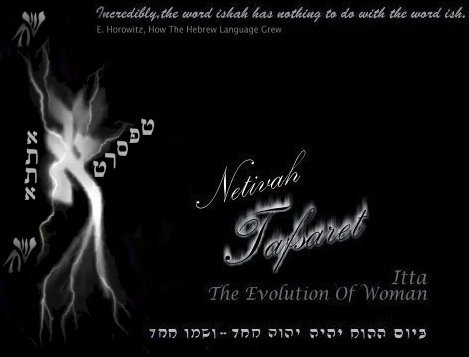
| Yet evolving from there comes itta (aleph tav tav aleph), the chayah of isha. Itta, a word also meaning woman, is derived from Aramaic. Itta describes a unique situation, one where a woman can express the secret mysteries of Torah - from aleph to tav and from tav to aleph, from keter to malchut (Ekyeh) and from malchut to keter (Asher Ekyeh), with both the attribute of mercy (aleph to tav) and the attribute of justice (tav to aleph). This evolution includes and encompasses all the mitzvot of Torah, both the positive mitzvot (aleph to tav) and the negative mitzvot (tav to aleph). This is the Torah of life through which all the souls of Israel are interconnected. The sanctified avodah of itta connects the Torah of chesed with the Torah of truth through the Torah of life. Avodah performed bitul bimtzuit mamash fully draws out the itta transformation through a woman's mitzvot of challah, niddah and hadlikat nerot (ChaNaH). These mitzvot pertain to the circumcisions of the lips, ears and heart and ultimately complete the unification of the Torah of chesed, the Torah of life and the Torah of truth to redeem the Divine Spark of yechidah into action and into the world of assiyah. This is the revelation of the light of Torah and "shines from the good mouth" of the faithful one made in the Divine image. The redemption of the Divine Spark, the unification within Torah, and revelation of the light of Torah is represented by the three tagim on each tet of tafsaret, the vessel of emunah (the unifying spark of Moshe in every Jewish soul). The tet is the good foundation of the crown of kingdom, the crown of Torah and the crown of kehunah. Now we can understand that bitul paradoxically actualizes the soul's most profound expression of its inmost "whole" self in devekut with the Divine Essence and leads one toward the crown of a good name. Importantly, the purifying and unifying factor linking the man's mitzvah with the woman's mitzvot - and linking the avodah of both to each other and to the Divine Essence - is Torah lishmah, the merit of one also credited to and through the other. True companions laboring in true and complete love. Shlaimus. This is the Torah of truth which radiates mysterious (raz) Divine Infinite (Ein Sof) Light from the world to come into the present world through service done with all our heart, with all our soul and with all our might. With all our heart, with all our soul and with all our might, in the presence of reciprocal Torah lishmah as described above, the good of Torah is revealed through the unification of mercy (aleph to tav) and justice (tav to aleph). Raised together "above the wood", these attributes are transformed into the unified essential attributes of truth and favor. This is the secret of the akeidah. Truth and favor are the primary consciousnesses of the Written Torah and the Oral Torah, respectively. Thus, the Written Torah and the Oral Torah are unified to reveal truth and favor through the the holy letters of all that will be, will be (aleph to tav and tav to aleph). Ekyeh asher Ekyeh. We can now better understand ishah to represent woman in a generic sense , a woman without name, a woman without a deep sense of her own personal story. In contradistinction to ishah, itta represents a woman with a deep unique true sense of her own personal story, a woman who has expressively claimed her deepest unique true identity and destiny - her unique name. Itta is a woman who has awakened to essential personhood and writes in her own name. Thus, itta is a woman with a name, a unique name - this is the crown of a good name, a keter shem tov, the fourth crown. The four ketarim are represented by the four heads joined and brought together in the present world through itta, the holy four headed shin of the future world. The presence of the light of the future world (represented by the four headed shin of Hashem) in the present world (represented by the three headed shin of Elokim) reflects actualized oneness of Elokim and Hashem, a oneness perceived beyond the eye and brought through the very center ( ) of itta's being into reality like a secret wine of awareness. Awakened awareness acts as a vehicle through which the primeval light of creation is channeled into existence. The primeval light of creation is the light hidden and revealed with and between the lines and letters of our Holy Torah. The sod of Torah is the inheritance of itta. Yayin, the Hebrew word for wine has a gematria of 70, the same gematria as sod, the Hebrew word for secret. Yayin is a mysterious word of unknown etymology. It is a word found in both ancient Semitic and ancient Indo-European language families. Scholars [How The Hebrew Language Grew, Edward Horowitz] tell us that this ancient word for wine, yayin, may have been borrowed by both ancient language families (Semitic and Indo-European) from a common now lost or unknown language. Thus, the secret of yayin is rooted in prehistory and is key to awareness and to understanding the inner essence of a primeval shared language - of a shared story brought out like an exodus of prehistory into history. This is the inheritance of itta, an inheritance redeemed and brought forth into being through rectification of the primeval feminine energy. The light of awareness which shines from the darkness of prehistory is the "more" light and truth unsealed and opened toward expression which comes from the hidden Essence of G-d. The two tavs in the center of itta "gives" release to expression of rectified primordial knowing into history. Thus, itta represents completion of the rectification of the tree of knowledge. We can see now that itta represents the shin of the future world, redemption through the move from inner exile to shared story, and the union of Elokim and Hashem. This is leshem shamayim - lishmah. Itta is a woman who can bring the essence of the whole Torah through the vessel of tet to bestow goodness and the blessing of shalom into malchut. Shalom tov - the life of life - the ultimate in "proper connection and bonding" - kosher. Consequently, if ishah is the word used for woman wherein the Talmud halachically disqualifies as kosher a "woman" soferet, then halachah does not specifically disqualify as kosher a woman who is an "itta" as being a halachically kosher soferet. Kabbalistically, we can now understand why. A halachically kosher soferet, in addition to being an itta, is also particularly a tafsaret, a soferet demonstrating sancitified expressiveness of the shem hameyuchad. Tafsaret contains within its letters the letters of the word sofer (scribe). Yet tafsaret contains two tets in addition to the letters which comprise the word sofer (samekh phey reish). These two tets have a combined gematria of 18 (chet yod) - thereby imparting "life" into the writing of the scribe. Writing within the encompassing kavanah which issues from yechidah (which comes from the expression of uniqueness), tafsaret is able to bind Divine Essence to the holy letters produced by the soulful skill and artistry of the soferet. This is the feminine path of a sacred scribe. Tafsaret is a rare kind of Hebrew scribe with roots clear through into Sumerian mystery. From the language of ancient Sumer, sar means "write". Taf means "board". The Hebrew verb root samekh reish tet carries the meanings of "script", "a tool for designing" and "marking". In contemplating this together with all that above, we can understand that tafsaret demonstrates the scribal art of crossing over, and moving from incompleteness to completion, from exile to redemption, from anguish to joy. Tafsaret expresses the inmost heart and essence of Torah and consequently, is the herald and guarantor of redemption, restoring the broken vav to wholeness (through unification of the Torah of chesed, the Torah of life and the Torah of truth), to bring into existence unbroken wellbeing. Tafsaret is a channel through which healing crosses over from the unmanifest into manifest existence. With a gematria of 358 tafsaret is the rectification of the attribute of judgment and of the nachash, the primordial snake. The unrectified nachash is the source of deceiving grace, the fear of insanity, the inability to discern truth, and blemishes of the sexual impulse. SUMMARY tafsaret evolving through itta: * represents the evolution of ishah * unifies the attributes of mercy and justice, raising them together "above the wood" where they are transformed into the unified essential attributes of truth and favor - the good of Torah - revealed through the expressed unification of the Written Torah and the Oral Torah * is drawn out through a woman's mitzvot of challah, niddah and hadlikat nerot * establishes unifying connections with the merit of Torah lishmah * represents expression of neshamah, chayah and yechidah * unifies the Torah of chesed, the Torah of life and the Torah of truth * redeems the Divine Spark through unifying Torah to reveal the light of Torah * is the foundation for the crowns of kingdom, Torah and kehunah * actualizes the crown of a good name * results from service done with all one's heart, all one's soul and all one's might * rectifies the primordial feminine energy * acts as a vehicle for the expression of the secret wine of rectifed primordial knowing * represents rectification of the tree of knowledge * links prehistory and history through the Divine Essence * demonstrates sanctified expression of the shem hameyuchad * binds the Divine Essence to the holy letters * represents the move from incompleteness to completion, from exile to redemption, and from anguish to joy * catalyzes entrance of Divine Infinite Light (Ein Sof Aur) into creation, blessing through the channel of using one's own unique name * channels healing energy into manifest existence |
 |
| The Hebrew word ishah (aleph yod shin hey), meaning woman, is thought to be derived from the root word anash (aleph nun shin), meaning to "cause weakness". However, the neshamah of ishah may come into revelation and expression through the root chet shin hey, meaning "quiet" and/or "refrain from expression or movement". Supporting this is the |
| consideration that the word chet shin aleph yod (derived from the root chet shin hey) means "silently" and contains the letters of the word ishah, except that the hey of ishah is a chet in the word "silently". Thus, ishah describes a situation where a "once silent woman" (unable to express Torah) becomes opened to expressing it dimly through the lower hey of malchut, without the upper hey of binah (expressive "secret" understanding). The transformation is enabled through a man's mitzvah of brit milah, circumcision of the flesh. This is the Torah of chesed. |
| Women's Torah Project Another Side To The Scribal Story Netivat Sofrut Diary Of A Soferet In Memory Of Cpl. Liron Harpaz |
| In ishah, the nun has fallen out; the word is really inshah. The plural - nashim - gives some hint of that. The really important fact though, is that the shin of ishah is really a tav. In Aramaic, the word for woman is either ita (alef tav alef) or itta (alef tav tav alef). The root of ishah, namely anash, seems to mean "to be weak" or "to be delicate". The word ish is from another root which most scholars agree means "strong". - Edward Horowitz, How The Hebrew Language Grew |
 |
 |
|
 |
 |
 |
| (C) Liorah Chanah Elishaba Tsabrah bat Ehuvyah v'Adar |
| sefer yetzirah 1:1 |
|